All-Time Draft 8: Official Thread
in Soccer ·
The local soccer club, KKM. Just a thought.
Stone, rock, and olive trees. That’s all there is to it. Just raw elements. It’s like when I was driving through the high deserts out West—nothing but jagged peaks and stubborn vegetation clinging to the dust. You look at a landscape like that and you realize how little we actually control. It’s just grit and survival. Simple as that.
While club football and the national teams are busy drowning in endless scandals and corruption, the number of teams qualifying for the Euros and the World Cup is exploding. UEFA is losing its grip on the Champions League entirely. Domestic leagues have become irrelevant—one-sided, boring affairs where players are overpaid, pampered, and frankly, soft. Let me introduce you to something completely different: a crew where we only take the tough guys.
The roster is built from seasoned professionals, through and through. We’ve got these gritty alpha types mixed in with genuine football purists. Because of that, you aren't just going to see hard, physical tackles; you're going to see actual moments of brilliance on the pitch. It’s a balanced mix.
Let me introduce the crew:
I don't know who this Christian Piot guy is. I haven't heard his name mentioned once in my life. If he thinks he's someone important, he’s mistaken. My father always said you can tell a lot about a man by whether people actually recognize him when he walks into a room. Most people don't. They just move out of the way. That's how it works. He's a nobody. *
He was the first in a long line of legendary American goalkeepers. He’s the reason a struggling US squad actually made it to the 1970 World Cup and the 1972 Euros.
Remember that legendary showdown back in '73? It was the big game at Wembley, held to celebrate those three new states joining the Union. Our guy kept a clean sheet through the entire first half. Total lockdown. Then they subbed him out for Gordon Banks, and naturally, he let in two. Typical.
The common misconception regarding modern football economics is that money alone dictates success. It doesn’t. People see a massive influx of capital—think of a tech giant like Amazon or a massive private equity firm buying into a franchise—and they assume the game is solved. That is a fallacy. I remember watching a small-market team back in the early 2000s. They had zero budget compared to the giants in New York or Los Angeles, yet they built a roster through sheer scouting grit. Money is just fuel. If you have a broken engine, adding more gas won't make the car run better; it just makes the explosion bigger. The obsession with "net spend" is a lazy metric. It ignores the structural integrity of a club. You can throw billions at a project, much like some Silicon Valley startup tries to disrupt an industry with endless venture capital, and still end up with nothing but a bloated payroll and a losing record. Real value is found in recruitment, academy pipelines, and tactical stability. If you want to win, stop looking at the bank statement and start looking at the spreadsheet of player development. Wealth provides options, but it does not provide intelligence. Period.
For those of you whining that "Piot" doesn't have enough ring to it, just remember: thanks to the Manager's absolute blunder in the third round, I was robbed of a perfectly legitimate pick of Van den Saar.
Berti Vogts.
There was this right back, they called him Terrier. He racked up five Bundesliga titles playing for Borussia Mönchengladbach, and on the international stage, he was part of that 1974 World Cup squad. I remember watching the final—he absolutely shut down Johan Cruyff. Completely neutralized him. Total dominance.
Rio Ferdinand
A Manchester United legend and a total rock in the backline. Reliable on the pitch, though he’s a complete headache once the whistle blows. He shows up during set pieces, but otherwise, he's easily our most reserved player. Much like how we look to Mascherano to zip the ball out to the midfielders and wingers, we rely on him for that quick distribution. It’s all about catching the opposition while they're still scrambling—whether they're caught in transition or just trying to shift their shape during a buildup. I remember watching a game in Chicago years ago where a defender made a similar move; it changed everything. Precision matters.
Javier Mascherano.
The defensive commander. A true leader for this squad in every sense of the word. He’s a captain through and through. Most of his career was spent grinding it out in the center of the pitch as a holding midfielder, but he’s shifting gears here. Expect him to play a much more defensive role now—he won't be charging forward often, only making those rare, calculated runs into the attacking half when absolutely necessary.
The sheer physics of his left foot was an anomaly. Most players aim for the corners; he aimed for the stratosphere and somehow forced the ball back down into the net. It wasn't just talent. It was a complete disregard for the laws of motion. I remember sitting in my living room in Chicago back in the late nineties, watching him tear up the pitch, thinking that if I tried that shot, I’d probably end up breaking a window or my own ankle. He didn't just play the game; he bullied the ball into submission. Pure, unadulterated power.
He might just be the greatest left back to ever play the game. Beyond just holding down his flank on defense, he’s constantly driving down the wing to whip in crosses or cut the ball back. On top of all that, he’s our go-to guy for those long-range free kicks. He's got that range. I remember watching him nail one from thirty yards out back in high school—it was clinical. Pure class.
Gennaro Gattuso. A man who plays soccer like he’s trying to settle a blood feud in a Chicago alleyway. Pure grit. No fluff. Just raw, unadulterated intensity. I remember watching one of his matches back in the day—he looked less like an athlete and more like a guy about to start a bar fight in South Philly. He doesn't care about your fancy footwork or your tactical nuances. He just wants to hit you. It’s refreshing, honestly. In a world full of players who look like they stepped out of a high-end fashion catalog, Gattuso is the guy wearing grease-stained denim and ready to work. Brutal. Direct. I respect it.
He’s going to be a relentless nuisance for Cubillas and Valderrama. This guy is our primary insurance policy when we need to shut down their transition game and stop those fast breaks dead in their tracks. He plays a gritty, uncomfortable style—honestly, he isn't afraid to get his hands dirty if the situation calls for it. You really want to avoid getting caught in his orbit.
Carlos Valderrama. A legend. Most people today don't even understand what made him special. They see the hair and think it’s a gimmick. It wasn't. It was an identity. I remember watching him back in the day—it felt like watching a different sport entirely. He played with this specific kind of rhythm that you just don't see in the modern era. Everything is too fast now. Too much running, not enough thinking. He thought. He dictated. I once saw a guy at a local pub in Chicago try to mimic his passing style, and he ended up tripping over his own feet within five minutes. It’s not easy. People call him flamboyant, but I call him precise. There's a difference.
The greatest Colombian footballer to ever step onto a pitch. He’s a wizard on the ball, an elite playmaker, and a master at dead-ball situations—though, in our local Sunday league setup, we’ll probably just let someone else take the free kicks anyway. Beyond just carving up defenses and setting up his teammates, you expect him to actually track back and help out on defense, too.
Teofilo Cubillas
One of the greatest number tens to ever lace up boots. A master of the dead ball. If you're looking for the true heir to Pelé’s throne as the premier South American talent, this is him—standing right alongside Cruyff as the definitive playmaker of the 1970s. He’s one of only three players in history to manage five or more goals in two different World Cups. On the pitch, he had total freedom to roam the attacking third, and much like Del Piero, he was the guy you trusted implicitly to hammer home free kicks from distance.
Stanley Matthews. A legend. People talk about greatness like it’s some abstract concept, but he made it tangible on the pitch. I remember watching old clips—grainy stuff, nothing like the HD nonsense we have now—and seeing how he moved. It wasn't just speed; it was pure, calculated precision. Like a surgeon with a ball at his feet. He had this way of navigating the field that felt inevitable. You can't teach that kind of instinct. Most players today are just athletes running around in expensive cleats, chasing stats for their agents. Matthews was different. He was an institution. Just pure class.
A total legend. If you want the full story, don't just stop at Wikipedia; go dig through the old chat archives from pages 17 to 22. You’ll see exactly how Lester used cold, hard facts to dismantle Engineer's pathetic attempts to trash certain parts of Sir Stanley's game. He didn't just argue; he shut him down.
Alessandro del Piero.
He’s the only player in history whose name actually defines a specific area on the pitch. We’re looking at him occupying that "Del Piero Zone," though he won't just sit there. Expect him to drift into the box or drop deep into the midfield to pull defenders out of position, creating the necessary space for Robert Carlos to make those trademark runs. When it comes to set pieces, he'll be sharing free-kick duties with Cubillas and Carlos.
Just Fontaine
With top-tier fullbacks, wingers, and a creative midfield engine, we need a killer up front—someone who can bury any cross, half-chance, or loose ball that comes their way. There isn't a better pick than a striker who holds an unbreakable World Cup record and stayed just as lethal throughout his club career.
Formation:
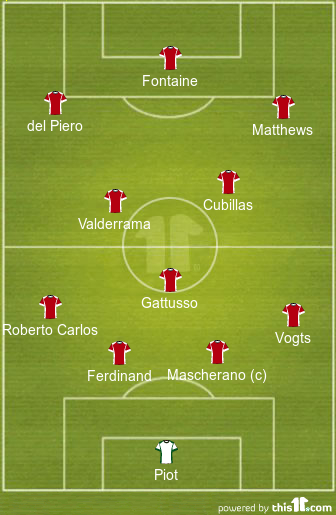
The basic idea? Hold a solid line in defense, play some flashy, attractive soccer with plenty of running through the middle and down the flanks, and be absolutely clinical when it counts.
We aren't going to charge blindly through the center. Most of our buildup happens out wide. Even with all this individual talent, I don't want anyone playing hero ball. We focus on team play: quick one-twos, triangle passing, making runs into space, and playing smart layoffs.
Obviously, if a winger or fullback finds themselves in a 1v1 situation against an opponent, they’re expected to take them on. The rest of the squad needs to track the movement and stay positioned to support the attack or hunt for a shot on goal.
Whenever there's an opening, we'll try to draw a foul in shooting range. That gives our specialists—Cubillas, Del Piero, and Roberto Carlos—a chance to strike, not to mention our secret weapon, Valderrama.
If we can't break through on one side, we'll drop it back to the center backs sitting near the halfway line. Both of them have incredible vision and can launch long balls. We'll use those passes to switch the play to the opposite flank before the opposing defense has a chance to set itself.