Gerald Jackson48 said:Sade is honestly incredible—and no, that’s not just me being biased because I suggested her. Her vocals are just on another level, both in terms of tone and sheer range, plus she has this sort of effortless, mysterious charisma that you just can't teach.
Look, the lyrics might not exactly reach some transcendental, metaphysical plane of existence—let's be real—but they aren't that shallow, trivial nonsense you usually hear in mainstream pop. They've got that old-school grit. The whole band seems genuinely inspired, too; honestly, that drum and bass combo? Absolute perfection.
Yeah, she really is a dream. 🙂
I was listening to the album yesterday on my way to the grocery store—living the dream during these lockdown days—and I totally get what you’re saying. The lyrics aren't exactly groundbreaking or anything, but they're... lovely? In a way. The music itself has that same vibe—just really smooth and easy to listen to. Her songs about love might feel a bit old-fashioned by today's standards—especially that specific way she conceptualizes relationships—but at the same time, it's sensual and, again, just really pleasant. It's nice.
I don't listen to them all that often—honestly, it's pretty rare—but whenever I actually do, it never fails to lift my mood.
So, since it looks like San Salvador is a total bust—meaning I won't be able to annoy you all with my usual deep-dive analyses—I guess that's that. 😁Look, I just wanted to jump in here for a second—mostly because I don't want us turning this thread into a total misinformation factory.
redbear12 said:Sounds like some kind of early ensemble or maybe just some indigenous music from before the Europeans even touched down in South America.
Despite what the name implies—which basically drags our minds straight into Latin America with those smooth guitar riffs—San Salvador really has nothing to do with...
Those guys. From San Salvador to El Salvador—they’re basically just French. 🙂 Before you jump to conclusions and label this "colonizer music"—the band's name actually comes from their own little slice of San Salvador, the small town of Saint Salvadour where they grew up. Interestingly, that name is actually Occitan—San Salvador. They sing in Occitan, or one of its dialects, which is arguably one of those "dying" languages native to that specific region of Corrèza. Through their local collective, Lost in Traditions—which was founded by Gabriel Durif, if I recall correctly, who serves as both the artistic director and lead vocalist—they collect, arrange, and perform the songs that have been traditionally sung in that area for generations.
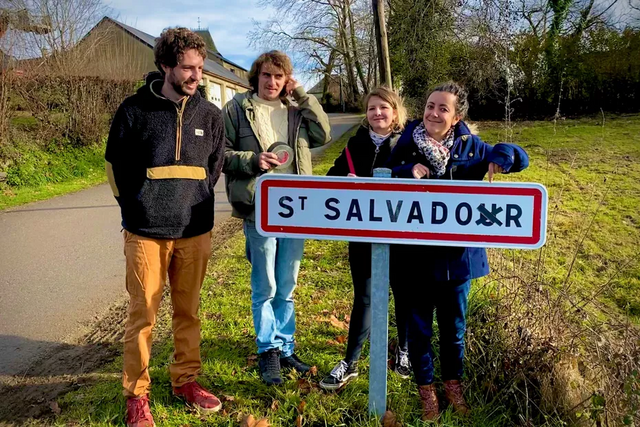
Or, you know, the way one of the band members explained it years ago on YouTube to some offended listener from El Salvador:
So, San Salvador turns out to be a bit of a shapeshifter, doesn't it? Depending on who you ask, it’s an Argentine city, a municipality in Spain, or even an island in the Bahamas. It’s a district in Peru and Paraguay, a movie starring James Belushi, a song by Bernard Lavilliers, and apparently some kind of story involving Tif et Tondu. It can be a volcano, a hotel in Venice, a hydroelectric dam, a Mexican restaurant, or even a folk choir from the Massif Central. Talk about having an identity crisis. 😉
(I don't speak French, but this isn't exactly rocket science)
And within all that—I can't say for sure, since nobody ever asks musicians actually interesting questions—but my take is that the answer to this massive question is hidden right there:
urbanheron4 said:So why is this guy wearing a Barcelona jersey?
See, Occitan isn't just some dialect from a corner of France; it’s spoken in parts of Italy, Monaco, and—well, Spain, specifically Catalonia, where one version is actually an official language.
Now, just like how the name San Salvador caused a bit of a mix-up here, things get confusing elsewhere too—and I’d argue the album cover is a direct response to that confusion and the whole identity crisis: who exactly is San Salvador, how do we as an audience perceive them, and whose music is it, really? Then you have that Barcelona moment, alongside this "summer vacation" vibe (the shirts, the tank tops, the duffel bags, the snapshots—plus that tagline on their page saying San Salvador isn't music from exotic islands) which acts as an allusion to the Bahamas and their specific San Salvador, much like the straw hat. And then there's that brilliant (genre-wise, which makes the story even better) cowboy moment—it's technically a gaucho, but those references tend to blur together in the cultural imagination—and that Western landscape seen in the first music video for
Fai Sautar, which inspired all the album's visuals. Because San Salvador is also this imaginary place in Latin America, built out of all the stereotypes we carry as listeners. On top of that, there’s the time dimension: what era (in our minds) does San Salvador and their music belong to? It feels traditional yet "modern" (
Fai Sautar is almost a pop track with echoes of the European hip-hop of my youth—not to mention all the other arrangements that refuse to stick to one "original" sound). All those shirts feel a bit retro, and that jersey is Stoichkov's number eight—he joined Barca the same year Gabriel Durif was born—but "retro" can also be read as something very "in" right now, making it timeless. To me, it seems like San Salvador is playing with all these confusions, quirks, and influences—all while the album cover remains this huge, colorful mess of chaos, which is also the album title, so that’s likely a reference too. 🙂
Of course, it’s also possible I’m overthinking it and Durif just really loves Barcelona. 😁
Here is the video for
Fai Sautar, which looks simple on the surface but is actually fantastic because it explores all those layers—plus, it's totally DIY since the collective members did everything themselves.