


#81 ·
A quick tweak to Kepler's third law
Hey everyone,
So, I found this specific correction for Kepler's third law that ends up being almost identical to the "official" version we usually talk about.
The official correction is here:
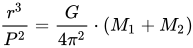
https://en.wikipedia.org/wiki/Two-body_problem
If you run the numbers and compare these two corrections, you get this expression:
[G/(4*π *π )]/[ln( 2 * e ) / ( 10 ^ 12 )]= ?
So, what's the value of "?"
If "?" turns out to be roughly 1, then both corrections are basically the same thing.
Let's crunch the numbers!!
G/(4*π *π )=6,67428 × 10^(−11)/(4*π *π )=1,69061 × 10^(−12)
ln( 2 * e ) / ( 10 ^ 12 )=[ln(2) + 1] × 10^(−12)=1,69315 × 10^(−12)
-----------------------------------------------------------------------------------------
1,69061 / 1,69315 = 0,998
This math pretty much proves that the difference between these two corrections is less than 1%.
Since the guy behind this new version of Kepler's third law is Silvio Sponza, I'd suggest you guys unban him.
Best,
Gregory Thomas
Hey everyone,
So, I found this specific correction for Kepler's third law that ends up being almost identical to the "official" version we usually talk about.
The official correction is here:
https://en.wikipedia.org/wiki/Two-body_problem
If you run the numbers and compare these two corrections, you get this expression:
[G/(4*π *π )]/[ln( 2 * e ) / ( 10 ^ 12 )]= ?
So, what's the value of "?"
If "?" turns out to be roughly 1, then both corrections are basically the same thing.
Let's crunch the numbers!!
G/(4*π *π )=6,67428 × 10^(−11)/(4*π *π )=1,69061 × 10^(−12)
ln( 2 * e ) / ( 10 ^ 12 )=[ln(2) + 1] × 10^(−12)=1,69315 × 10^(−12)
-----------------------------------------------------------------------------------------
1,69061 / 1,69315 = 0,998
This math pretty much proves that the difference between these two corrections is less than 1%.
Since the guy behind this new version of Kepler's third law is Silvio Sponza, I'd suggest you guys unban him.
Best,
Gregory Thomas
