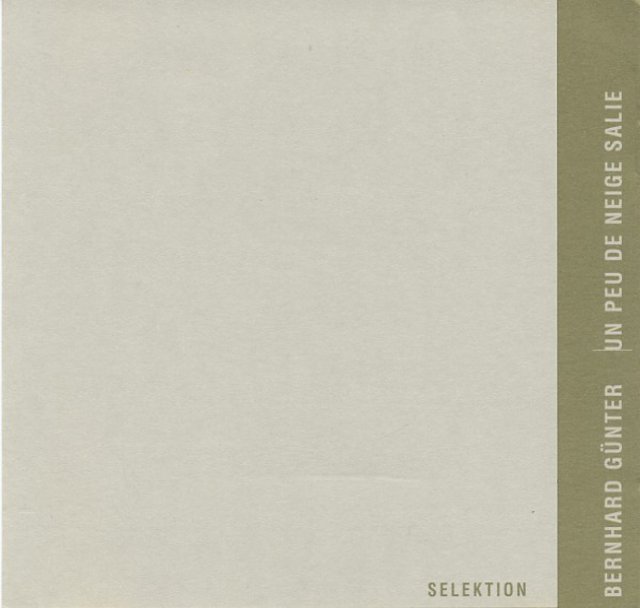
I hadn't heard of Günther before, so this was my first time listening, but honestly, it reminded me more of those sonic spaces Ryoji Ikeda or Alva Noto explore than anything related to John Cage.
"Meditation" is probably the right word for it. I don't know if it's been mentioned yet, but I've read in a few places that the title actually came from the author's haiku poetry, just like this:
The title of the album comes from one of his haiku: "elle fonderait dans ma main / un peu de neige salie" (roughly "it would melt in my hand / a bit of soiled snow").
(...)
He became interested in Japanese aesthetics and haiku and this interest is reflected in The Economy of his compositional materials and The Use of silence in his work.And now I see that this exists too...
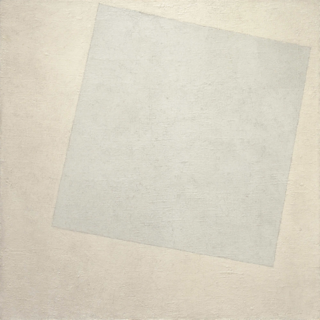
Gerald Jackson48 said:I guess Malevich's white on white painting probably caused quite a stir back in its day, too. But what's really the point of "wanting to provoke an audience response with a work of art" if the artist then refuses to deal with—or just doesn't know how to handle—those reactions?
(...)
I wouldn't really compare Neige Salie to white on white, though, since there were plenty of experiments with sound ("anti-music") way before 1993.
I wasn't trying to make a comparison; I was just trying to steer the conversation toward minimalism and experimental stuff instead of what we started with. 🙂 That painting definitely has its history and was pretty controversial as soon as it hit the galleries, especially with critics, so nothing surprising there... though it's nowhere near the impact of the 'black square,' which actually triggered intense emotions and very positive personal responses from people, which was the whole goal:
"According to minimalists, a work of art represents nothing. It’s only what you see. The other thing doesn’t exist. They have an objective quietness." I was more drawn to the idea of infinite space, the repetition, and how soothing the image is. Even that dirty white, with its soft, subtle tones.
brightwolf48 said:Music without rhythm, melody, or harmony isn't music, and there is absolutely nothing here; therefore, there's no composition either. And no, turning it up or down doesn't help. Garbage is garbage, and anyone claiming they see music and art in this is just a snob trying to feel special.
I actually loved how intense your negative reaction was. 🙂 It didn't surprise me, but the choice of words did.
brightwolf48 said:I don't think John Cage should be anyone's role model. I mean, he already pushed things to the absolute limit. He went all the way, and honestly, there isn't much left to do in that direction that would actually make sense or feel significant.
(...)
That first Malevich painting is the absolute peak of subversion and pure concept. You honestly can't top it. It’s the same deal with those Haneke films you linked. Any other later works that try to lean on those same subversive themes and ideas just... I don't know, they just irritate me. The thing is, I can't really be more subversive or provocative than my own idols. Or maybe that's just how it works. I guess I'm just stating my piece here. What’s the basis for that? I mean, what are you actually basing this on?
I'm glad you decided to head in this direction, but I can't say I agree with that last point. I mean, there’s always room to grow... and maybe even to get better! 🙂
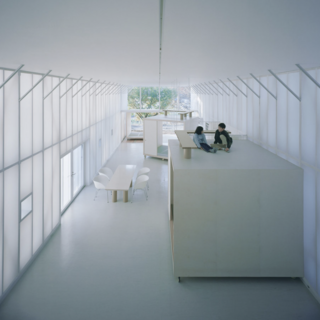
Look, I know this isn't really the topic at hand, but it’s easier for me to explain using houses and architecture. With buildings, purpose is the priority—you actually have to be able to live in the space. Long before the Bauhaus movement ever existed, a much more radical minimalism had already been achieved halfway across the world in the East. That style is still evolving there in ways most people here just don't get. As for this other, experimental direction—the examples I mentioned aren't even recent anymore—that kind of growth is driven by technology. But what I find interesting is that for them, technology doesn't dictate or limit the outcome. The final product isn't some forced "style" or a way to show off. It's something way more complex, and in the end, it just results in pure simplicity.
That’s just incredibly hard to pull off... I guess. Maybe.
Just another half-baked example. It’s got Kanye West vibes when it comes to style and—I guess—beauty. Or at least that's what someone wrote somewhere, claiming they discovered two magic words. Wabi-sabi.So, he claims they became part of his entire life philosophy and completely overhauled how he lives, right? And that’s how we ended up with this "stunning" house. Its value is mostly aesthetic, I guess, so there’s really no point in even bringing up that multi-million dollar price tag. Honestly, the house is the complete opposite of what those two words actually mean. Even if the designer managed to hit their goals of beauty and harmony, it’s still way too far from being pure, humble, or possessing that kind of intrinsic, elegant simplicity.
Don't come for me just yet... here's another one. This is it.. 😁
I guess Japan just gets it. They have this natural grasp of deeper moral and aesthetic principles that others struggle with. But then you look at the Belgian approach, and it's a completely different story. I don't know what to tell you. It’s just how things are. Maybe I'm wrong, but I think it's pretty obvious. I guess we should just deal with it. I guess Kanye and his crew just skim the surface, picking up only the shallowest layers. They end up totally misreading the whole thing, turning it into nothing more than some trendy fashion statement or a way to signal prestige and luxury. It’s like a design house trying too hard to sell an image—prioritizing the packaging over the actual substance. They're basically just pretending to be something they aren't.
And that’s just not how it works with this kind of music. I guess.