That was an interesting experience. It’s definitely not really my vibe—as some people already mentioned—because it feels a bit over-calculated in its drama, even if that fits the album's theme. That’s probably why I didn't revisit it after listening about ten years ago; it felt like someone was shouting in my face about how important, powerful, and terrifying they were, demanding I take them seriously. That kind of thing irritates me, whether it's people or music, but listening now, I think that might actually be the whole point of the album—there’s a certain layer of irony there. 😁
Anyway, I listened to it three times, so here are a few observations, even though most of you have covered the bases. I really should be working right now, but this is way more fun 😍
Since these songs are clearly multi-layered and any "clear" interpretation is bound to miss the mark, I always try to weave a little story together—maybe I'll hit on something.
Starting with New Mind, it feels like a cult narrative to me—joining a sect (not necessarily literal), being ready to reset everything you thought you knew, and setting the stage for the dualistic thoughts and contrasts that ripple through the album, like Damn You to Hell / Now Save Your Soul...
Then comes In My Garden, where he addresses God (in whatever sense) for the first time—gentle, merciful, and soothing. This leads into Our Love Lies, where he calls out to Him in this desperate, almost pathetic way, followed by Sex God Sex, where that "love" becomes an obsession—uncompromising, brutal, and dirty... it reminded me of characters in Flannery O'Connor stories who provoke and challenge God, loving and hating Him all at once, seeking both salvation and punishment. Their faith drags the most grotesque parts of themselves to the surface.
In Like a Drug, our "hero" seems to be losing his mind a bit, hallucinating... honestly, that was the most tedious part of the album for me; it just bored me. In You're Not Real, I get this sense that the people around him are losing their tangible dimension. Love for others, physicality, sex—none of it matters anymore. He alienates himself and turns inward to see if there's anything "real" left inside him. Beautiful Child is powerful and atmospheric—maybe the best depiction of that internal struggle. I imagine Rosemary wondering if she should kill her child 😁 while convincing herself, "this is MY LIFE, this is MY CHOICE"—killing off everything that holds you back on the path toward self-discovery and enlightenment.
Blackmail, which is such a telling title, feels like another address to that gentle, comforting God, but then in Trust, He becomes terrifying again. Through Girin's creepy vocals in "Don't Be Afraid / You Can Trust Me Now," you get that impression of God ironically mocking His own unconditional love for His "child."
Then we have Real Love, which is my favorite track on the album—totally my style. It reminds me so much of Angels of Light. Blind Love follows it like a sort of reconciliation with mortality, returning to the position of a child, with Girin's vocals acting almost like an extra instrument. And of course, the closing Children of God is incredibly effective and almost hypnotically infectious.
Some standout moments: that beautiful transition from Blackmail into Trust, and the sound of water and nature noises during the shift from Trust into Real Love—is there a connection to Blood and Honey?
Steven Newman50 said:In that dark atmosphere, Girin's shamanic energy dominates, paired with symbolism that complements the music visually, evoking religious soul-cleansing rituals similar to those found in a cult.
Steven Newman50 said:It makes sense in principle—and even though it sounds negative at first glance, there’s this underlying message about universal good, opening your mind, and eventually reaching enlightenment (I know, I say that word way too much, but hey, that's just the energy I get at their shows).
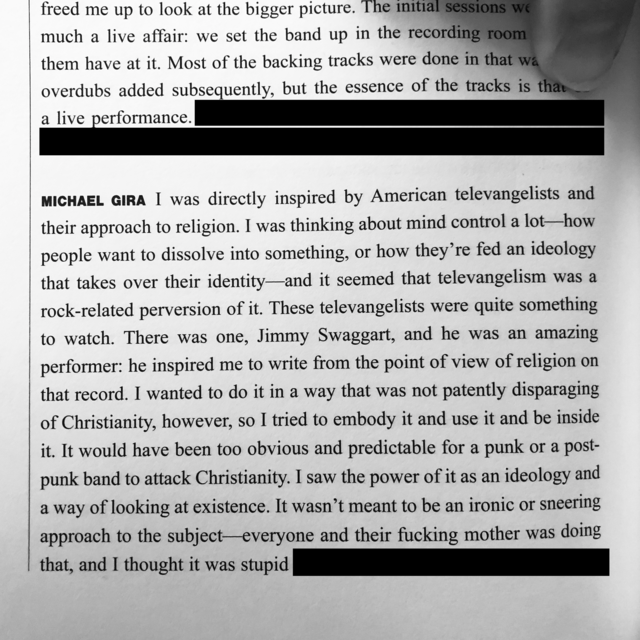
With Gira, it isn't really a direct critique of religion itself; it's more about those deep, personal struggles and internal battles, all told through universal symbols—whether it's suffering, the body, parental relationships, or in this case, Christian religion, the concept of God, and various religious rituals.
I love this 👍
That's pretty much how I experienced it too—hearing regret, obsession, self-loathing, and this desperate pull toward something bigger and stronger through all those laments about violence and reflections on a-corporeality.
Lisa Davis46 said:it loaded on my iPad in such high resolution just now, and I feel like it's already pulling me in,
without even listening to the actual story the album tells starting from the second track (since 'New Mind' is just the prologue).
Oh, now I'm curious—what kind of story is pulling you in if 'New Mind' isn't part of it? No need to write an essay like 😁, but I'd love to hear how everyone else felt, especially those of you who've been spinning this album for a while.
Anyway, this actually reminded me of an album I absolutely adore (not a Swans thing, though) that I might suggest soon. I'm not sure if it'll be a hit with the group, but I'd be so interested to see what you guys think.