Anthony Perez9 said:Did I actually call it "shameful"? No, I didn't. That is simply one form of religious stubbornness and fanaticism that runs contrary to modern science, humanistic principles, and education for the sake of ancient religious myths. You would essentially be undermining all of that by casting doubt (throwing mud) on the theory of evolution and such.
Just hush now; it's a good thing you aren't like the people you just described. 🤣
Anthony Perez9 said:You won't live to see it.
Oh, give me a break. You've just grown up and lost your edge, that's all. 🤣
Anthony Perez9 said:I don't argue with creationists; there's no point. They are religious fanatics who just insist on doing things their own way and refuse to acknowledge any scientific papers or rationality. ☕
And where on earth have you seen them? The moderators chased them off long ago. 🤣 Besides, who cares if they do show up? It’ll be easy enough to raise an outcry, report them to the administration, and the problem will be solved. Creationists are down there. 🙂 Especially those of the Protestant variety—they really are the worst. 🤣
mistyotter35 said:You've missed the point entirely. This is a purely technical question, which is why the author started the thread in the first place: does insulting someone's faith and its followers constitute hate speech? That is all.
Now, this is actually a very good question. Enough with the joking around; let's get a little serious for a moment. 🙂
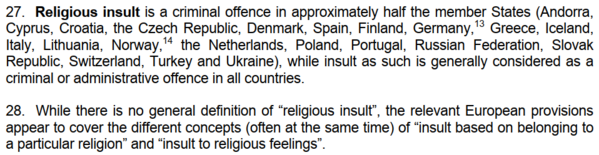
You know, it depends on who you ask. Just type Google CDL-AD(2008)026add into your search bar.
It isn't my forum password, but if you type that in, you'll find this (unless you're in North Korea, in which case you'll get a bullet to the head lol):
I’ve been reflecting quite a bit lately on the delicate balance between Freedom of Expression and Freedom of Religion, specifically regarding how we handle the regulation and prosecution of blasphemy, religious insult, and incitement to religious hatred. This brings to mind the significant work done by the Venice Commission during its 76th Plenary Session held in Venice back in October 2008. It is a complex, often sensitive subject, but the findings from that session provide such vital clarity. One of the most profound takeaways is the principle that individuals must tolerate and accept the denial by others of their religious beliefs, and even the propagation by others of doctrines hostile to their Faith. It sounds harsh to some, I know—and I certainly struggle with the discomfort of it myself—but it is essential for a functioning, pluralistic society. The Court recognized that States may adopt measures restricting the Freedom of expression in attacks that are judged to be incitement to hatred, but there is a very fine line to tread here. In this respect, The Court considers that the religious beliefs of others deserve respect, yet we must be careful not to allow legal protections to become tools for silencing legitimate discourse or dissent. It is a difficult tightrope to walk, but studying these frameworks helps us understand how to protect both the sanctity of belief and the necessity of free speech in a modern democracy.I’ve never been much of a fan of overly complicated titles, but I suppose there are times when they are simply unavoidable. That leads me to this somewhat cryptic quote:
The CEO report from this commission is...
I am here..
In my view, this forum needs to strike a careful balance between freedom of belief and freedom of thought—two concepts that, while related, are certainly not the same thing. This community is essentially a microcosm of a multicultural society; we have all sorts of people here, including those with vastly different religious convictions. On one hand, I believe that criticizing those beliefs, expressing doubt, or questioning them is not only welcome but actually quite desirable. However, on the other hand, I think we occasionally need to draw a line to ensure we don't cross over into what looks more like religious insult or harassment, which can quickly spiral into hate speech.
The Court has consistently maintained that individuals exercising their right to practice their religion—whether they belong to a majority group or a minority—cannot realistically expect total immunity from criticism. It is part of life that they must tolerate and accept The denial by others of their religious beliefs and even the propagation by others of doctrines hostile to their Faith. That said, the Court recognised that States May adopt measures restricting The Freedom of expression in attacks that ara judged to be offensive, particularly when those attacks touch upon matters held sacred by believers. From this perspective, in this respect , The Court considers that The religious beliefs of others a constitute legitimate "rights of others" under the protections outlined in Article 10(2).
It can be quite difficult to strike the right balance or draw a clear line here, but I truly believe that neither extreme is the correct path. There is absolutely no need to "protect" this forum from legitimate criticism of religious beliefs, yet there is equally no need to be "lawless" in those critiques. We have to recognize that not all criticism is actually critique—sometimes, what we see are simply insults, disparaging remarks, and similar behavior.
Furthermore, I believe any critique of non-religious views is just as valid and necessary as any other. There really isn't a distinction between religious and non-religious opinions when it comes to scrutiny—all of them should be open to criticism. The real problem arises when people operate under the assumption that only religion deserves to be questioned. Honestly, it feels like that mindset has become a bit of a dogma here on this forum, and quite a narrow-minded one at that. For instance, look at the posts from coppersailor28 or Anthony Perez9. They seem to start from the premise that statements such as:
In short, Christianity was the only true boundary for science...
They present themselves as these grand, sweeping scientific declarations, but in reality, they are nothing more than empty, anti-scientific rhetoric. Honestly, there is absolutely nothing of substance there. To put it bluntly—as some might crudely say—it is all just pure nonsense. 🤣 In much the same way, these specific claims and viewpoints are highly susceptible to criticism, especially when we see how various historians of science argue the exact opposite. If coppersailor28 were looking at a PDF of a history textbook, they would have been laughed out of the room long ago unless they provided actual references to back up such ridiculous assertions. But then again, I suppose that doesn't really matter to him, given how deeply he seems entrenched in his so-called dogmas.
Historical negationism is a deeply troubling phenomenon that strikes at the very heart of our shared understanding of reality. When we talk about the intentional distortion or outright denial of established historical facts, we aren't just discussing academic disagreements or differing interpretations of data. We are talking about a deliberate attempt to dismantle the truth for the sake of political leverage or ideological purity. It is, quite frankly, a bit disheartening to witness how easily certain narratives can be weaponized to erase the lived experiences of entire groups of people. By stripping away the context of past atrocities or minimizing the impact of systemic injustices, negationists seek to create a sanitized version of history that serves a specific, often harmful, agenda. This isn't just "revisionism" in the healthy, scholarly sense—which is vital for progress—it is a calculated assault on memory itself. I find myself struggling with how to effectively counter these claims when they spread so rapidly through modern digital channels. It feels like a constant uphill battle to maintain the integrity of the historical record against those who would rather rewrite the past than confront the uncomfortable truths it holds. Truth should be our anchor, yet negationism attempts to cut that anchor loose, leaving us adrift in a sea of manufactured falsehoods.It is truly exhausting when you try to engage someone by offering several top-notch sources, only to have them continue shouting the exact same narrative—one that stands in total opposition to the very references you provided. They reject every piece of evidence, yet they insist they "just know" the truth, repeating the same tired talking points they've been peddling forever. It is quite ironic: they claim science is the only cure for ignorance, but the moment you offer that cure, they reject it entirely, leaving them with nothing but dogma. And honestly, it isn't just one dogma; they have enough of them to fill a buffet. LoL
When we have forum members who believe that "science" is inherently anti-religious by default—viewing it as the "ultimate weapon" against faith, and then using that very "weapon" to constantly insult and mock religious convictions—it leads to a total degradation of discourse. To me, that is a true breeding ground for fundamentalism, exclusivism, intolerance, and narrow-mindedness. I believe this mindset needs to be completely debunked, because one of the biggest myths many users here cling to is precisely this one. If you touch this myth, you’ll likely face the wrath of users who believe in it more fervently than some people believe in the Virgin Mary (LoL). The irony is that science itself demonstrates things aren't quite as they seem—but no, they cling to this myth at all costs because, like all myths, it can't survive being challenged. This fabricated antagonism between religion and science emerged in the 19th century, and as I mentioned, many still refuse to let go. We need to expose this and show that such antagonism only exists when both science and religion are understood through a very one-sided lens. Anyone who believes there is an inherent conflict between science and religion either 1) doesn't understand science, 2) doesn't understand religion, or 3) understands neither. Understanding the nature of this tension requires a bit more effort than just counting on your fingers. This is why we see perennial conflicts in the Religion section; a specific group of users stubbornly upholds the so-called conflict thesis, despite it being widely rejected:
The consensus among historians of science is that the thesis has long been discredited, which explains the rejection of the thesis by contemporary scholars. Into the 21st century, historians of science widely accept a complexity thesis.
Of course, there are explanations for why the conflict thesis remains the sole theory for many regarding the relationship between science and religion, but our space doesn't allow us to dive too deep into that here. Generally speaking, this topic has been thoroughly addressed in modern histories of science.
In other words: solve the problem of the science-religion antagonism, and 90% of the issues in the Religion section will vanish. LoL. A little bickering among religious folks is fine; after all, they are human beings, and that's just part of human nature. But the primary, massive problem is this myth of conflict. Get rid of that myth, or at least manage it better—and you've solved almost everything here. It would be an instant fix, guaranteed.
I also get the impression that perhaps this forum views itself as being "above" earthly laws or even the laws of the US, much like the Pope or the Catholic Church ( 😁 ), which is fine. However, even in the US, there is an eye toward maintaining "religious peace"—or at least preventing its excessive disruption—and there's probably a good reason for that.
Indeed, the European Court of Human Rights has held that, in order to ensure religious peace, States have an obligation to avoid as far as possible expressions that are gratuitously offensive to others and thus an infringement of their rights, and which therefore do not contribute to any form of public debate capable of furthering progress in human affairs.
Maybe we could learn something from all this and make this forum a more pleasant place? How many users have actually left this forum specifically because of the toxic atmosphere and the imbalance in discussions? Why should anyone have to endure constant trolls and spammers? Do we tolerate them at the expense of everyone else? Sometimes it feels like we sacrifice meaningful discussions and high-quality contributors just to accommodate those who constantly shout and clamor without ever contributing anything of substance. The ones who write quality content are the ones who leave.
Another point I think is vital: the forum needs to be protected from the religious insults that believers often hurl at one another. We should ensure that someone waking up on the wrong side of the bed doesn't walk away thinking that only "unbelievers" pose a threat to the faithful. Anthony Perez9 is right on this; he was often targeted with nonsense simply because he couldn't restrain himself in a debate. Not all believers are as saintly as they imagine; a quick glance at the Religion section convinces me there are more trolls there now than ever before. facepalm The mass of believers struggles with dogmatism, exclusivism, and intolerance. What we need is a healthy balance—a moderate model where opinions are respected a bit more. Even if we don't like what someone says, we don't need to resort to insults. I suppose a little venting is understandable when life gets stressful, but it shouldn't be a daily occurrence; that crosses the line into being unhealthy. LoL
You are very welcome.