Since high school, I’ve always felt like hair and nails should be totally up to them. If they wanted to get some piercings at sixteen, I’d say go for it, as long as they hit up a legit, professional studio. Once they turn eighteen, tattoos are really their call, though I still wish they’d actually give it some serious thought instead of just acting on impulse. As for smoking? Yeah, I am never giving my blessing to that. Look, I was a smoker myself back in the day—started at twelve and didn't quit until twenty-four—and it wasn't like I suffered any kind of trauma just because my family didn't approve. We don't have to agree on every single little thing, right?
For now, everything seems pretty chill, but who knows? You can never tell when some random teenage brain decides to throw a massive party and go completely off the rails.
Grace Murphy27 said:Just endless questions and zero actual answers... 🙄
Look, everyone just needs to chill out for a second, okay? People around here usually don't even hop on until they've finished their entire workday and handled all their responsibilities, so they'll get to it when they actually have a spare moment.
Our usual check-up, an 8-year-old with lymphadenopathy...
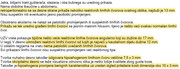
The CBC results are within the normal range, except for 1% atypical lymphocytes, and the markers look fine—immunoglobulins haven't changed (IgA is below detectable levels, others are normal, IgE is elevated) The cytology shows slightly low lymphocyte counts, but no atypical cells. Does the descriptive part at the bottom of the report look okay to you guys? What does this actually point to?
I still can't wrap my head around how a kid can have enlarged, reactive lymph nodes for 4 or 5 years straight without us ever finding a single actual cause for all that reactivity. How common is that, really? Every single time we dig through medical literature or search the internet regarding these nodes, it says any node larger than 1 cm needs investigation, but here we have old ones and new ones popping up constantly, and they never just shrink back down to a normal size... On top of that, besides the areas where the old nodes were already visible, there are now new "lumps" appearing around the head area (behind the ear, under the hairline). I get that you can't exactly biopsy every single one of these nodes, and none of them look suspicious, but the sheer number of them is just overwhelming.
Is it overkill to be doing these ultrasounds once a year? Some of the doctors clearly act like we're being a total "nuisance" by coming in "constantly" if the kid isn't showing obvious physical symptoms—but we brought him in for an ultrasound 14 months after the last scan specifically because these new lumps appeared, and we asked them to check the old, known areas too.
I really don't want my kids' schedules being weighed down by some mandatory elective they didn't even ask for.
And speaking of numbers, my crew is actually in a pretty good spot; all three of them are in classes where at least ten other kids are opting out of religion class. They aren't just outliers, and there are enough of them together that the school won't be able to single them out or make a thing out of it.
This is massive news and honestly, it’s just devastating—it turns out that when these absolute hacks churn out garbage books, nobody in our entire education system even bothers to call them out or provide any kind of real critique.
The reason they're rushing the biopsy is because they absolutely have to rule out whether this is some kind of metastatic mess—you know, like cancer spreading from somewhere else straight into the liver.
Thanks a million, Is there like a specific deadline for when this needs to happen? Because she’s already stuck on a waiting list... We'd honestly just pay out of pocket to get it checked privately if it means speeding things up or if it's actually the smarter move.
I couldn't find a specific thread about decoding abdominal ultrasound results, so I'm throwing this out here to see if anyone can help me make sense of it. It’s for an older female relative, born back in '46. Because she’s been dealing with repeated bouts of low potassium, her doctors decided to run an abdominal ultrasound. The report says her liver is normal size and shows normoechoic, inhomogeneous, hypoechoic parenchyma, but there aren't any obvious focal lesions visible. The portal vein looks fine in the hepatic hilum area. Bile ducts aren't dilated either, and the common bile duct at the hilum is within normal limits. However, they did spot an inhomogeneous formation in segment 4 of the liver—it's about 22mm, showing hypoechoic echoes, and isn't vascularized (maybe steatosis or some kind of secondary thing?). The gallbladder has thin walls and is filled with anechoic content. The pancreas looks okay in terms of size and shape, with maintained parenchyma that's hyperechoic and clearly defined. ... There's no sign of enlarged lymph nodes or any free fluid in the abdomen.
They've recommended she get an abdominal CT scan as soon as possible just to figure out exactly what that liver finding is.
I don't have all the other details right this second, but regardless, I was hoping someone could take a look at this and give me an idea of what we might be looking at? Just for context, she's a woman, overweight, and manages hypothyroidism with medication.
Since Nicholas Myers has been following along as our resident internet doctor for a while now, I wanted to direct this mostly toward him—if he can find a spare second—but honestly, anyone else is welcome to jump in too. 😍
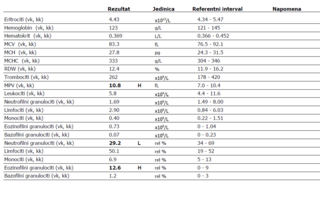
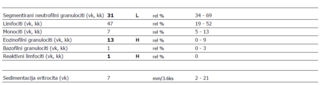
We’ve been doing regular checkups for my seven-year-old little lymphadenitis warrior, and for months now, we've been seeing this persistent dip in his neutrophil granulocytes (the normal range for his age is 34-69, but his numbers this year have been sitting at 29, 31, 31, and 28). Everything else seems to be right where it should be (red blood cells, hemoglobin, platelets, leukocytes, lymphocytes, absolute counts, glucose, bilirubin, ferritin, LDH, CRP). His IgA is still unmeasurable, but IgM and IgG are within the normal range.
Is this constant fluctuation in the relative number of neutrophil granulocytes something I should actually be sweating over? We’re planning to head back in soon for ultrasounds of all the areas where those enlarged nodes were found, but while we're just sitting around waiting on referrals and appointments, I figured I'd try to get a little more clarity.
Thanks, his pediatrician sees him all the time, but because things have been such a mess over at the hematology-oncology department due to some COVID fallout, we've just been put on the list for remote consultations instead. Appreciate all the input, everyone, so I guess we'll just stick to our usual routine for now. 👍
Much appreciated, Nicholas Myers. Sadly, we can't just head in for a checkup right now—not unless things actually take a turn for the worse. What’s really eating at me, though, is how the neutrophils are consistently low while those eosinophils stay elevated, plus there's always those atypical lymphocytes showing up. Since these results seem to be the baseline for this kid, should we just accept them as their "normal"?
My little one has lymphadenitis, and we’re due for a follow-up, but honestly, I don't have anyone else to turn to for a second opinion, so maybe you guys could weigh in? We haven't been able to get a cytology smear done yet. I'll post an update if anything looks off in the results.
Amanda Wright86 said:Just go get a private CA-125 test done, and if those levels come back high, then go see a top-tier specialist at Mayo Clinic.
Thanks for the advice. I actually had that test run a few times back when my hormonal IUD was basically causing a total meltdown in my ovaries, so everything looked normal then. But it’s been at least three years now, so I guess I could just go ahead and have it checked out.
Everything looks fine on the ultrasound, so there hasn't really been any reason to worry. Though, during the last checkup, one of my ovaries was acting totally haywire—the doctor couldn't even find it right away, which he said is because that ovary is actually displaced.
Could you include the measurement units and those reference ranges? You know how they vary from one lab to another, though looking at this, I don't really see any major discrepancies here.
By the way, did they even bother checking if endometriosis might be what's causing all this trouble?
Dear Felixe, honestly, whenever I even bring up the possibility of endometriosis, I just get brushed off—either with a shrug, a hand wave, or both. 😁
My hormone levels are technically within the normal range, sure, but most of them are hovering right on the edge of those reference limits. Just to be clear, I’m listing the values for the follicular phase since I had the bloodwork done on Day 4 of my cycle: LH (s) 3.98 (2.4-12.6) FSH (s) 10.95 (3.5-12.5) Prolactin (s) 209 (102-496) Estradiol (s) 98.75 (45-854) Testosterone (s) 1.47 (0.29-1.67)
My whole cycle is a total mess, which is the only reason I actually managed to snag a referral for this hormone panel. But after seeing the results, the only "solution" she offered was to start on oral contraceptives. Since I've dealt with some nasty side effects from birth control back in the day, I'm really not feeling that option, and I have no clue if there's anything else out there besides just sitting here and suffering through this mess.
Hey everyone, I could really use some help looking over my lab results today. I had my hormone levels checked because my period has been a total nightmare lately. My cycle usually runs about 23 to 27 days, and the bleeding lasts for 7 or 8 days—but the worst part is this long lead-up where there isn't much blood, followed by two days of heavy bleeding with huge clots. On top of that, ovulation is super painful, and sometimes sex hurts, or even just certain positions when I'm working out. My ultrasound for my uterus and ovaries came back completely normal, though.
Here’s what my hormone levels looked like on day 4 of my cycle: Can anyone help me make sense of these numbers from my day 4 testing?
LH (s) 3.98 FSH (s) 10.95 Prolactin (s) 209 Estradiol (s) 98.75 Testosterone (s) 1.47 Tested using the ECLIA method, Roche Cobas E601 (E411)
From what I can tell, everything falls within the standard range for the follicular phase, but doesn't it seem like they're all hovering right at the bottom end of the scale?
The kid probably needs a chest X-ray to check out those lungs, plus some blood work—ESR, CK, LDH, electrolytes—and a urine culture. You really ought to look into testing for those atypical infectious bugs that can cause this kind of clinical picture, specifically Mycoplasma pneumoniae, though viral stuff is on the table too. If you haven't already, I’d suggest heading over to the Mayo Clinic.
Thanks so much for getting back to me. In the meantime, we went ahead and did another urine test, and my doctor said everything came back totally clean. She reviewed it, and nothing showed up. Also, the ESR result just came in: it's sitting at 6.
So now we're basically stuck waiting without any clear next steps, just hanging tight for the viral panels, the throat swab, and the AST results. We figured we'd wait until those results land early next week before having another sit-down with the doctor if this fever keeps lingering (it hasn't topped 99.1, but it won't drop below 98.4 either, and we're on day 13 now), especially since the kid feels fine and—thanks to all these pandemic restrictions—isn't even missing school or sports anyway.
I don't think we have a pediatric infectious disease specialist here in San Francisco, so I assume we'd need a referral to go see someone at the clinic in Washington, D.C.?
Bonus question: should we be monitoring the thyroid after a while given that borderline TSH level? There's a history of thyroid issues in our family—my grandma and uncle both have it, and I've dealt with thyroid fluctuations after every pregnancy that just seemed to settle down on their own.
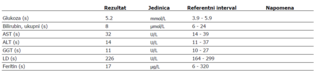
So, we've got this 13-year-old kid who was sent in for some lab work because they've been running a low-grade fever for over a week now, though nothing else seems to be going on wrong. Physically, everything looks totally normal—appetite is fine, and their bathroom habits (poop and pee) are completely regular. Tested negative for COVID, so that's one less thing to worry about.
CBC and differential look perfectly fine. Urinalysis is also pretty much normal. But when you look at the urine sediment, things get a little weird: there's an elevated red blood cell count (8 when the reference range is 0-2), some mucus, a few spermatozoa, and a whole bunch of bacteria.
Moving on to the biochemistry: Glucose is 5.3 (normal is 3.9-5.9) Urea is 5.0 (normal is 2.7-6.8) Creatinine is 66 (wait, the range says 25-42, so that's actually high) Total bilirubin is 13 (6-24) AST is 19 (11-38) ALT is 10 (10-33) GGT is 12 (10-27) CRP is 0.3 (0.1-2.8)
TSH is 3.35 (right at the top end of the 0.68-3.35 range)
The plan right now is just to have them go back and redo the urinalysis.
Just for context, the kid is moderately active, but they haven't been training for the last 8 days because of the fever and they've mostly just been hanging out at home—plus, with all these restrictions lately, their usual workout intensity hasn't even been what it normally is. All these tests were done first thing in the morning, fasting.
Hey everyone, happy New Year! Wishing you all nothing but great health and hopefully zero trips to the doctor this year. 😍
Here’s the results from our two-month checkup. The kid has been doing okay since the last visit—no infections or anything, but he did develop some skin issues on the soles of his feet (we're thinking dyshidrosis). Lymph nodes remain constant; they're enlarged or palpable across all the usual areas.
Can anyone dive deeper into what neutrophil granules actually mean? Also, these rouleaux formations keep popping up in the blood smears... I read that it can sometimes just be a result of a poorly prepared slide, but honestly, looking at how things go at our local lab, it feels like they mess up the prep almost every single time. 🤔
Keith Gonzalez said:It definitely plays a part, whether it’s before or after, just like El Gato pointed out. But honestly, you really have to ask about the specific person we're talking about, look at their actual labs, and figure out why anyone is even questioning things in the first place. HL and NHL aren't exactly twins when you look at the lab results and how you actually treat them. The "gold standard" for this kind of hematology work is doing lymph node punctures if they're swollen, or bone marrow punctures—which basically leads to a bone biopsy later on. Lab tests can be super vague, even if they give you a hint of where to look next.
To be specific, what we're dealing with here is a kid who has enlarged and multiplied lymph nodes across all regions, though the ultrasounds show them looking reactive. Nicholas Myers has been tracking these labs for years (the little guy just turned 7, and he's been under medical supervision since he was 3.5). The lab work doesn't show anything majorly off, though there were some immature cells showing up in the blood smears. A second round of testing didn't turn up a definitive cause either. We had one node examined, and it’s been over a year and a half now without any real worsening. Two punctures came back inconclusive, so they eventually did a biopsy on a conglomerate in the neck. The findings were mostly mixed, with an elevated proliferation index... Also, there's little to no IgA, and it isn't being compensated for by IgG.
We were warned about the possibility of developing an indolent (?) form of lymphoma, so we're staying on top of it with constant monitoring. But really, it's just blood work most of the time, while we head out for neck, abdomen, and armpit ultrasounds maybe twice a year.
Sometimes we run into info that totally clashes with our current approach, and I just feel this nagging need to dig around to make sure we aren't missing a step somewhere.
Thankfully, the kid is doing great—super lively, full of energy, eating well, and honestly, his presence alone helps take the weight off our shoulders.
Maria Fisher46 said:It’s honestly tough to give you a straight, quick answer to something like this. There isn't some magic symptom or "smoking gun" sign for lymphoma, and there isn't a single blood marker you can just point to and say, "Yep, that's it." Even things like Ferritin or LDH levels can come back totally normal. At the end of the day, the only way to know for sure is through a biopsy. Everything else—all those other clinical signs—just helps a doctor decide if they should pull the trigger on a biopsy or not, but until that tissue is actually looked at, nobody knows if someone has lymphoma or not. And let's not forget, the technique used for the biopsy and the quality of the sample itself matters just as much; an inadequate sample can easily lead to a false negative. It’s just not that simple... In my own practice, I’ve seen all sorts of things, including cases where a lymphoma was present but every single lab result looked perfect. I’ve even seen people gaining weight and feeling absolutely great, showing zero outward signs of being ill, only to have a lymphoma confirmed by total accident later on.
I totally get that this is incredibly complex stuff and there aren't any easy shortcuts or brief answers here. Thanks for putting so much effort into this discussion. 🙂
 [/IMG]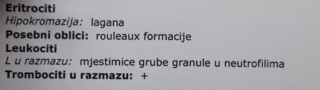
 [/IMG]