CheckEmoji Community · the emoji forum
🏠 Home 🆕 What's new ❓ Unanswered 🔥 Popular 📡 RSS Members 👥 0 online log in · register
Home › Nicholas Myers › Posts

Posts by Nicholas Myers

1304 posts shown.

Megan Jones27 said:I'm struggling to make sense of these OGTT results. My doctor isn't overly concerned about the lower numbers; he suggests we just retest the fasting level in a month. He thinks these other two values are slightly low, but there's no need to "investigate" further.

Fasting: 5.2 (Pregnancy threshold < 5.1)

1 hour: 4.4 (Pregnancy threshold < 10)

2 hours: 3.2 (Pregnancy threshold < 8.5)

I did the OGTT at my local community clinic. It was packed, so I asked if I could wait out the interval between blood draws at home. They said yes, as long as I took a light stroll. I live literally 200 meters from the clinic—maybe a 2 or 3-minute walk—and I certainly wasn't running. I also asked if using the restroom was okay, and they said it was fine. Now I'm left wondering if these numbers are artificially low because of that brief movement, or if they point to an actual issue. In my last pregnancy, the fasting number was identical, but the progression felt more standard: 5.2, 7.8, 6.4.

Sent from my iPhone 15 using Reddit

Ma'am,

Theoretically, these results lean toward gestational diabetes since one value deviates from the norm—specifically the fasting glucose, though in my view, those criteria can be quite stringent. Furthermore, at the two-hour mark, you see hypoglycemia, given that the levels have dropped below 3.3 mmol/l.

In cases of gestational diabetes, there are documented instances of what's called a "delayed insulin response." This occurs in two stages: an initial period of diminished response, followed by a late surge in insulin concentration, which ultimately drives glucose levels down too far.

Additionally, as I recently noted to Roger Rodriguez, some studies tracking pregnant women who developed hypoglycemia during an OGTT (values under 3.5 mmol/l, almost always occurring after the two-hour mark) show that a significant percentage eventually met the diagnostic criteria for gestational diabetes, particularly regarding elevated fasting glucose.

Given that, your OBGYN's recommendation is consistent with these patterns, and you should follow their guidance.
amberowl said:Thank you.

I was smoking, but I quit the very same day I saw these results. I've started exercising, and my diet is on track now—I'm being very careful about what I eat.

I'm roughly 6'2" and weigh about 235 lbs; my goal is to get down to around 200-205 lbs.

My blood pressure is mostly sitting at 120/80.

How long should I wait before getting my labs redone to check my cholesterol levels?

Thanks again.

To whom it may concern,

Given the details provided, I recommend scheduling a follow-up lipid panel in six months. This should be paired with strict dietary discipline, regular physical activity, and continued abstinence from smoking.
Kimberly Morris said:image

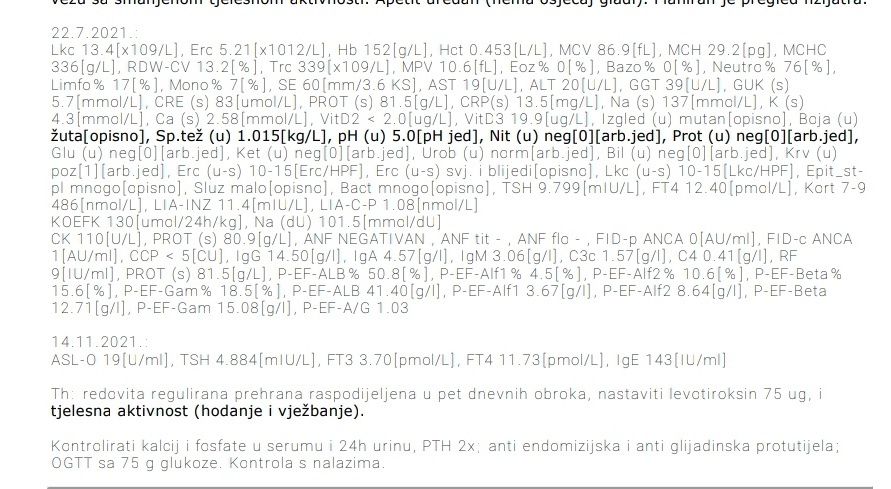
Here is the report for Felix the Cat. I asked my doctor if you could take a look and perhaps offer some commentary. Thanks in advance!

Ma'am,

My apologies; it appears my response from yesterday failed to post due to some technical glitches.

I previously noted that a total calcium level of 2.58 mmol/L shouldn't be directly linked to your symptoms. It's a very mild hypercalcemia, though we really need to see the ionized calcium levels to be sure. This specific pattern—low Vitamin D paired with elevated calcium—is often seen in hyperparathyroidism, primarily the primary type. While secondary hyperparathyroidism can occur alongside Vitamin D deficiency, calcium levels in those cases are typically normal or even low. I see your endocrinologist is already considering this possibility and has ordered follow-up testing.

However, none of that accounts for the elevated ESR, high CRP, or the leukocytosis with neutrophilia. Those markers point toward systemic inflammation, which is actually more concerning to me than the calcium levels. The cause of this inflammation remains unclear, though a colonoscopy to rule out inflammatory bowel disease might provide some answers. That said, IBD wouldn't necessarily explain the neurological symptoms you mentioned. It is worth noting that migraines are more frequent in patients with IBD, potentially triggered by the inflammatory process, which usually subsides once the condition is managed. Still, it will be quite problematic if the endoscopic findings and biopsies come back negative.

As for temporal arteritis, the clinical picture and lab results don't seem to align.

It is entirely possible that the neurological issues are one matter, while the systemic inflammation is an entirely separate issue. It is difficult to say for certain at this stage.
brightscout9 said:Are you suggesting high transferrin saturation happens when UIBC is low?

I’ll definitely retake the test in 2-3 weeks.

And I'll try cutting back on foods high in iron.

Transferrin saturation is calculated using the formula: Fe/TIBC or Fe/(Fe + UIBC). So, my primary focus is the ratio of elevated iron against a lower TIBC. But yes, since TIBC equals Fe + UIBC, your logic holds up too.

My advice? Don't mess with your diet. Just eat normally so the lab results actually reflect reality.
amberowl said:Full panel results

Glucose 5.30 (ref. 3.9 - 6.2)
Urea 3.5 (ref. 2.8 - 8.3)
Creatinine 60 (ref. 59 - 104)
ALT 21 (12-48)
AST 20 (11-38)
GGT 23 (11-55)
Cholesterol 6.30 (3.2 - 5.2)
Triglycerides 0.90 (0.11 - 1.70)
HDL cholesterol 1.20 (0.9 - 2.2)
LDL cholesterol 4.7 (2.60 - 4.1)
Iron 17.8 (11-32.2)
Total bilirubin 20.20 (2.0-21.0)
Direct bilirubin 3.00 (
I also ran urine tests and a full CBC. I wasn't sure if I should post those too, but everything looks fine. Nothing is even hitting the borderline; most values are sitting right in the middle of the reference range.

I'm 21. These were just routine checkups since my last blood work was back in 2013. Just wanted to see where things stood out of curiosity. As far as I know, I don't have any other health issues, though I dealt with some arrhythmia once in a while.

Over the last year, I haven't really watched what I eat or stayed active. I've gained some weight—went from an ideal 92kg up to 110kg, currently at 105kg, and I'm working on bringing it down. I started hitting the gym and immediately cut out all the junk. I'm getting back into the healthy habits I had before COVID. Around New Year's, I was eating quite a bit of jerky; generally, I've always been fond of dried meats and eggs.

Sir,

Fix your diet and drop some weight, and your cholesterol numbers should follow suit. For a 21-year-old, this cholesterol profile isn't acceptable. Do you smoke? What are your blood pressure readings?
brightscout9 said:Hello,

Thanks for the reply.

I don't have any symptoms and I'm not suffering from any illnesses.

No specific instructions were given; I just run these types of tests twice a year on my own initiative.

In previous tests, my Zeljezo levels were always fine, as was my urinalysis.

I'm not an athlete.

There hasn't been any significant physical exertion.

Thanks for the response...

Dear Sir,

The results primarily show high transferrin saturation, even though the ferritin level is normal—this can be one of the earliest indicators of iron overload. Since iron concentrations fluctuate quite a bit, relying on a single data point isn't reliable. I suggest repeating the test in a few weeks; if the transferrin saturation remains high, further investigation will be necessary. Your cholesterol is slightly elevated, so it would be wise to address that through dietary adjustments. As for the urinalysis, there are no abnormalities; the slightly higher epithelial cell count isn't a pathological finding, it simply suggests skin contact during sample collection.
slycyclist14 said:Hi, I need to renew my driver's license. Part of the process involves a medical exam where they draw blood, followed by a review of the results—blood work, psychological tests, etc. Here’s the catch: I need to claim I’m not on any medication, but I actually am. I don't take them here in the States. Is it possible for certain medications to show up in a standard blood test? Are these screenings comprehensive or just basic panels? Basically, can I get caught in a lie?

Standard medical evaluations for a Class D driver's license don't typically screen for specific drug levels in the bloodstream; instead, they focus on routine biochemistry and a complete blood count. However, keep this in mind: certain medications can cause fluctuations in lab results—for instance, elevated liver enzymes might hint at something. Furthermore, because drugs can impact psychomotor skills, a combination of lab data, physical exams, and psychological testing could indirectly raise red flags, potentially leading a doctor to suspect someone is using medication or other substances.
Melissa Bishop49 said:(vK) RBC 4.66 ( o ) 10e12/L 3.86 - 5.08
(vK) hemoglobin 135 ( o ) g/L F 119 - 157
(vK) hematocrit 0.412 ( o ) 0.350 - 0.470
(vK) MCV 88.4 ( o ) fL 83.0 - 97.0
(vK) MCH 29.0 ( o ) pg 27.4 - 33.9
(vK) MCHC 328 ( o ) g/L 320 - 345
(vK) RDW 12.9 ( o ) % 9.0 - 15.0
(vK) platelets 179 (o ) 10e9/L 158 - 424
(vK) MPV 11.4 ( ) > fL 6.8 - 10.4
(vK) WBC 8.2 ( o ) 10e9/L 3.4 - 9.7
(vK) neutrophils 67.7 ( o) % 44 - 72
(vK) # 5.55 ( o ) 10e9/L 2.06 - 6.49
(vK) lymphocytes 22.9 (o ) % 20 - 46
(vK) # 1.88 ( o ) 10e9/L 1.19 - 3.35
(vK) monocytes 7.2 ( o ) % 2 - 12
(vK) # 0.59 ( o ) 10e9/L 0.12 - 0.84
(vK) eosinophils 1.5 ( o ) % 0 - 7
(vK) # 0.12 ( o ) 10e9/L 0.00 - 0.43
(vK) basophils 0.7 ( o ) % 0 - 1
(vK) # 0.06 ( o) 10e9/L 0.00 - 0.06

Hi, I'd appreciate some input. Is everything within range, or is there anything suspicious here?
Thanks 🙂
I had COVID two months ago; no other underlying health issues.

Aside from a slightly elevated platelet volume—which might be linked to that recent infection, though perhaps too much time has passed since the acute phase—everything else looks standard. No other deviations noted in these results.
Kimberly Morris said:Dear Nicholas Myers, brightgull95, and everyone else,

You all know me; I’ve become a bit of a fixture on these forums due to a long string of physical issues that are now starting to bleed into my mental health because I feel completely dysfunctional.

It's constant: low-grade fever, body aches, bouts of lightheadedness, migraines, insulin resistance, Vitamin D deficiency, frequent diarrhea, and a level of exhaustion that doesn't lift regardless of sleep or light exercise. My immunologist ran some tests, and they've ruled out rheumatoid arthritis and lupus. However, she noted that my HLA typing suggests a high probability of inflammatory bowel disease (IBD), which might explain the nighttime diarrhea—something I previously just blamed on a subpar diet. I'm waiting on a colonoscopy. My cardiology workup came back normal.

On the morning of December 20th, I woke up with this intense pressure in my temples. I assumed a migraine was coming. But instead of a migraine, I just had this strange, persistent headache all day. It lasted for a few days before the pressure turned into tingling sensations. This tingling would hit my temples and spread toward my cheekbones and downward. It intensified daily, feeling more pronounced on the right side than the left. After ten days, I finally saw my doctor. She suggested it was linked to my migraines and neck issues, recommending Normabel and a massage. I tried both; neither helped. Now, it’s been 20 days of temple pressure and tingling...

Today, my endocrinologist called to say my lab results from seven months ago finally arrived (!!!!). My Vitamin D is still low, but my calcium levels are quite high. She told me to stop taking Vitamin D immediately until I can re-test my calcium.

I don't have the actual report in front of me. My question is: could my neurological symptoms be linked to excess calcium in my system?
It feels somewhat like temporal arteritis, though I’m hoping that isn’t the case since I don't have pain while chewing and I'm not even 40 yet... 😟

Thanks in advance to everyone for reading and for any insight you can offer.

To the poster,

The symptoms you're describing can't be explained by elevated calcium alone. The specific concentration matters significantly. Finding hypercalcemia alongside low Vitamin D is an unusual combination that warrants investigation. Furthermore, diarrhea isn't typically paired with high calcium; usually, you'd see constipation. Then there are these systemic symptoms that remain unexplained, even if the rheumatologist has ruled out autoimmune disease.

Beyond the fact that this constellation of lab results is atypical, most of your complaints can't be attributed solely to high calcium, and further diagnostic work is clearly needed. Unfortunately, I can't say much more at this point.
I’m shifting focus toward this thread instead; it might actually be worth our time.
brightscout9 said:Hi there,

I had some blood and urine tests done today.

My doctor ordered them during my annual physical.

Can anyone help me make sense of these high and low levels?

Hello,

To interpret these results, we need context. Why were these tests ordered in the first place? Are you experiencing any symptoms, or do you have any existing medical conditions? Have you seen similar fluctuations in past lab work? Also, consider things like your activity level—are you an athlete, or did you push yourself physically right before the draw? Please review the guidelines in the opening post of this thread and provide those details so we can better assist you.
Hannah Stewart27 said:They aren't

Ma'am,

I suggest expanding your testing—specifically, seeing an immunologist or a dermatologist. Regarding hyperthyroidism treatment, you might consider tapering your Propylthiouracil dose further, though I can't say for certain without tracking your hormone levels over time.

Since the double dose of Letizen hasn't worked, it seems time to switch antihistamines. Try Levocetirizine (Xyzal) at 2 x 5 mg. If there’s no improvement in a week, move to 5 + 0 + 10 mg. If still no response after another week, go up to a quadruple dose, or 2 x 10 mg.

That said, I would still advise getting those specialist tests checked first.
Harold Garcia60 said:Hi there. Our son was diagnosed with metabolic renal tubular acidosis, so he’s currently on potassium and sodium citrate. We monitor his blood work regularly (acid-base status), and these are the latest results: https://imageupload.io/i/yfE9eSvzdj

I would appreciate any insight anyone could offer.

Hello,

For a child dealing with renal tubular acidosis, the target bicarbonate levels should be at least 22 mmol/L (ideally sitting between 22 and 24 mmol/L). That explains why the citrate dose is elevated. The rest of the acid-base profile looks solid. Those slightly elevated lactate levels are likely just a byproduct of squeezing the finger during the draw; nothing to worry about. As for the partial CO2 pressure, it's negligible—most kids start breathing faster (hyperventilating) right before a prick, so seeing a lower pCO2 is perfectly expected.

All in all, from what I can see, everything is being handled flawlessly.
Hannah Stewart27 said:Hello,

My apologies for the lack of detail; I appreciate you clarifying things given the sparse data. A low TSH was flagged during a routine checkup four months ago, which subsequent tests have confirmed. My initial treatment was Athyrazol, but after two weeks, I developed a fever and hives all over my body. Suspecting an allergic reaction, my doctor switched me to Propylthiouracil (starting at 3x1 for two weeks, then moving to 2x1, which is my current dose). Alongside this, iron-deficiency anemia was detected. Given a family history of colon cancer, I underwent both a gastroscopy and a colonoscopy. To summarize: in addition to chronic gastritis, GERD, and a hiatal hernia, I had H. pylori in my duodenum, which was treated with standard triple therapy and is now testing negative. The urticaria hasn't let up since it started, and despite regular TSH monitoring, my doctor is ordering further tests—which I’ve posted here for interpretation—due to the holiday season. Honestly, though, I’m struggling to see the logic behind some of these tests because my primary issue remains the unbearable hives (I'm taking Letizen 2 x1). I assume the anti-CCP was ordered because of persistent, intense pain and a lump in my elbow that has been present since August; my doctor diagnosed it as tennis elbow. I am 43, maintain a healthy weight, and follow a balanced diet.

Thanks again.

Hello,

Were anti-TSHR (thyroid-stimulating hormone receptor antibodies) ever tested?
Hannah Stewart27 said:Hi, could someone please help me interpret these results? They were ordered primarily due to hyperthyroidism diagnosed back in August (TSH was under 0.01, then rose to 1.63 at the one-month follow-up), and also because of various health issues—specifically daily hives. I had protein electrophoresis done as well.

Albumin 61.5 % - 52.0 - 68.0
(S) Alpha 1 globulins 2.7 % - 2.0 - 5.0
(S) Alpha 2 globulins 7.8 % - 7.0 - 11.0
(S) Beta globulins 7.6 % L - 9.0 - 14.0
(S) Gamma globulins 20.4 % H - 12.0 - 20.0
(S) Albumin 45.5 g/L - 35.00 - 49.00
(S) Alpha 1 globulins 2.0 g/L - 1.00 - 4.00
(S) Alpha 2 globulins 5.8 g/L - 4.00 - 11.00
(S) Beta globulins 5.6 g/L L - 6.00 - 10.00
(S) Gamma globulins 15.1 g/L H - 8.00 - 14.00
(S) Albumin/Globulin 1.60 1

(S) Anti-CCP antibodies - 0.2 kU/l - (S) Thyroid Stimulating Hormone (TSH) - 5.07 mIU/L H - 0.35 - 4.94 CMIA
(S) Free Triiodothyronine (FT3) - 4.13 pmol/L - 2.43 - 6.01 CMIA
(S) Free Thyroxine (FT4) - 9.96 pmol/L - 9.01 - 19.05 CMIA

Thanks in advance!

Hello,

It’s difficult to interpret these without clinical context. Are you currently taking any medications? Is the hyperthyroidism being treated, which might explain the current state? And why was the anti-CCP requested?

Regarding the serum protein electrophoresis: there are minor deviations indicating hypergammaglobulinemia. This can be seen in cases of infection or chronic inflammation in its broadest sense—keeping in mind that inflammation isn't always an infection. There is also a slight decrease in the beta fraction, which is typically associated with malnutrition or low protein intake. However, it could also relate to liver or kidney issues, or perhaps hypolipoproteinemia.
Sarah Wells23 said:Is it normal for blood sugar to be lower after consuming glucose than it was while fasting?
OGTT results:
Fasting: 4.3
1h post-load: 4.0
2h post-load: 3.6

Note that between the last two readings—specifically between the 1-hour draw and the 2-hour draw—I had a severe bout of diarrhea. I'm not sure if that skewed the numbers; the doctor just mentioned I shouldn't strain myself.

I am 29 weeks pregnant. We were actually suspicious of diabetes because I’ve been gaining weight rapidly and feeling constantly hungry and exhausted.

Are values under 4 even considered normal, or is this hypoglycemia?

Hello,

This isn't hypoglycemia. In pregnancy, hypoglycemia is typically defined as values below 3.5 mmol/L (sometimes even below 3.3 mmol/L).

Your glucose pattern during the OGTT is unusual, as we generally look for a steady rise and fall.

The most atypical part is the drop during the first hour. While seeing lower values in the second hour following higher initial peaks happens occasionally, your specific trajectory is odd.

The clinical significance of such a pattern isn't well established. Some studies have tracked pregnant women who developed hypoglycemia (under 3.5 mmol/L) during their test. In those cases, the dip usually occurs at the 2-hour mark rather than the 1-hour mark. Interestingly, those patients often went on to meet the criteria for gestational diabetes, particularly regarding elevated fasting levels.

However, that doesn't apply here since you don't meet the entry criterion of being under 3.5 mmol/L.

The wisest move would likely be to discuss a monitoring strategy with your OB-GYN, especially given the symptoms you described.
irongull13 said:Sir, when I had my full blood panel done in Washington, D.C. a few months back, my total bilirubin was at 98. My conjugated levels were at 10, while anything under 5 is considered normal. Since then, I haven't checked the conjugated levels specifically—just the total, which has hovered between 50 and 60 u/mol over the last three tests.

Sir,

In that case, the conjugated bilirubin made up about 10% of the total. That still points toward unconjugated hyperbilirubinemia. When you factor that in with the clinical history and symptoms already mentioned, it fits the profile of Gilbert's syndrome perfectly. My previous suggestion stands: get a genetic test to confirm via UGT1A1 genotyping.
Melissa Long82 said:Hi, I'm also looking for an interpretation of these results, specifically the urine analysis portion.
For the last few weeks, I've been dealing with pain in my upper right abdomen. At first, I thought it was just my stomach, but then the pain shifted further right, and lately, some mornings it's even radiating to my back near the right kidney area. After an initial checkup, my endocrinologist referred me to the CIA for blood work.
The results are available here: https://postimg.cc/fSjy8.1 miles

I'm 25. I have hypothyroidism, but I've been on regular medication for five years now, so it hasn't been an issue. About three months ago, they found an endometriotic cyst on one ovary. Initially, I felt it as hip pain, but it turned out to be ovarian. I have a pelvic MRI scheduled soon to see if there are any other lesions.

Regarding diet and weight, nothing has changed. I have a standard build (5'7" / 141 lbs) and stay active with sports. No history of surgery.

The only thing bothering me in these results is the elevated bilirubin; it was actually even higher at 30 during my last blood test. Does that indicate anything?

Hello,

The symptoms you're describing are non-specific. They require imaging, much like your endocrinologist suggested. As for the urine analysis, everything looks within the normal range. Based on what you provided, the bilirubin level in this report is 24 mcmol/l, not 30.
irongull13 said:The links I posted earlier aren't working, so here are updated ones.
https://postimg.cc/TyX4yvbp
https://postimg.cc/LhhN88Wx

To whom it may concern,

It looks like we're dealing with Gilbert's syndrome. It would be wise to check the conjugated bilirubin levels as well. Genetic confirmation via UGT1A1 genotyping is also an option; it isn't prohibitively expensive—likely around $100—and can be handled at places like St. Jude Children's Research Hospital, Mayo Clinic, or Cleveland Clinic.
Amy Cox79 said:I went ahead and started taking a B12 spray on my own. My primary care physician didn't suggest any supplements yet; instead, he scheduled follow-up labs (glucose, iron, UIBC, and TIBC) for next month. Thanks for the heads-up on potassium—I'll make sure to check my ferritin levels. These labs were done fasting. One thing I have noticed over the last few months is increased hair loss. Also, I'm not sure if it’s worth mentioning, but I experience heart palpitations. They don't cause much distress, but I once read they might be linked to potassium levels. Thanks!

Hello,

Potassium levels around 3.5 mmol/L shouldn't typically trigger cardiac issues, as that's right on the borderline. However, it might be worth digging deeper if you're feeling symptoms. My previous responses assumed a systematic review of a healthy individual without complaints, but you've noted some specific issues.

In my view, you should re-test your fasting glucose, along with a two-hour postprandial test or an OGTT. Checking ferritin specifically is also highly recommended, rather than just repeating Iron, UIBC, and TIBC. Have you had your thyroid levels checked? You should probably re-run your electrolytes in a little while as well.

We have a dedicated thread for cardiac concerns, so it would be better to move this discussion there (Heart Palpitations).