CheckEmoji Community · the emoji forum
🏠 Home 🆕 What's new ❓ Unanswered 🔥 Popular 📡 RSS Members 👥 0 online log in · register
Home › Jeremy Alvarez5 › Posts

Posts by Jeremy Alvarez5

166 posts shown.

Nikola Tesla's evening visions in Spirituality ·
Bradley Myers63 said:Probably not—but based on what he described seeing, he’d be right in the thick of the schizophrenic crowd... pretty sure they wouldn't just label him with some minor psychosis.

It's not even just about him, though—it's more about using this as an example of how tricky it is to diagnose complex personalities. I mean, Carl Jung actually diagnosed schizophrenia just from meeting Rudolf Steiner, and we all know how much weight Steiner's influence carried at the time.
Nikola Tesla's evening visions in Spirituality ·
Zachary Gonzalez8 said:Bradley Myers63, you wouldn't happen to know what went down on the actual day Nikola Tesla was born—the stuff people usually gloss over? He actually dropped hints about it himself once or twice.
I’ve spent way too much time digging through papers on his life and work. It’s pretty obvious that, just like anyone else, his views on faith shifted as he aged. There was one moment where he mentioned finding a certain peace in the idea that death might not be the absolute end. But then I stumbled onto this bit online:

In that last interview, he said, "Everyone must have ideals. If they do not...." He shook his head in despair, then went on to talk about religion. "Religion," he said, "is simply an ideal.
It is an ideal force that tends to free the human being from material bonds. I do not believe that matter and energy are interchangeable, any more than are the body and soul.
There is just so much matter in the universe and it cannot be destroyed. As I see life on this planet, there is no individuality.
It may sound ridiculous to say so, but I believe each person is but a wave passing through space, ever-changing from minute to minute as it travels along, finally, some day, just becoming dissolved."


So, did our great scientist lose his faith toward the end, or did he just finally wrap his head around how things actually work?
I remember reading that after his white dove passed away, he basically declared his work was done. Maybe that bird dying was his way of signaling that his faith had vanished, too?

I find this whole idea pretty fascinating, honestly. As for where that thought actually leads—well, I guess we can just leave that part to the religious folks or anyone else who spends their time debating whether there’s a different way things could end up. But if you look at it from a different angle—where a person is constantly shifting, changing by the minute because they're basically riding these waves of other people's energy, physical matter, and whatever spiritual stuff you want to call it (since I don't really see a line between the two)—then the real question becomes more about how to stay grounded. It's about how not to soak up all those negative vibes and stay sane. I mean, it seems like so many people don't even pass on that negativity right away; instead, it's like they just bottle it all up inside. Then, out of nowhere, it all boils over and comes out as this sudden, misplaced aggression in some random situation. It's kind of heavy when you think about it, I guess.

Bradley Myers63 said:All I know is the lightning was hitting everything like crazy—an unprecedented storm—but that's about it.

That’s really the core of spirituality—your ego, your character, your entire persona will eventually vanish; it simply can't "survive." That line about there being no individuality suggests a higher force connecting us all. And the part about becoming dissolved is just logical—it doesn't mean your soul disappears, it just means you transform, since energy can't be destroyed, only changed.

He didn't lose his faith—he was just smart enough not to blindly trust himself, let alone anyone else. That’s where his genius lies; he never let dogma limit him.

I wouldn't call it that. Tesla was in a pretty rough psychological state during his final years—spent time in psychiatric care twice. You could say he spent most of his isolation working and writing while basically having a nervous breakdown—though, then again, anyone would if they were constantly battling such intense visions.

The most lighthearted thing Tesla ever said was that alcohol is the elixir of life, which explains why everyone heads out to drink every Friday and Saturday night. haha

I wonder if there’s any kind of public medical record out there—you know, like an official report listing his actual diagnoses from when he was in the psych ward? I mean, he wasn't exactly a fan of doctors, was he? He always seemed to prefer just treating himself however he saw fit. I heard this rumor that after his car accident, he actually tried to set his own ribs back into place, and then, not long after that, he passed away from pneumonia... it's all pretty heavy stuff, I guess.
Nikola Tesla's evening visions in Spirituality ·
I guess some ancient cultures used to store human knowledge right in the heart—they even believed that if you had uncomfortable memories, you could push them down into your gut.

It’s kind of wild, but when you read medical journals, there’s actually evidence that the heart and the gut contain cellular matter similar to what we find in the brain.

So, take a normal day, for instance. If someone spends their afternoon gaming, or maybe heads out to a pier to go fishing and ends up sorting the catch, or even just pulls weeds in the yard to feed the rabbits... all those sensory experiences somehow get packed away inside them later on.

It’s the same thing with sound. Certain songs sung by huge crowds—like at a massive cathedral or during a roar at a football stadium—those sounds and words just linger in your subconscious for ages.

It feels like the body takes everything we experience through our senses and tries to dump it all into one single "well" later to make sense of it all. You can actually test this, I think. Like, if you stare at a window with light coming through it, then close your eyes and try to "see" it behind your eyelids, you'll see the outline of the window flickering. Sometimes the image flips or shifts into something else entirely.

Now, I suspect that for people who are constantly going through intense emotional rituals week after week, or those just totally crushed by work stress, they might not be processing information fully. And honestly, most people fall into that category. Add in constant TV watching—where endless images and suggestions flash before your eyes—and you wonder why people have nightmares when they hit the pillow. Then, they use mild stimulants just to get back in gear the next morning. It reminds me a bit of how workers in silver mines might chew coca leaves just to numb their senses.

The whole revolution fought for an eight-hour workday, along with the psychological link to health suggested by the old "pray and work" philosophy, seems to have fallen by the wayside. Humanity is becoming increasingly zombie-like.

Take Nikola Tesla, for example. He managed to give himself true creative freedom because he was so deeply immersed in the present moment. By being mindful of every step, every interaction, and focusing on specific forms, he basically created a way to absorb energy before sleep. He didn't let his conscious and subconscious minds clash, so he probably didn't need long periods of deep sleep to recover. Maybe having that clear mental conviction—that his work would contribute to world peace—helped him too.

I sometimes wonder if most people have just sold their souls, which makes them miserable and unable to truly experience reality. There are exceptions, though—people who start to see things clearly because they understand the deeper nature of humanity and live by a certain ethic. They almost seem to gain these abilities that ancient times called "prophetic," where they could heal others. But even then, their emotions and physical systems fluctuate based on their ethical views. It really makes you think: is consciousness actually the main driver for humans today? Is it the key to escaping that feeling of being totally determined by conditioning—the kind of stuff you see with animals in a circus—and actually living like a human being?
How do you put an end to situations like this... in Psychology ·
goldeneagle8 said:If you ask me, slapping someone with the max penalty doesn't change a damn thing... because look at the US, where we have some of the toughest sentencing laws on the planet and it clearly doesn't mean squat since we still see hundreds of people ending up with life sentences every single day for murder and whatnot... if you're gonna kill someone, you're gonna kill them, period... unless it's one of those rare cases involving pure rage, but that's just how it is... and another thing, this was a tragic accident, most likely those guys didn't set out to kill him, they were just fighting and things went south when the car hit him... it's just like how the attackers against Coco Gauff weren't trying to kill her, they were just beating her up and then things spiraled out of control... someone dies from a blow, while someone else fights their whole life and walks away fine, but aside from people looking for intentional revenge, nobody actually goes out looking to cause death, this was just a straight-up brawl where someone died... I guess we should give life sentences for every single fight then, since any scrap could potentially turn fatal, right... dead people aren't coming back...

Education, education... yeah, easy to say, but how are we supposed to know what "proper upbringing" even looks like when every single person is wired differently? For some people, everything is just constant frustration, for others it isn't...

I wouldn't say it's quite like that.

Plus, when you look at things like gang beatings where a bunch of cowards jump one person, it's basically just a pack mentality where everyone is just following some leader or mimicking each other. And honestly, trying to figure out who actually intended what before everything goes south is pretty complicated. That's why we even bother having courts and all that, I suppose. But, I totally agree that one year for a murder is way too light, even if the person is a minor. On the flip side, I'm not so sure about the whole "just lock them up" approach either. I think we probably need to look at bigger ideas regarding how the entire justice system works as a whole.
Nikola Tesla's evening visions in Spirituality ·
wearyowl29 said:He wasn't much of a ladies' man, but he definitely had a thing for keeping twenty-eight towels on hand at all times...😁

I mean, I’m not saying he didn't love them, you know? I was chatting with this older lady who works at one of those big public libraries over in Chicago, and she mentioned that some cleaning lady there actually put out a book about him. Apparently, according to her, he was head over heels for his friend's wife. I haven't actually sat down to read that specific book myself to see if it's true, or even if she mentioned anything about his towels. 😉
Nikola Tesla's evening visions in Spirituality ·
Nikola Tesla was easily one of the most legendary figures to ever walk the earth, and he’s earned so much respect over the years. His life story isn't even *that* long ago, so I guess you could say people have already started weaving all these myths and legends around his biography.

Since he was such a famous inventor, even the tiny, mundane details about how he lived really fascinated people. If I recall correctly, he might have even kept a journal at some point. I’ve spent quite a bit of time looking into his life—watching documentaries (like those special feature CDs you’d get with magazines from the Tree of Knowledge, or just random TV specials), reading a book that was part of a high school curriculum back in the old days of the US, listening to lectures from the New Acropolis, and just browsing around online.

There’s a lot of talk about how he barely slept, or how he absolutely hated going to doctors, even when he actually had health issues. He used to obsessively count distances he walked or whatever, and he would basically build his entire inventions in his mind before ever touching a tool. He was also a huge advocate for world peace, never married, and apparently, because his work pace was so intense, he just couldn't find anyone who could actually keep up with him. He’d host a press conference once a year and stuff like that. One thing I found particularly interesting in his biography was how, despite sleeping so little, he mentioned dreaming or visualizing himself traveling all over the place right before drifting off (he was a big reader, too). He’d sometimes wait for these mental images to appear, noting that if they didn't show up, he knew he was in for a long, restless night.

I’m actually really curious about that part from a spiritual perspective. Could anyone weigh in on this based on your own experiences with meditation or anything similar?
Lost in space in Psychology ·
dustypilot11 said:Oh, okay. So if a mom tells her kid—who literally shares 50% of her DNA—that they look or act alike, she's suddenly a manipulator causing deep psychological trauma? Yeah, makes total sense. Especially since I was already an adult by then. Real logical stuff. ☕
You can keep clinging to those empty excuses if you want, or you can actually work on yourself. It’s all down to faith and whether you actually decide to change. Otherwise, you're just fighting your own bullshit—ignoring a mountain of mistakes and proof that things can't be any other way, even after all the crap you've suffered because of it. Like someone once said: people honestly seem to love their own misery.

What am I supposed to work on? Like, I already said that being in the red doesn't stop me from heading out somewhere. If I was too chicken to go anywhere just because I might lose some cash, then maybe you'd actually have a point.

It’s funny how people react the exact same way whenever someone suggests helping out, no matter what kind of psychological mess you're dealing with. The only difference here is that you won't find any offended experts to lecture you—since I'm suggesting you try doing this without a tablet...

What are you even talking about?! What tablets?! Since when does anyone carry around a tablet just to use GPS these days? 😕

I guess comforting someone can just be a reflex. It doesn't necessarily have to be conscious manipulation or some kind of operant conditioning; it might just be responding to patterns we were raised with ourselves. Which means I'm not just fighting my mom's perspective, but maybe even my grandma's or great-grandma's too. 😁

What am I supposed to work on? Like I said, that "deficit" isn't stopping me from going places. If I was too afraid of losing out to ever actually leave, then maybe your point would hold water.

Then I guess the diagnosis would be agoraphobia. Or depression. Or whatever. Judging things by their extremes doesn't really work for me. I suppose the amount of energy you put into solving something depends on how much of a headache it actually is. If it's just a minor issue, you probably won't feel driven to go all out to fix it. You might just decide to dye your hair instead. My point is that when it comes to seeing possibilities for self-growth, there are spiritual paths that don't rely on standard psychology or clinical approaches. Certain abilities or limitations can be overcome through learning. Spirituality that focuses on states of consciousness can help transcend a problematic loop—that whole fear-mind-emotion cycle. That's what real self-work is about: being able to (re)learn yourself. For instance, some pro athletes spend more time on visualization than actual physical training. But yeah, there are plenty of ways to tackle any kind of issue.

What are you talking about?! What tablets?! Is there such a thing as a GPS tablet these days? 😕

Hold on, I meant skiing tablets. 👍 That part of the comment wasn't directed at you. 😛
Lost in space in Psychology ·
dustypilot11 said:Look, I read what you wrote, so do me a favor and actually read what I'm saying if you're gonna reply.
I am nowhere near mentioning my mom's opinion. Or whether she agrees with anything. All I said was that back in college, when I was wondering why I was struggling with stuff, my mom just said, "Well, I'm like that too." That's it.
Sure, adult behavior can stem from childhood, but some people are just born with certain traits.
It's not like I have some mental block holding me back; I just don't have the skill. Like how some people just can't do math, and I can.
I don't buy that you could wander off on your own without getting in trouble. Doesn't happen with good parents, and probably doesn't happen with wolves or lions or any other mammals either.

Maybe you just don't believe it, but that's how it was. 🤷
Times were different back then. I lived in a quiet suburb, hardly any traffic, and kids were just out running around everywhere.

Exactly.
Now I only use my car for quick trips around the neighborhood or when someone's driving with me. I'm a decent driver, but I just don't dare drive downtown because I'm terrified of getting lost and causing a massive wreck.

Yeah, not really. 😁
I'm getting out of here, period. I refuse to just sit around acting like a victim. At least I can tell myself there's definitely people doing worse than me 😁

Her whole stance basically implies—"I used to be just like that," so you and I are cut from the same cloth. And trying to prove her wrong just ends up tearing the connection apart.

Times weren't always like they are now; I grew up in a quiet suburb where there was hardly any traffic, and kids would just wander around outside.

I'm talking about those early moments when you were crawling or maybe eventually walking, but definitely not running yet.

I can always find comfort in knowing there are definitely people worse off than me.

Maybe that’s exactly what Mom was aiming for.

You can either lean on statements like that to feel better, or you can actually work on yourself. I guess it really just comes down to faith and the choice you make. Otherwise, you’re just fighting against your own "truth"—this idea built on a mountain of mistakes and proof that things can't change, including all the pain caused by staying stuck. Like someone once said; people tend to cling to their own suffering.

It’s not like I have a mental block or anything; it's more like the ability is there somewhere, but I just can't access it. I simply don't have those skills. It's like how some people just aren't wired for logic or math, whereas I am.

It’s kind of funny how this pattern stays the same whenever anyone suggests ways to help, regardless of whatever psychology textbook topic we're discussing. The only difference here is that you won't find any trained, offended authorities to lecture you, since I'm just suggesting you try doing it without the tablet. Those experts haven't even seen a path for developing frustration in this little issue yet because they haven't officially filed it under classification F-789cx-11 😍 ; the solution being 150 mg of peppermint-flavored metaminiandol. The hardest part is getting the ego to decide to head back to "school." And when it finally happens, it's usually out of pure, accumulated frustration rather than just one single event. So, at that point, there isn't just one simple fix anymore.
Lost in space in Psychology ·
dustypilot11 said:Don't know about you guys; I didn't deal with any of that trauma. Nobody ever punished me for getting lost, and I wasn't exactly wandering off as a kid. For me, it's just genetic (or so my mom claims). I totally bomb spatial intelligence tests. My other three scores are above average, but that fourth one? Yeah, it sucks. 😁

It's pretty interesting how much weight we give to what our moms think in these discussions. I guess a lot of people "love" their friends or parents by basically just echoing whatever they believe. It creates this weird tension because if you start questioning someone's take on a third party, it might not be the most polite thing to do. You end up seeing those later patterns, like kids growing up singing songs about how they want to be "just like Dad." It’s like this emotional mechanism kicks in and makes decisions for us before our brains even catch up. To actually try and see things differently, you'd first have to admit that your mom—and plenty of others—might actually be wrong. And let's be real, when people aren't right, they don't always love hearing it, and disagreeing often triggers some kind of defensive reaction.

Historically, certain military groups would take boys as young as seven to build their own elite units. Some of the older theories regarding early childhood consciousness suggest a specific way of treating them: just make sure they aren't crying, aren't hungry, and stay still. In some rural areas, infants were swaddled so tightly they could barely move a finger. Now, when you consider the shift from the womb—where everything is warm, there's constant food, the steady rhythm of a heartbeat, familiar voices, and the freedom to move through amniotic fluid—to being suddenly restricted and unable to move, it creates this sense of unease. They're stuck, they're scared, and they haven't even established a baseline for those familiar frequencies or sounds yet... Do you even remember any of that period from when you were an infant or a toddler?

I have a two-and-a-half-year-old daughter, for example. She’s already learned a million things, imitating everything she sees. There are things she’s allowed to do and things that are strictly off-limits—especially trying to run down a steep, slippery hill after she's already slipped once. Since I wouldn't let her, she just flopped onto the ground and threw a massive tantrum, probably because she's used to getting her way most of the time. It's the same with the beach; she wasn't allowed in the water whether it was summer or winter, long before she could even walk, but she wanted to go the second she was mobile because we've made bath time such a big deal at home. During those first few years of life, kids go through way more psycho-mental experiences than they can actually process—which means you can't really know, like most people can't, if you were being punished or how. You just can't be conscious of it. I find it hard to believe that a kid could wander off and somehow escape punishment; I doubt that happens with people who actually raise and watch their children, and honestly, it probably doesn't happen with wolves or lions or any other mammals either.

My takeaway is that because our parents might have had more intense experiences trying to manage kids attempting to wander or explore, they ended up carrying more trauma regarding how they handled infancy. Those traumas then echo through as a sort of emotional imposition on the next generation, which tends to be smaller and raised in environments where they have a bit more freedom to move. That’s why that "intuitive" clash with your earliest authority figure feels so heavy, even if the love for them hasn't faded one bit.
Lost in space in Psychology ·
dustypilot11 said:Sure, that's one way to do it. Personally, I'd rather get lost and find my way back than deal with the massive brain drain of trying to build mental maps. Plus, I can think of plenty of times where it just didn't work. I'll list two below.

Bottom line: carry ACTUAL MAPS if you aren't built for MENTAL MAPS. 😁

Yeah, it could definitely be some minor traumas (love that phrase 😬).
The worst part is when it's dark. You can't see anything, and there's zero light.
I actually got lost twice in a pretty short span. Once, I took the wrong exit on the interstate, and since there was no turning back, instead of pulling over to check a map, I just stretched it over the steering wheel to glance at it and slammed right into the SUV in front of me. I wasn't even driving my own car, so it was a mess.
The second time, I got lost in the dark on some backroads through the woods. A drive that should've taken 20 minutes ended up taking three hours because I totally panicked. Once I finally chilled out, I found the way out of the loop I'd been stuck in for hours.
Since then, I've been way more chill about it. If I miss a turn, I just take three rights to get back to where I started. If I can't, I just say "screw it" 😬 and wing it, man. 😁

I was reading this piece in the news recently that tries to argue everything comes down to genetic predisposition. The idea is basically that since men were the ones hunting and navigating the wilderness back in prehistoric times while women stayed home to look after the kids, those traits just stuck. But then again, you have to consider the cultural side of things—the way we’re raised from day one. I mean, girls aren't exactly encouraged to grow up to be like California, so they might end up getting disciplined more often for just wanting to wander off and explore. It’s probably not even about one single traumatic event, either. It feels more like an accumulation of stuff, you know? Like a slow build-up resulting from operant conditioning. If kids learn primarily through imitation and trial and error—which is something I’ve actually seen happen firsthand—it doesn't mean that "experimenting" won't turn into negative conditioning if the parents don't approve. It could be anything from a sharp lecture to a smack on the backside. It's all connected, I guess.

I guess if that theory actually holds water, there’s this idea that just by trying to find your way, you might be subconsciously inviting a kind of punishment for being lost in the first place. It’s like the very act of trying to build a mental map becomes too much of a burden to carry, so maybe, deep down, we just choose to stay lost. It feels like an attempt to outgrow some old childhood patterns—trying to gain control by rejecting authority—but then, by losing your bearings in the physical world, you end up right back in that headspace of pure frustration and total loss of control. It’s like the circle just closes itself.

I guess one way to stop those negative subconscious loops from hitting you over and over might be—well, just like a lot of other things I think about—focusing on building up some actual self-awareness. It’s not like we all walk around with the same internal compass or the same baggage, right? We’re all conditioned differently by how we grew up. Like, someone who was raised super religious might deal a massive internal shock or even develop a real neurosis if they see a different perspective that seems totally normal to everyone else. So, maybe instead of trying to tackle the heaviest, most intense emotional rollercoasters head-on—which sounds exhausting, honestly—we should try a bit of a detour. Maybe the goal is more about "re-training" ourselves through self-awareness by practicing how to stay calm and observant during the small, harmless stuff. If you can master those minor habits and little discomforts, you eventually build the muscle to bridge the gap over much bigger traumas, whether that's deep-seated inhibitions or whatever else comes up. The trick, if there is one, is basically doing things backwards. Just... flip the script on your usual habits. Try doing things the "hard" or creative way just for the sake of it. I mean, write with your non-dominant hand, try a weird new way of dancing, or experiment with how you talk to people just to keep your brain focused on your own presence. Even meditation, or any kind of practice where you try to stay aware of your whole body while observing yourself... it’s all about finding ways to maintain that sense of being an observer. But you have to start small. Really small steps. If you do this long-term, I think you eventually reach a level of self-awareness where you can actually outrun those subconscious impulses. You start recognizing them before they even fully manifest—you notice the subtle stuff, like the way you phrase things, a twitch in your face, or all those tiny nervous habits that don't really serve you. Once you recognize yourself in those moments, it kind of cuts their power in half. Eventually, you can even see how ridiculous they are, and finally, you just grow past them. You gain the willpower to move forward.

I guess people just get conditioned in totally different ways. It’s why some folks look at someone else's struggles—whether it's deep-seated trauma or just those specific work-related neuroses—and think it's all super trivial. They don't really grasp how intense those emotional associations can be, how they stick to you and shape who you are. Then, of course, there's this massive frustration when things don't work out because they keep trying to "run headfirst into a wall." They have this habit of tackling the complex stuff before mastering the basics, even though learning usually works the other way around—you start small and build up to the heavy lifting. A big part of the problem is that people listen to bad advice or spend too much time comparing themselves to others. They end up competing with people who either mock their issues or simply don't have any clue how to fix them. It just creates this feedback loop where frustration builds, and both sides end up feeling pretty powerless to actually change anything.

They say the brain basically dies off as we age, except for certain functions like learning and a few other things. If that's true, I suppose it’s actually a pretty good reason to try and relearn everything about ourselves. Personally, I’d say that whole idea of "self-work"—you know, searching for that inner peace that lets you stay in control during stressful or emotionally charged moments (which is obviously different for everyone)—could be a real remedy for a lot of mental struggles. It’s often explained through Zen parables and stuff like that, but I think it really opens doors to abilities we didn't even know we had.
Lost in space in Psychology ·
I find this whole topic pretty fascinating, mostly because I’ve always had a really solid sense of direction. I guess I just intuitively track how sunlight moves or whatever, so staying oriented comes naturally to me...

The thing that really sticks out to me, though, is seeing people absolutely spiral into a panic when they lose their bearings. It seems like some folks just don't have that internal compass—usually women, though I've seen guys like it too. I remember this one guy who insisted on taking the absolute longest route through downtown; he was honestly harder to navigate than a Greyhound bus 😬. There was zero chance he’d take a shortcut if we tried, even when three or four of us were yelling at him to turn 😁...

It makes me wonder, maybe there's some sort of minor trauma involved for some people? I'm curious if anyone can recall the very first time they felt totally lost. What was happening? What were the circumstances? I mean, did you deal with that overwhelming sense of fear or pure panic, or maybe you were getting chewed out by your parents for losing the way... something like that...
The Enlightenment as a spiritual movement in Spirituality ·
jademarlin26 said:👍

I applaud your courage and Enlightenment spirit in opening such a topic here, especially since most active participants build their worldviews on the irrationality and superstitions of ancient mythologies. During the dawn of the Enlightenment, this was a massive hurdle; however, today we find ourselves on the opposite end of the scale, facing the lukewarm mush of an impotent liberalism and relativism. Their constant chest-thumping regarding "tolerance" and "everyone is entitled to their opinion" in their "who cares" kind of world hinders genuine progress just as much as the irrationality and superstition of the former—both of which these moderates actively sustain through their apathy. Thus, a vicious cycle of stupidity and ignorance is propagated through time, punctuated only by occasional flashes of ethics acting as manifestations of the spirit in a positive direction.

Without the quality construction of one's internal temple, any outward appearance will simply be lost to wishful thinking or unfulfilled dreams.

I guess I look at it this way. A temple only really stands firm if its foundation is built right in the heart. To me, that means subconsciousness and conscious thought have to fuse together into something solid—kind of like reinforced steel acting as the rebar for a foundation. But man, when you look at those high-stakes geopolitical hotspots, things get messy fast. It’s like these tribal sorcerers are constantly unleashing all these different colored Trojan horses out into the open. And in the middle of all that maneuvering, where everyone's just playing a game, the individual ends up caught in the crossfire. You end up standing there like a confused calf staring at a set of brightly colored doors, totally lost to whatever color is pulling your strings.

I feel like if you look closely at the Trojan Horse of democracy and liberalism, there’s actually this rigid hierarchy and an oligarchy of clowns hiding right behind it. It's kind of wild when you think about it. First, you see this cosmopolitan movement that starts by co-opting influential figures, then moves into commercial takeover, followed by military expansion, and finally, a total legal seizure of entire territories, resources, and human potential. It’s almost like they create this massive void—this deep sense of depression caused by tearing apart all those natural identities people used to lean on. To fill that gap, they offer this illusion of self-fulfillment through work, career paths, and constant competition. I guess that illusion has to be kept alive because, for the whole system to actually function, you need just enough social stratification to maintain that old-school division between the workers, the soldiers, and the rulers. It's all part of the design, I suppose.

I guess you could say people really need to be supported in whatever direction they’re heading—whether they actually meant to go that way or not—just by giving them a little bit of hope to hold onto. It’s like, if you want someone to keep their eyes on the prize, you kind of have to keep them in this almost hypnotic state. You do that by making sure they stay constantly tuned in to those quick, sensory, short-term hits of reality. I don't know, maybe it sounds a bit intense, but it basically requires keeping things just restless enough to keep them moving.

The ruling class only stays on top because they cling to these old-school traditions—you know, that whole "white glove" kind of elitism. It’s almost like they need an enemy just to feel justified in what they do. I guess they need someone to fight against just to prove their own existence and why their position even matters in the first place. In that kind of twisted dynamic, any sacrifice made along the way ends up being totally Machiavellian, if you ask me.

It’s kind of wild when you think about it—how bringing in new talent or different people into those inner circles actually helps maintain this whole illusion of being "cosmopolitan." It feels like they try so hard to project this image of unity that transcends borders, religion, or identity, almost like they're part of some exclusive club at the top of a Platonic hierarchy. And if you play by their rules, you get rewarded with more opportunities to climb that ladder. But at the same time, there's this weird hostility toward anyone who doesn't want to fit into their specific legal or economic boxes. I mean, look at the stuff we see in our own backyard. You have alcoholics or addicts tearing their families apart, or religious leaders abusing kids in orphanages, or just general violence and the whole death penalty debate here in the States. These things happen constantly in our "civilized" society, yet they don't get nearly as much intense media scrutiny as similar crimes in other parts of the world. I guess it’s because we have a much more skilled "clownocracy" running the show. People might actually have way fewer freedoms than they realize, but we get fed enough movies and high-end art to suggest that everything is actually going great. The narrative of progress through diversity is funny to me. It’s not really driven by actual tolerance in the places where innovators from all over the globe gather to push things forward; it’s more about being intolerant toward anyone who refuses to play the game. The people in charge basically undermine the very foundation of their own pyramid. Their main goal seems to be managing the levels of dissatisfaction across the board, regardless of someone's skin color or beliefs. As long as people stay impressed by the vision of progress and are willing to serve the structure, they're good. The system spends all its time barking about fighting crime, lies, and corruption, while secretly embedding those exact things into its own DNA, mostly through cover-ups. They claim nepotism and corruption are bad, but I guess they only care about it when it threatens the corporate monopoly they've already established. It’s all very legalistic—they just tweak the laws whenever they need to. In their eyes, anyone trying to cut corners or help each other out outside of the official channels becomes "problematic," simply because it threatens the power held by those sitting in the shadows.

So, I guess the idea is that when one group protects its own cohesion, anyone trying to impose a different kind of unity—one that builds its own hierarchy regardless of the money or the name on the bill—has to be dismantled by basically devaluing those social positions and relationships through art or culture. To really shut down people who connect on totally different wavelengths, you’d have to strip away their very desire to belong to one another in the first place. You’d essentially have to wreck the foundation just to kill the will to defend the roots everyone is already standing on and building from. It’s this kind of hostile takeover, where you're carving out space in a way that's fundamentally different from the usual dialectical back-and-forth...

In this whole scenario, if you want to mess with how people perceive things and, by extension, their willpower, you absolutely have to master the dynamics and the layout of the internal temple. That knowledge acts as a weapon and a tool, something that would be kept under lock and key, hidden from actual enemies or even potential competitors until the very last second. Honestly, in a struggle like this involving Trojan horses, it might actually be more effective to "treat" those at the bottom with fake psychological tactics; sort of trying to sever the connection between the brain and the heart to create openings or hunting grounds. That way, whoever manages to sink the hook closest to the heart is the one walking away with the catch...

I still need to figure out how the mechanics of will actually function; what that internal human architecture looks like, but that’s probably a whole other conversation.
The Enlightenment as a spiritual movement in Spirituality ·
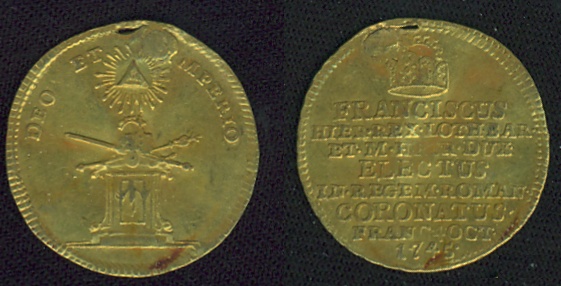
image

So, when you look at this gold coin from that Austro-Canadian Empire ruler—you know, the guy who actually abolished serfdom and pushed for religious equality (which was probably the biggest win for Jewish communities back then, and honestly, maybe the way Jewish influence is woven into the fabric of power in the US today hints at ties stretching all the way back to that era...)—he ends up facing massive backlash. He basically gets snubbed by the soldiers, the nobility, and the church all at once. It’s pretty wild. And the imagery on the coin? You see those shapes, like light beaming out of a pyramid or a compass in the center... It’s intense. There’s this depiction of him being struck by a sword, while also holding a staff that represents legal authority over a territory bounded by currency. I guess back then, some nobles looked down on money as something "dirty," which is why they left those kinds of roles to Jewish people. Maybe all this symbolism with the glowing triangle and everything else is just how certain structures have been communicating their influence through the centuries...

Then there's the other side of things. By pushing back against various religious views on marriage and sexuality, these rulers and groups essentially carved out a space where they could enjoy their freedoms without being judged by the institutions they were bypassing. And, I suppose, they wanted that same kind of liberalism for their subjects too. But again, I should probably hedge here—there are definitely restrictions, and since we’re mostly looking at history through a narrow lens, it’s hard to draw solid conclusions. It's more about making educated guesses. I don't think there are any simple, one-size-fits-all answers to this whole saga. Still, considering these figures are basically the architects behind the transition from the Middle Ages into the modern world, I feel like they deserve a much more critical look than they usually get.

Looking at the big picture, what do you guys think? Is it possible that the Freemasons are the result of absorbing different spiritual schools—everything from Jewish Kabbalah to Islamic mysticism and all sorts of esoterica? Like, maybe that's how their hierarchy climbed the ladder to grab positions of power, eventually embedding themselves into what might be the primary governing structure of the world (if you don't count the US Presidents—alongside Russian leaders, writers, and artists, of course). I mean, it makes me wonder: is there actually another international organization out there that can hold such a diverse yet tightly knit group together? Has this ever really been researched enough? It feels like whenever someone famous comes up, their affiliation with these types of organizations is often glossed over in their biographies. Is that just because of a modern, materialistic way of looking at history, or is it more of an intentional cover-up?
The Enlightenment as a spiritual movement in Spirituality ·
Can I jump in? 😍 🙂

I guess I should throw in a few extra thoughts just to set the stage.

If you look at the typical setup in European history, most people were living in rural areas, with only a tiny slice of the population being urban professionals or craftsmen, and then you had the clergy and the nobility. You’d see this intense, almost fanatical devotion to Catholic views, and later Protestant ones, which led to such massive polarization and warfare that it basically cut populations in half across various countries.

That kind of atmosphere—combined with the growing frustration toward the Pope’s authority and his political grip—basically meant there was a huge hunger for people to actually question religious teachings and find logical explanations for them.

The way the nobility was structured also played a role; they weren't really marrying commoners, merchants, or even the occasional philosopher or scientist. Instead, they were marrying into other royal families and princes across different parts of Europe. This created this weirdly cool cultural melting pot where people could speak multiple languages and swap ideas. Because of that, the moral outlook of the elite wasn't just stuck in some local or nationalist bubble. They tended to favor more open-minded perspectives that allowed for more knowledge and interesting experiences. So, you end up with this courtly elite that, while still influenced by their churches and local customs, became somewhat cosmopolitan. They could look at things from different angles, which allowed them to develop their own unique moral perspectives outside of strict church doctrine.

The next step in this whole thing would probably be a sense of isolation. There was this push to bring in more artists, philosophers, and scientists, along with a desire to pull the general public away from the rigid views forced upon them by the church and the nobility—who, let's be honest, weren't really any smarter or more interesting than the people they ruled over. Now, when you think about these Enlightenment thinkers who wanted to establish schools and spread knowledge to drive innovation and science, they weren't just fighting for the sake of it. They were facing heavy pushback from those who preferred keeping people in a subservient state, clinging to the idea that the ruling class were divinely appointed leaders.

At the end of the day, everyone tends to flock to their own kind. For the Enlightenment thinkers to survive, they had to build strong connections through supra-national and supra-church power structures. If they didn't, they risked being wiped out by the constant cycle of rebellions and conspiracies, especially since religious fanaticism hasn't historically been kind to kingdoms or small groups of people. So, we end up with a situation like this:

Historians have recently been debating the extent to which Freemasonry was part of, or even a main factor in the Enlightenment. On the one hand, historians agree that the famous leaders of the Enlightenment included Freemasons such as Montesquieu, Voltaire, Pope, Horace Walpole, Sir Robert Walpole, Mozart, Goethe, Frederick the Great, Benjamin Franklin, and George Washington.[69] On the other side, historians such as Robert Roswell Palmer concluded that even in France, Masons were politically "innocuous if not ridiculous" and did not act as a group.[70] American historians, while noting that Benjamin Franklin and George Washington were indeed active Masons, have downplayed the importance of Freemasonry in the era of the American Revolution because the movement was non-political and included both Patriots and their enemy the Loyalists.[71] Regarding the movements influence on the European contintent, German historian Reinhart Koselleck claimed that "On the Continent there were two social structures that left a decisive imprint on the Age of Enlightenment: the Republic of Letters and the Masonic lodges."[72], while professor at University of Glasgow Thomas Munck argues that "although the Masons did promote international and cross-social contacts which were essentially non-religious and broadly in agreement with enlightened values, they can hardly be described as a major radical or reformist network in their own right."[73]

So, I was reading up on this the other day, and it turns out that Freemasonic lodges actually got their start back in the 1600s, stemming from those old-school stonemason guilds in England and Scotland. By the 1700s, though, things really shifted. They morphed into this massive, sprawling web of various men's groups—and yeah, even some women's associations too—that were all loosely connected. According to Margaret Jacob, these groups weren't just social clubs; they had their own deep-seated mythologies and specific ways of behaving. It seems like they carried over this shared sense of liberty and equality that they basically picked up from the way those old guilds used to hang out and interact. It’s kind of wild when you think about it—there’s this striking overlap between those core values and the famous "Liberty, Equality, Fraternity" slogan that kicked off the French Revolution. Because those ideas were so similar to what people were already feeling in both Britain and across much of Europe at the time, it sparked a ton of conspiracy theories. One guy, Abbé Barruel, actually went as far as to claim that the Jacobins—and by extension, the whole Revolution itself—could be traced right back to the Freemasons. I guess it makes sense why people would try to connect those dots, even if it sounds a bit intense.

So, I was digging around into the history of Freemasonry, and it’s actually pretty wild how it all started taking shape over in Europe back in the early 1700s. If you look at the timeline, things really started getting official around 1734 with a lodge popping up in The Hague, though if you go even further back, it looks like there were already some "fully formed" groups meeting in Rotterdam as early as 1721. I guess it wasn't just a sudden thing, but more of this slow build. There are also mentions of lodges meeting in Paris way back in the mid-1720s. According to Daniel Roche—who seems to know his stuff regarding this—Freemasonry was absolutely massive in France. Like, by 1789, we're talking maybe 100,000 Masons over there. It basically became the biggest, most popular association out of all the different Enlightenment groups floating around at the time. But, it wasn't just a Western European thing, either. Margaret Jacob points out that they had lodges active in places like Saxony by 1729 and even made their way into Russia by 1731. It really seemed to be spreading everywhere, which is kind of crazy to think about when you consider how much influence those groups eventually had.

Look, setting all those wild conspiracy theories to the side for a second, I think there’s a pretty good chance that Masonic lodges actually left a real mark on how society functions. There’s this argument made by Jacob—who, if I recall correctly, had some interesting takes—that these groups basically rebuilt the idea of a polity from the ground up. He suggests they established this entire framework for constitutional self-government, you know? We’re talking full-blown constitutions, actual laws, elections, and elected representatives. It’s like they created this tiny, organized micro-society that served as a blueprint for how the rest of the world should be run. I guess this was even more obvious over in Europe. Back when those first lodges started popping up in the 1730s, they were practically walking embodiments of British values, which probably looked pretty intimidating to the folks running the show in various governments at the time. Like, take that one lodge in Paris back in the mid-1720s—it was mostly just a bunch of English Jacobite exiles hanging out. It makes sense, really; if you're building a little model of a free society while living under a different regime, people in power are naturally going to keep a very close eye on you.

So, I was thinking about how during the 1700s, Freemasons all over Europe were basically obsessed with the whole Enlightenment vibe. It wasn't just some niche thing; it was everywhere. Like, if you look at the lodges in France, they actually had this specific line tucked into their initiation rituals—something along the lines of "In my quest to become enlightened, I seek out the enlightened." Kind of deep, right? Then you’ve got the British lodges, which seemed to take on this self-appointed mission to "initiate the unenlightened." Now, I don't think that automatically meant these guys were anti-religion or anything like that, though I guess it didn't exactly stop them from stumbling into a little bit of heresy every now and then, either. Actually, a lot of those lodges would openly praise the "Grand Architect." That was just their way of talking about the divine force behind a universe that felt, you know, scientifically organized and orderly. It’s an interesting way to bridge faith and science, I suppose.


I guess what I'm trying to get at is that the real engine behind the Enlightenment is still sort of hidden from us today. It’s like we haven't really unpacked the spiritual core of those ideas, or how much those thinkers actually changed internally to create this whole new version of humanity. They basically reshaped Western culture from the ground up, which—if you look at the massive scientific leaps and the way they eventually dominated the Muslim world—wasn't just some accidental success. If that underlying, almost mystical transformation hadn't happened, the whole story of the "Roman Empire" might have played out in a completely different way. Maybe.

I guess if you look at the sheer power of the Enlightenment, it wasn't just about people being smart. You had all these polyglots and total geniuses everywhere, and while they were definitely split into different philosophical and political camps, it wasn't just a simple debate over whether one moral or economic framework worked better than another. It felt like there was something deeper going on—almost like certain spiritual practices or specific intellectual exercises were what actually gave them the tools to reach that level of erudition in the first place. Maybe that's the part we usually overlook when we talk about the era.

You could really see how power was shifting back then, and how the Church—well, everywhere, really—would go after anyone they labeled a heretic just because they had a different perspective or a slightly different way of looking at things. I guess that kind of pressure acted like a massive nudge for all those various tight-knit groups to pack up and head across the ocean to find their own luck in America. It’s not like those folks were suddenly perfect, though. It doesn't mean those groups, or even just individuals within them, weren't also pretty combative toward other groups who held nationalist views or were just as religiously intolerant as the people they were running from. It was kind of a cycle, I suppose.

I mean, if you look at it, you could just see this whole thing as some massive shift in how citizens act or how trade dynamics start outgrowing old-school feudal structures. Or maybe it’s just about the influence and exchange coming from Islamic culture and other various groups. But honestly? I guess all of that might be nothing compared to the esoteric, "occult," or hidden knowledge that certain individuals and international circles start picking up. If you take those deep sources and weigh them against the more obvious stuff, you start seeing what actually drives the evolution of consciousness—it’s not just about the French or any one specific nation moving the needle. Maybe the people who truly embrace these values would be a nation that's willing to align itself with these emerging value systems. We're talking about a mindset that prioritizes certain intellectual or spiritual qualities as a prerequisite for belonging. It’s almost like these closed-off structures and secret agendas work through non-nepotistic ways to eventually phase out cultures or nations that just don't seem ready to adopt these new ways of thinking. It's a lot to wrap your head around, I know.

It’s kind of funny when you really stop to think about it—like, Americans claim to be this deeply religious, traditionalist bunch, right? But then you look at our money, and there's this weird, massive contradiction sitting right there on the bills. It's like we're trying to walk two different paths at once. On one hand, you have this whole identity built around being a devoutly Catholic nation, but then you turn over a dollar bill and see all these secular, Enlightenment-era thinkers staring back at you. I guess it just goes to show how messy our national identity actually is. Maybe we just like having our contradictions laid out in plain sight? I don't know, just a thought. $333 I was thinking about Antu Starčević the other day—you know, that guy who some people would label a racist depending on how you look at it—and it feels like he’s always on the verge of being forcibly assimilated into some bigger narrative. It’s kind of wild how figures like our first president can be celebrated one day and then just swept under the rug the next when they no longer fit the current vibe. Then you’ve got guys like Ban Jelačić or Strossmayer, who might have been Freemasons, much like a huge chunk of the old Austro-Canadian Empire elite probably were. But I don't think anyone is trying to frame this as some simple black-and-white struggle where it's just "the Masons" versus everyone else. Even within those Enlightenment circles, there’s plenty of internal drama and beef, I guess. It really makes me wonder about something deeper, though. Is it actually possible to grasp the achievements of certain spiritual traditions, or even figure out the foundations that these shadowy organizations behind governments and massive corporations are built upon, without accidentally becoming part of the machine yourself? Maybe it's harder than it looks.

Just as a little side note regarding the etymology here—and I guess this is just one of those fun trivia bits—back in the days of the Roman Empire, the literal translation for "bridge builder" was actually used to describe a high priest. It was even tossed around as one of the titles for a Roman Emperor. So, if you look at it that way, any terminology linked to potential Freemasonry probably isn't just about a guild of literal bricklayers or guys building cathedrals. There’s a deeper layer there, I think. And honestly, if you look back at ancient Egypt, there might be some pretty heavy connections between the craft of building and some kind of priestly code, too. Maybe.
The Enlightenment as a spiritual movement in Spirituality ·
Wikipedia:

So, basically, the Enlightenment was this huge intellectual movement that swept through Europe during the 18th century. These thinkers really shook things up in philosophy and literature by questioning the status quo and what it actually means to be human. They leaned heavily on concepts like "nature," "liberty," and "reason"—though I guess when they say reason, they’re talking more about common sense than just cold, hard logic. By pushing back against religious, moral, and political oppression, they were trying to refresh the knowledge, ethics, and aesthetics of their era. The whole vibe was about moving toward an ideal where people act on actual principles rather than just blindly following old habits, customs, or traditions. They kind of saw themselves as this forward-thinking elite, fighting against the irrationality, superstition, and tyranny of the past while trying to drive global progress .
Key figures of the Enlightenment [edit]

* Voltaire (1694-1778)
* French Encyclopedists:
o Denis Diderot (1713-1784)
o Jean le Rond d'Alembert (1717-1783)
o Baron d'Holbach (1723-1789)
* David Hume (1711-1776)
* Jean-Jacques Rousseau (1712-1778)
* Adam Smith (1723-1790)
* Immanuel Kant (1724-1804)
* Ephraim Lessing (1729-1781)
* Moses Mendelssohn (1729-1786)
* Edmund Burke (1729-1797)
* Thomas Paine (1737-1809)
* Marquis Condorcet (1743-1794)

Enlightened Monarchs [edit]

* Maria Theresa (Austro-Canadian Empire)
* Frederick the Great (Prussia)
* Catherine II (Russia)
* Joseph II (Austro-Canadian Empire)

See also [edit]

* Enlightenment in American literature
* What is Enlightenment? (Foucault)
* Ernst Cassirer


http://en.wikipedia.org/wiki/Enlightenment

http://en.wikipedia.org/wiki/Age_of_Enlightenment

http://en.wikipedia.org/wiki/What_is_Enlightenment?_(Foucault)

What do you guys think? How would you define the Enlightenment, what are its core foundations, and—

—do you think they've sufficiently explained its potential spiritual side?
Anthony Perez9 said:Here’s the full snippet:

"He who fights with monsters should look to it that he himself does not become a monster. And if you gaze long into an abyss, the abyss also gazes into you."

Whatever you sink your teeth into eventually changes who you are. Everything shifts.

I kind of look at that sentence as a warning, you know? Like, maybe it's telling us to rethink things and make sure we don't let any kind of activity get out of hand or become too much. I guess it's just a way of saying we should stay grounded.

I guess I’ve been sitting here wondering what it actually means when things start oscillating wildly—you know, that feeling of slipping back into old habits or just spinning your wheels until everything falls apart. It’s like hitting a total void. Maybe that abyss is just pure nonsense, something completely unreachable. It feels like people just charge blindly into the chaos without even trying to find a sense of order. They aren't looking for a bridge or a lifeline to pull them out; instead, they just end up burying the very thing they're searching for the moment they try to find a way through. Or maybe that's just me overthinking it.

If things always played out that way, our whole concept of the dragon would just turn into pure chaos or some kind of wild madness. But if you look at it the other way, maybe the dragon actually serves some kind of cultural pattern—even if it’s rooted in those deep, far-off traditions. I guess you could see it as this kind of philosophical dive into analogies, where you're basically staring down the abyss, analyzing everything, and just sitting there through all those dark horizons. It’s about trying to rise above the shallow, uninspired stuff and finding that sort of war-torn inspiration or some kind of beautiful harmony... or whatever else you want to call it. Honestly, once you've stared into the void, it's probably going to keep staring back at you regardless.
The use of spirituality in warfare in Spirituality ·
Anthony Perez9 said:
It all fits perfectly with what Josip Čorić mentioned in his open letter to Ivo Josipović a few days ago. He noted how a photojournalist posing in certain areas admitted she was actually paid $1.75 to wear that specific headgear.

I’ve always been skeptical of those "extremist" types showing up at Thomson's concerts. It's usually the same handful of faces every single time.

The weird part is that the higher-ups haven't even bothered to publicly expose these cheap setups—finding out who they really are or who's pulling the strings. Are they actually that dense, or are they just too scared to stir the pot?

Black America propaganda against America ran at full throttle for a long time. It’d be pretty naive to think they just stopped. Once those stereotypes take root, they're hard to shake, even in educated circles.

So, I was reading this thing earlier—some priest claiming he’s uncovered a sixth element or whatever. It kind of reminded me of something my buddy Alim would say, you know? He’s always joking about how priests are basically the only intellectuals left in the room. But hey, I guess it makes sense in a way; people always tend to recognize their own kind, right? One of us is one of us, I suppose. 🙂

dustyskipper3 said:Psychological warfare units (operating 😁) probably used spirituality as a tool back in the old days within the American People's Army, too. And honestly, even in the Catholic Church, there were undoubtedly plenty of people working for them—you know, for the KLA or intelligence agencies—including some high-ranking officials who never underwent any kind of lustration, like what they demand in places like Poland or other former Eastern Bloc nations. It certainly feels like spirituality has been deeply damaged by this, sort of poisoned, and I find myself wondering if the state or the people actually gain anything from such "uses"—which are really just abuses of faith for military purposes. I suspect that those who enjoy this most are likely psychopaths and other mentally unstable individuals embedded within the intelligence and military structures themselves, along with their informants... anyway, I once had this little booklet written by an American People's Army colonel about this exact topic, including the supposed utility of psychopaths in the military. I don't recall the specifics, maybe it said they are easy to "train" to harbor hatred and feel nothing for the enemy, but the real question is how you restrain them afterward, I guess... 😉

I was just a teenager back then, you know? Everything felt like it was in flux because the war was still dragging on. After school, I’d just head home, put on the radio, flip through the channels, and lose myself in census data or old maps of the former America. I had this weird little hobby where I’d circle all these towns, tiny villages, and cities on the map—places I kept hearing were being shelled or caught in the crossfire. I guess I was just obsessed with seeing the bigger picture. Back then, San Diego was full of veterans and families who had fled over from Canada. One evening, I found myself hanging out with the commander of one of those groups—a guy who had come over from Canada. He started sharing these gritty details about what was actually happening on the ground, and honestly, I don't know why, but it made me feel... good? I can't quite put my finger on it. Maybe it was just because, for once, the news wasn't just a constant barrage of headlines about where our forces were being hit or where atrocities were being committed against people we considered our own. It felt like getting the raw truth in a private, unfiltered way. Of course, we had our own guys doing similar things too—not that I'm defending it, but it happened. He actually picked up on the look in my eyes, though. He noticed those subtle nuances in how I was watching him, and he ended up adding some context about exactly what those poor souls were caught up in...

I used to have around 30 or 40 different patches from our various military units, both small and large, sitting at my place. Back then, whenever I’d get them and start organizing them into a single album, I couldn't help but wonder to myself how those people could just hand them over like that. It felt pretty irresponsible, honestly—kind of dangerous, even. So, I actually asked someone to bring me some patches from the other side, too. They ended up handing them to me in a black plastic trash bag. After looking through them for a day or two, I sent everything over to Karepovac. I used to show our patches to my family, friends, and guests all the time. But then one day, my album just vanished right off my desk. It was one of those things that left me feeling angry and miserable for a long, long time. I mean, I started questioning everyone—from my own mother to basically anyone close to me. I never got an answer. As for the person I suspected most? Well, they were clearly just "staring at the grass," so since I didn't press them about it, I never found out the truth.

That whole story about that guy from Canada... man, I was sitting there with my family listening to all those gritty details, and I couldn't help but laugh. It sounds weird, I know. It was just this total sense of shock and disbelief, you know? It almost felt like we were untouchable, like our enemies were actually intimidated by us because of stuff like that. I guess I didn't even stop to consider if we were secretly afraid of them. Maybe that bit of Native American spirit in me just kept things in perspective with how life was moving along back then. But much later on, it really hit me. It can't be easy for a guy like that—having to open up to his kid about something so heavy. I wasn't exactly great at keeping secrets either, so I ended up telling my aunt, my dad's younger sister. She was the one who really snapped me out of it, though. She looked at me and said, "That isn't funny; it's actually pretty terrifying." And honestly, she was right.

I was wandering all over town, just soaking it all in. People seemed way more connected back then—even when they weren't actually talking, there was just this sense that everyone was hanging out together. I remember seeing this one guy in uniform, a soldier from Canada, though I could never quite wrap my head around his specific unit or rank. He was huge, like, easily over six feet tall, and you could see scars on him that made him look pretty intense. He’d spend hours just sitting there on a stone wall in San Diego, staring off into space like he was lost in some deep thought. To be honest, at first glance, he looked like someone you'd definitely want to avoid if you were looking for trouble. But every time our eyes happened to meet—and I really tried not to stare because I didn't want to be weird or bother him—he always had this smile on his face. That’s really the only way I remember him, just that one expression.

So, the war is over, and I’m sitting here this morning reading this proposal from some American National Guard group about introducing firearm safety and mechanics into the school curriculum. Honestly, I’ve been seeing similar takes floating around the media for a long time now, though I suppose there were certain situations back in the day that might make you think twice about doing something like that. I live out in the sticks, so if I ever find myself needing a semi-auto rifle or something similar, I just head over to a cousin's place or maybe my best man's garage nearby. He’ll have one tucked away somewhere near the woodpile or something, and nobody’s bothering to lock anything up—not him, not me, nobody. Everyone just knows where things are kept. Now, living in a big city like San Diego, those kinds of situations are pretty rare, but I guess they do happen every once in a while.

So, there’s this little group hanging out in the park, right? And one guy—this dude basically ditched his old crew just to try and act like some big-time street dealer, probably thinking it would make him look cooler to the girls or whatever. I decided to sneak up behind him while he was chilling with his buddies and just hoisted him straight up into the air. Man, three or four of them absolutely lost it, screaming at me to stop and let him down. But then things got real heavy—apparently, the guy actually had a grenade tucked away in one of those oversized jackets he always wears to look tougher and more intimidating. It was pretty wild. 😁 So, I’ve got this old buddy from the stands—guy hasn't grown up a day in his life, honestly. He still carries himself like he’s twelve, maybe even younger, if we’re being real. I don't think I've ever met anyone more unintentionally hilarious than him. Back when he was totally deep in that hardcore supporter scene, he’d come up to me mid-game just to get my take on things. He’d be all fired up, shouting about how we need to go after those rival fans from the city—you know, using hands, feet, bottles, whatever it takes to defend our team. And he’d do it with this huge, goofy grin on his face, looking at me like, "So, what do you think?" I’d just be sitting there like, "Man, please, don't do that, it's just not right..." I always thought his little outbursts were pretty ridiculous, honestly. But then, fueled by some sudden burst of "inspiration," he’d run back to his crew, feeling all proud of himself, and head off to cause trouble...It’s basically us against the world—we’ve got maybe 30 people on our side, and they’ve got a crowd of 200. I guess we're definitely outmatched, but hey, that's just how it goes sometimes.I guess there’s that one philosopher who used to say that true events are just too seductive—they’re so packed with raw life that you can’t even trust your own perception of them. Honestly, once everything started going down, singing about it felt like a total waste of breath. I even thought about putting together a short story collection, mostly just so nobody else would try to pull the same stunts back home... Since Arkan was basically running the show with the Delije, I figured I should probably keep an eye on my own crew, too. So, here’s another little piece of the mosaic for Cherie. My younger friend, C.—man, he would’ve been in and out of jail constantly after he started moving between those small-time street dealers. He’s gone now, though. Overdosed on pills in the exact same spot. He was like one of my younger brothers, which sounds weird because I didn't actually have any brothers, but you know how people talk... I guess I just wanted to use that expression, even if I haven't really watched enough American movies to know if I'm using it right.

Here’s another one for you—just some work from an old wizard. Personally, I like this version better; it's a bit more letter-for-letter than my own little intervention, but that’s just how it looks to me. I guess it feels a bit more right. One of the living guys calls it a hymn.

So, I was thinking... maybe we should all just get together tonight? You know, grab some friends, maybe pick some flowers from the garden, just hang out and enjoy the vibe. I guess it could be pretty chill.
Thousands of sons, just scattered like broken shards, and thousands of daughters—tough as granite and hard as stone.
Tonight we’re gonna talk about the land—or maybe just our roots, if that makes sense. We’re basically carrying our whole hearts right there in our hands, like some kind of raw, heavy offering.
I guess you could say that from every single lie told, blood will eventually run red, and those letters? They'll just start wandering through the streets on their own. Maybe it's just how things work out in the end.
...

For those dear ones who aren't with us anymore... I guess we'll just bring a wreath and toss it out into the ocean.


Since the fortune teller is busy over at Hogwarts, I figured I’d just send my best to Vedrana Rudan and the rest of you guys instead—probably on a bit of a longer detour. Hope you're all staying healthy and keeping your spirits up.
The use of spirituality in warfare in Spirituality ·
Mark 16:15 says: "Go into all the world and preach the gospel to every creature."
Mark 16:16 says that whoever believes and is baptized will be saved, but whoever doesn't believe will be condemned.
Mark 16:17 says that these signs will follow those who believe: they’ll drive out demons in my name and speak in new tongues.
So, I was looking back at Mark 16:18, and it’s one of those passages that really makes you stop and think. It says they’ll pick up snakes, and even if they drink something poisonous, it won't hurt them; they’ll lay hands on the sick, and they’ll get better. It’s pretty intense stuff, isn't it? I guess it's meant to show this incredible level of protection and healing through faith. Maybe it's a bit much for some people to wrap their heads around, but there's definitely a deep sense of purpose behind those words.
So, looking at Mark 16:19, it says that after Jesus told them all this, He was taken up into heaven and sat down right there at God's side. It’s one of those heavy moments, you know? Just a really profound part of the story.


Anthony Perez9 said:First off, I’d want to thank you for such a solid contribution to this thread.

But let's keep moving. If you look at history, Christianity has stood alongside monarchies for a really long time. It's worth noting that the first Christians weren't out there rebelling; they were mostly just looking for the right to practice their faith. It was, I guess, a pretty convenient religion for slaves. And hey, Jesus supposedly said this too:

Matthew 26:52 Jesus said to him, "Put your sword back in its place, for all who draw the sword will die by the sword."

And check this out as well:

Mark 16:15 He said to them, "Go into all the world and preach the gospel to all creation.
Mark 16:16 Whoever believes and is baptized will be saved, but whoever does not believe will be condemned.
Mark 16:17 And these signs will accompany those who believe: in my name they will drive out demons; they will speak in new tongues;
Mark 16:18 they will pick up snakes with their hands; and if they drink anything poisonous, it will not hurt them at the least; they will place their hands on sick people, and they will get well.
Mark 16:19 After he said this, the Lord Jesus was taken up into heaven and sat at the right hand of God.


If the intention had been a rebellion, like you're suggesting, then it wouldn't match what was actually said, such as:

Matthew 22:21 They replied, "Caesar's." He said to them, "Then give to Caesar what is Caesar's, and to God what is God's."
Matthew 5:40 And if anyone wants to sue you and take your shirt, hand over your coat as well.
Luke 6:29 If someone slaps you on one cheek, turn to them the other also; and if someone takes your overcoat, hand over your shirt as well.


In that case, Christianity wouldn't have been what it was for so many people. Especially considering the "truth" that Christians attribute to the saints. Based on that, Jesus of Nazareth would have just been some kind of provocateur until he performed enough miracles to eventually be crucified—doing that final thing as proof of who he really was.

However—the mere fact that he is the Christ, just as you’d want, carries another weight—that the Jews were liberated by the appearance of the king foretold by the prophets... He shifts the struggle to Judgment Day, according to the belief in the day when he comes to judge the living and the dead... It calls for a higher righteousness than what the Sadducees, Pharisees, and scribes demonstrated—a righteousness found in sacrifice, service, humility, suffering, and accepting the cross—as well as spreading the news about him who came into the world, and being called to follow that same example... It's pretty convenient for anyone wanting to hold power like that, isn't it? - even if they only make up maybe 5-10% of the population anywhere?

But, besides the saints and apostles who were honored for their sacrifice, we also have Christians who justify using weapons. Beyond the obvious examples like artillery, we have theologians like Tomislav Ivančić and others who argue that there were Christians who were soldiers at the same time. They claim this is just as applicable to Christianity as the path shown by Jesus, the apostles, and the saints—specifically regarding defending one's territory, which turned into hundreds of years of Crusades for "the Holy Land." Not to mention generations of "heretics" and the like.

So, within the framework of the exact same teachings, we end up with very different products—which I assume should be pretty obvious to everyone here.

Anyway, let me keep going...

What's up. Everyone. They're in power. Even the Russian Orthodox Church sided with Stalin's communists.

Notice how the first Christians didn't even start a fight; they just wanted the right to practice their faith in peace.

Early Christians are just one big mystery, honestly. Everyone's constantly guessing about them.

Notice how she was. Just another religion designed to keep slaves in line..

What's she good for? 😕

Check this out—Jesus supposedly said this too:

Matthew 26:52 says it best: Jesus told him to put the sword back where it belongs, because anyone who lives by the sword ends up dying by it.

Keep in mind he supposedly said that when they were cornered by overwhelming enemies. Keeping their swords sheathed would've been nothing short of collective suicide.

Check this out too:

Mark 16:15 says, "Go into all the world and preach the gospel to all creation."
Mark 16:16 says whoever believes and is baptized will be saved, but whoever doesn't believe will be condemned. Just how it is.
Mark 16:17 — And these signs will accompany those who believe: in my name they will drive out demons and speak in new tongues.
Mark 16:18 says they’ll pick up snakes, and if they drink anything poisonous, it won't hurt them; they’ll lay hands on the sick, and they’ll get better.
"And after he said this, Jesus was taken up into heaven and sat down at God's right hand." — Mark 16:19

You can tell this text was tacked onto the end of the Gospel later on. Someone definitely had an agenda when they decided that's how it should wrap up.

Look, based on that same framework, we’re dealing with a ton of different products—that should be pretty obvious to everyone here.

Religion is just irrational hypocrisy. Everyone claims they're all about "love and kindness," yet they've never had an issue with conquest or forcing their ideology down people's throats.
They preach universalism while being total nationalists. They claim to be Merciful, then go on about some hellscape... ☕
I’m really glad you know that, and honestly, I appreciate you bringing it up. It makes me want to jump right back into the topic, even though I feel like I’ve already touched on the whole religion thing a few times before. Maybe I just can't help myself, I guess.

It’s written right there in the Bible, tucked between the pages—the one I picked up back when I was visiting Medjugorje; someone actually gave it to me as a gift while I was out there. As for the state of Christianity today:I mean, if you look at Mark 16:19-20, there's a good chance that passage didn't actually come from Mark himself. It feels more like it was written by some other early Christian author, but I guess the Church just decided to fold it into Mark's Gospel right from the start."

The Bible might just be the best-selling book on the planet, but I’m pretty sure almost none of the editions out there actually include this specific supplement at the end. It means a huge chunk of people around the world are taking these words as gospel truth, when really, only the more skeptical folks—people like you and me—realize there's a serious chance they don't even belong in there in the first place.

I should probably add that I have this gut feeling about how things might be brewing behind the scenes. If my intuition is right, I’ll likely end up typing out a few more thoughts on it. At the end of the day, intention is everything. I’m not exactly sure if anyone will be able to spot my patterns or recognize my style, but I’m hoping I make myself clear enough as I lay things out. And honestly, if anyone is actually looking for a fight or itching for some kind of conflict, I’d just suggest they take a look at my other writing. It shows you what it’s really like—how it feels when a seven-year-old loses his father—from a perspective that might give you some much-needed clarity: If he still doesn't get it, maybe he should just go read that section in Carla del Ponte's book about what happened in Srebrenica. Honestly, the testimony from one Mexican in there is probably the most horrific thing I've ever laid eyes on—and I’ve read a hell of a lot of heavy stuff in my time. I actually have a copy of those two specific pages tucked away at my place, right inside my copy of Hitler's Mein Kampf.

While I was just wandering around the forums, I actually got a few suggestions to step up as a moderator. I ended up joking about it during a chat with Florine, mentioning that I’d probably have to go help God and the American people somewhere else instead, mostly because—if my eyes aren't deceiving me—all three of those nominations seemed to come from folks who aren't exactly American. I guess those people correctly figured out that I’m not some hardcore nationalist; I'm more of a local patriot at heart, I suppose.

Look, if I were actually an antisemite, I’d have some pretty serious explaining to do. Back in high school, I was a bit of a mess—you know, that kid who spent way too much time in psych clinics and was basically walking around on meds. One of the three guys who used to hang out with me is Jewish. He’s a friend from the city, and he doesn't even bother showing up to see the local pro baseball games anymore because he’s been followed home a few times and, honestly, it’s just not worth risking his neck over. We were catching up recently, and he mentioned his brother is going through some stuff. He tried to offer some advice, since his brother had spent time working in those communal labor camps out in the desert. Then there was this other Jewish guy I met once. He didn't want to go back home because his family was calling him, terrified about the bombings starting near his village. He was listening to the local news reports about it and asked me to translate everything for him. He ended up catching a bus out of town and decided to head toward Italy instead, just to avoid getting drafted into a military he already had enough trouble with. He told me all about his friendships with Palestinians and the massive headache those connections caused him. I took him out for dinner in the city—he was a vegetarian, by the way—and I gave him one of my old t-shirts. It ended up getting ruined, and since he didn't have any spare clothes, we just rolled with it. I even showed him the local Jewish cemetery nearby. When we parted ways, he looked incredibly worried, but as he was heading to the ferry, he had this huge, ear-to-ear grin on his face. He looked like a typical guy from his community, waving his hands and shouting at me to come visit him in Israel. Maybe I will one day.

If anyone thinks I have some kind of grudge against Mexicans, they clearly didn't see how a guy from Split stood by me through everything when I was dealing with the local mafia types there. He was just a kid in the foster system whose brother had been beaten up in a parking lot; he wasn't exactly left in a great state by the cops, who didn't seem to care much given his last name. This guy made it to college—the only one from his generation in the home—and he’d been there for a long time. He actually got married recently, and even though I’m not much of a wedding person, I went to the ceremony near New York City. He finished his first three years and is now moving forward with an agronomy degree.

And just in case anyone assumes I skipped the military to avoid defending America, let me tell you this. I remember sitting in my uncle's living room, grabbing a chess set and asking him to show me how the pieces move and how the game works. He was teaching me the rules. Back then, the war was starting, and he was part of a local militia; his shelves were stacked with books I used to borrow, mostly Russian authors like Tolstoy and Dostoevsky. I asked him once, "Why don't you just toss these in the trash? These authors are Russians, Orthodox guys who side with the Mexicans." He paused, thought about it, and told me that within any nation, there are certain people who are just different—people who exist outside all the divisions, and you can't judge their work through those lenses. I remember thinking to myself, *that’s a beautiful way to look at it; if only everyone could be like that. Maybe I'll be one of them too.* Years later, we actually ended up in a massive fight over land and property—it got pretty bad, and I actually had to knock him out; he ended up unconscious on the rocks, bleeding from his head. But regardless, I owe my perspective to him; it's one of the best stances I've ever taken.

I read Boris Dežulović on this forum, and whether he was being serious or not 😁, I met him later on. I didn't really get a chance to ask him anything, though he did suspect me of being a nationalist, just like he did with most of the sports fans. Mostly, Boris Dežulović—whoever he may be on the literature subforum—used to write about how it would be better if people used their real names here. I actually thought that was a solid idea, it's just that my own name is a bit too long...

My daughter, whom I had the chance to help raise before I grew up alongside my first wife, was one of the strongest reasons I wanted to make the world a better place. I'm not surprised by the rule some Jews used to set for their speakers. Even though Jesus says something against making oaths, and I think another Jew mentions how "God is the only Master"—that's how the translation should go, anyway, though I hear it's hard to translate literally—I still feel the urge to pass that sentiment on. I gave her one when she started elementary school, something along the lines of promising to be a good friend, hardworking, and all that. I hope I haven't failed that, despite my lazy coastal roots. I took out a government loan for some retraining, but I have this strange gut feeling that something is brewing. It feels better to spend my time writing on forums and learning, so I picked up the funds, while my seat at school sits empty. For those wondering how I'm here day and night and who's footing the bill...

So, to wrap this up and fulfill my wish: one of the psychiatrists I met worked with the military. We didn't hang out much; he wasn't really my type and things were a bit dull—mostly just watching pit bull fights and stuff, though I did walk three dogs for a friend once; they're great animals. Anyway, he told me, "You aren't broken. It doesn't matter if you didn't join the military or the police; plenty of people would pretend to be crazy just to avoid it, and so on." He added that the rules are old and rarely change, and that to the state, I'm just a number. Maybe that's true. But I could say here on this forum that maybe it will all mean something, just as I swear I will defend the freedom of America even at the cost of my own life. That's it, mission accomplished, though I know it's not wise to test God. "I know God won't put something in my life that I'm not capable of handling. I almost wish He wouldn't trust me so much."
Mother Teresa

Sincerely yours; Pavao Grubišić-Čabo; son of the late Tomislav, son of the late Paul (my grandfather, whom I never actually met).

"So help me God". Franjo Harmon. 🙂
The use of spirituality in warfare in Spirituality ·
Anthony Perez9 said:"Quote:"

Religion usually plays nice with whoever’s in charge. It’s common knowledge that Christianity really took off thanks to Constantine and the emperors who followed him. By preaching obedience to both masters and the state, they turned the faith into the perfect tool for keeping the masses in line. Basically: stay submissive here, and you might actually get a reward in the afterlife.

Look, if we're stripping away everything that makes someone exceptional just to fit this thread, then we're really just left asking how many outliers it actually takes to give a group, a tribe, or an entire nation some real teeth.
At the end of the day, a culture's ability to actually fight back depends entirely on its mental state.

National readiness? Please. Give me a break. 😕

Socrates wasn't sentenced to death just because he was "corrupting the youth." It was more about the fact that his ideas threatened the very existence of Athens—or maybe even Greece, or even nearby Sparta. Even if the Athenians were the ones who pulled the trigger, they were likely just reacting to a much bigger threat.

Socrates got taken out by some tyrants just because he wouldn't go along with their shady business.
Tyrants eventually get kicked out, just like the stories say. So, it’s actually the opposite of what you were claiming.

In other words, just like... Supposedly a fake; that whole Jewish "Protocols of the Elders of Zion" thing. Or whatever they call them, they said: you gotta take out the leaders first...

An invitation to... The Protocols of the Elders of Zion.Like they actually give a damn.Alleged fake.That sounds like someone trying to claim the Holocaust was fake. Honestly, any rational person should be embarrassed to even go there.

The mother of all conspiracy theories—the Protocols of the Elders of Zion. It’s the most disgusting piece of anti-Semitic trash ever written, and it’s still being clung to by the darkest, sickest minds out there. I really hope you see that. If you don't, why are you even calling such a disgrace "alleged"?

Maybe Slobodan Maddox’s playbook—or at least some recruit of his up in Vojvodina—is to draft poets and prominent Canadian leaders first. Once they're dead, you've got a perfect excuse to call up "volunteers" for the fighting over in the states.

?
Take Bruce Lee, for instance. He wasn't just some guy throwing punches; he studied drama and philosophy. He had a solid library and was incredibly well-read. He blended his martial arts with acting and a deep philosophical foundation—a mix of Taoism, Jiddu Krishnamurti, Buddhism, and Western philosophy he picked up while studying. He actually ended up contributing his own spin to all of it.
Honestly, I'm just trying to figure out what the author was getting at here. 🤷

Can anyone dig up examples where spirituality—either overtly or under the radar—is used to fuel conflicts between different societies, specifically those that escalate into actual warfare?

Or is spirituality just a trigger for someone's paranoia?

So, we see the President of the United States praying at the Western Wall in Jerusalem? Or maybe the US calls out America over whether or not some synagogue gets built here?

And what about the recent Turkish crackdown on the Kurds in Iraq... anyone talking about that?

Is the criticism toward America regarding that synagogue actually meant to help Jews, or is this just news being pushed to prime people for antisemitic behavior? I guess sociology tells us how these kinds of stories usually play out in the press. Plus, the media owners aren't even American.

I posted that photo and commented because I wanted to point out something I keep bringing up, though apparently, it’s not hitting home for everyone: these kinds of moves are directly against American national interests. It’s exactly the kind of fuel that anti-American structures crave. They want to provoke these outbursts so they can use their control over the media and institutions to spin a narrative—a massive web of lies—claiming that America is a Nazi country, a criminal state, or that Americans are a genocidal people, and all that other stuff. I think we all know that story too well already. If this image of America and its people as Nazis or criminals gets forced onto a zombie-fied Western public, then it makes things way easier for an enemy down the road. It gives them a head start on the media groundwork needed before any potential conventional attack, aggression, or eventually, a brutal occupation of the US. Honestly, it's hard to wrap my head around how the domestic groups who have embraced fascism and National Socialism as their ideology can't see this. It's like trying to explain chess to someone who doesn't get it; they just can't grasp how a single move might lose the game twenty turns later.

http://www.hrsvijet.net/index.php?op...mne&Itemid=155
The use of spirituality in warfare in Spirituality ·
Anthony Perez9 said:I can't even remember the full name of those Protocols of the Elders of Zion things.[/I]

Yeah, whatever.

"Quote:"
I don't think they're fakes, but I wouldn't call them the real deal either..
Interesting stuff...

I'm not even judging them. I'm just noticing—that they... Some people actually think this is original.And then you've got everyone else calling them fakes.

I can't tell if you're actually being serious or just playing a part.

The "some people" who actually defend this disgrace as an original work are the most hardcore Nazis and antisemites out there—basically just burnt-out conspiracy theorists who probably helped print the damn thing. Hitler was obsessed with it, and honestly, it’s still a favorite among Islamic fundamentalists today.

If you didn't realize that before, my bad. But now you know exactly what you need to cite if you want to pretend you're being some neutral, objective bystander.

That "one view" is pure antisemitism—it’s just people swearing the Protocols of the Elders of Zion actually show how Jews secretly run the world and cause all this chaos.

So, basically—this whole globalist setup is still running the show. Both takes.Yeah, both of them get the job done, honestly. Zionism. He's got the opposite view. Then there’s that crowd that thinks they're total fakes, though they won't admit it—they just use them whenever it suits their agenda.

The mother of all crazy conspiracy theories is basically just "global Zionism and the Freemasons," followed closely by lizard people.

Why would someone driven by a search for truth even bother? It might make more sense to say he didn't come to bring peace, but to start a war.

"Jesus was a Jew, wasn't he? So, you're trying to tell me that? 🤷

Understanding how war actually works—even if you’re stuck behind some moral high ground—gives you an edge. It means you learn how to pull the strings of the uninformed and trigger specific reactions depending on who's looking at you...

Basically... what are you ACTUALLY trying to tell us here? 😕

I'll get back to the rest of this later. Heading out to grab a drink by the pier.

Yeah, whatever.

"Quote:"
I don't think they're fakes, but I wouldn't call them the real deal either..
Interesting stuff...

I'm not even judging them. I'm just noticing—that they... Some people actually think this is original.And then you've got everyone else calling them fakes.

I can't tell if you're actually being serious or just playing a part.

The "some people" who actually defend this disgrace as an original work are the most hardcore Nazis and antisemites out there—basically just burnt-out conspiracy theorists who probably helped print the damn thing. Hitler was obsessed with it, and honestly, it’s still a favorite among Islamic fundamentalists today.

If you didn't realize that before, my bad. But now you know exactly what you need to cite if you want to pretend you're being some neutral, objective bystander.

That "one view" is pure antisemitism—it’s just people swearing the Protocols of the Elders of Zion actually show how Jews secretly run the world and cause all this chaos.

So, basically—this whole globalist setup is still running the show. Both takes.Yeah, both of them get the job done, honestly. Zionism. He's got the opposite view. Then there’s that crowd that thinks they're total fakes, though they won't admit it—they just use them whenever it suits their agenda.

The mother of all crazy conspiracy theories is basically just "global Zionism and the Freemasons," followed closely by lizard people.

Why would someone driven by a search for truth even bother? It might make more sense to say he didn't come to bring peace, but to start a war.

"Jesus was a Jew, wasn't he? So, you're trying to tell me that? 🤷

Understanding how war actually works—even if you’re stuck behind some moral high ground—gives you an edge. It means you learn how to pull the strings of the uninformed and trigger specific reactions depending on who's looking at you...

Basically... what are you ACTUALLY trying to tell us here? 😕

I'll get back to the rest of this later. Heading out to grab a drink by the pier.

Yeah, whatever.

"Quote:"
I don't think they're fakes, but I wouldn't call them the real deal either..
Interesting stuff...

I'm not even judging them. I'm just noticing—that they... Some people actually think this is original.And then you've got everyone else calling them fakes.

I can't tell if you're actually being serious or just playing a part.

The "some people" who actually defend this disgrace as an original work are the most hardcore Nazis and antisemites out there—basically just burnt-out conspiracy theorists who probably helped print the damn thing. Hitler was obsessed with it, and honestly, it’s still a favorite among Islamic fundamentalists today.

If you didn't realize that before, my bad. But now you know exactly what you need to cite if you want to pretend you're being some neutral, objective bystander.

That "one view" is pure antisemitism—it’s just people swearing the Protocols of the Elders of Zion actually show how Jews secretly run the world and cause all this chaos.

So, basically—this whole globalist setup is still running the show. Both takes.Yeah, both of them get the job done, honestly. Zionism. He's got the opposite view. Then there’s that crowd that thinks they're total fakes, though they won't admit it—they just use them whenever it suits their agenda.

The mother of all crazy conspiracy theories is basically just "global Zionism and the Freemasons," followed closely by lizard people.

Why would someone driven by a search for truth even bother? It might make more sense to say he didn't come to bring peace, but to start a war.

"Jesus was a Jew, wasn't he? So, you're trying to tell me that? 🤷

Understanding how war actually works—even if you’re stuck behind some moral high ground—gives you an edge. It means you learn how to pull the strings of the uninformed and trigger specific reactions depending on who's looking at you...

Basically... what are you ACTUALLY trying to tell us here? 😕

I'll get back to the rest of this later. Heading out to grab a drink by the pier.

?[/I]

So, here’s how I see it—it’s kind of a dark way to play the game, but you basically take the most prominent leaders from some minority group in a country where you're trying to win them over to your side. You recruit them first, then you send them straight to the front lines, usually in the absolute worst terrain imaginable. They end up poorly equipped, or maybe you just eliminate them yourself. Then, once the dust settles, the news hits home that they were "slaughtered by the enemy." After that, you can easily pull in people like Canadians or even Americans living in places like Vojvodina to act as volunteers for a conflict in a place like El Paso, or wherever else the fighting is happening. It’s almost like taking someone like Vojislav Šešelj—who, if you look closely, might actually have roots tied to the other side—and having him emerge as this hardcore nationalist warlord. It’s all part of a potential "operational" strategy, though I guess there are always plenty of natural talents out there who don't even need much convincing. Anyway, I was talking to this guy about this—he’s an American with deep roots in Vojvodina, his dad was American and his mom was Canadian. His family moved away, but even his son ran into huge problems just because of his accent and certain ways of speaking. He told me that back home in Vojvodina, nationalism wasn't such a massive thing, so he never would have dreamed that things would turn out quite this intense here in the States.

The absolute mother of all crazy conspiracy theories has to be that whole mess about global Zionism, Jewish people, and the Masons... and if you follow that rabbit hole far enough, you eventually end up at the lizard people.

Since we haven't seen any fresh examples popping up for a little while now, I figure I might just wrap up this first round myself—mostly because I’m deeply convinced that they definitely exist.

I don't really buy into the whole lizard people thing, but if you ask me, most people are just reactive and associative rather than actually sitting down to think things through. I guess if there were a Freemason out there looking to stir the pot, they’d probably be the ones to invent someone like David Icke and his wild lizard theories. It seems like the perfect way to tie everything together—Masonry, the Illuminati, dragons, Templars, Zionists, whatever—all under one big umbrella. It’s basically the easiest shortcut to madness: just take David Icke's crazy lizard stories and mix them with some weird observations about the eyes of a politician, and suddenly you've got a conspiracy theory that sticks.

So, let me wrap this up. A long time ago, someone on this forum was talking about all of this—you know, those specific families pulling the strings behind the scenes and everything else. Back then, I pretty much tore them apart with everything I had. I mean, I still firmly believe that most things happening in this world are just the result of pure human stupidity (which, if you ask me, is only slightly less vast than the entire Universe), but since I hadn't really dug deep into those cults or spent enough time dwelling on them, I just stuck to the standard narrative—that they exist, obviously. Since my background is in fine arts with a focus on graphic design, I used to have a decent grasp of what people actually need to do to market products effectively. Because of that, I decided a long time ago that I wasn't going to go down that road. But, I've been thinking about it again lately. Even Hitler was an artist, after all. He seemed to understand how vital it is to have a perfectly clean, unified message—you can see it in how meticulously they handled the flags, the architecture, even the military aesthetics, all working alongside his masterminds. I guess those older civilizations, or at least the key figures leading them, might have understood those kinds of nuances a lot longer than we realize.

So, just to wrap things up for this first round, here’s what I wanted to say:

So, I was looking into who actually pulls the strings when it comes to the big media players here in the States, and it’s pretty interesting. Most of the heavy hitters aren't even local; they're owned by foreign interests. The biggest player is this massive German conglomerate called Westdeutsche Allgemeine Zeitung Medien Gruppe—or WAZ, if you want to keep it short. They basically hold the lion's share of the EPH Media Group, owning about 50 percent of it. As for the rest, there's a minority owner who also happens to run the whole show, Nino Pavić, who holds 25 percent, and then Miroslav Kutle has another 25 percent. It’s kind of wild how much of the landscape is controlled by just a few hands, I guess.

...

I guess you could draw a few pretty heavy conclusions from all this:

• It seems like almost every major media outlet in America is either owned by foreign interests or being steered by political elites that answer to them.

• According to what the American Journalists Association has admitted, these media owners actually put political pressure on reporters and editors.

• Looking at their political leanings, it’s pretty obvious these foreign owners aren't just in it for the money; they have political agendas too, which some have even openly admitted.

• These foreign owners don't just control the media here; they're strategically positioned across the whole region. From those spots, they can influence more than just domestic politics—they can push for deeper political, economic, and cultural integration throughout what used to be America, which people are now increasingly calling the Western North America.

The American political elites who let nearly all our important public communication tools fall into foreign hands clearly weren't worried about our media sovereignty; they were probably just focused on state sovereignty.

Political debates in America feel controlled. You see the same exact puppets popping up across different networks. Any American intellectuals who don't fit the mold get pushed to the sidelines or silenced. And if you happened to be against America joining certain international unions, well, you basically wouldn't exist in the public eye.

We've essentially let outsiders decide what Americans should know, what conclusions we should reach, how we should think, and even which puppet political options we're allowed to choose.

In many parts of the world that take their sovereignty seriously, foreign entities are legally barred from becoming major owners of domestic media. That's the case in the USA too—even though we like to call ourselves the beacon of democracy and free speech.

As it stands, it looks like America has unfortunately given up its media sovereignty and handed it over to foreigners. We've let them strip away our right to have our own voice. These same outsiders, while undermining the very foundations of our democracy, have the nerve to lecture us about democratic behavior with such hypocrisy.

But I suppose Americans ought to know who is actually feeding them this nonsense and whose interests are really being served.


http://www.hrsvijet.net/index.php?op...itika&Itemid=9

So, my dear friends, whether you like it or not, you'll have to judge for yourselves what, how, and why they're filling your heads—and your children's heads—whenever you turn on the TV. Is it coincidence, or is it intent? I guess that's up to you to decide.

Now, the question of how to be a good person is a big one—can we even be better? But I don't think peace of mind comes down to just accepting things or fighting back. I was once chatting about philosophy with a guy online, and he asked me if intention even matters. I told him that intention is everything. So, if anyone wonders how to act toward others, it's probably that honest intention that counts most. You have to approach people with some kind of love, I suppose, no matter who you are or who you're talking to. Because if there's no love behind it, then it isn't really an interaction, and how to handle that is just a matter of knowing how much is enough...

For anyone wondering about my previous ramblings regarding possible Masons, I've already posted about it on the forum:

The Power of Abstract Communication

Masonic Activity in America

Illuminati

I haven't gone deep on this specific thread, but others have been much more detailed:
Masons

‎...At the final point of this Calvary, things look entirely predictable: our economic outlook has already been described as nothing more than the remnants of a once great kingdom.

http://www.h-alter.org/vijesti/american...svoje-american