CheckEmoji Community · the emoji forum
🏠 Home 🆕 What's new ❓ Unanswered 🔥 Popular 📡 RSS Members 👥 0 online log in · register
Home › lonetrucker4 › Posts

Posts by lonetrucker4

387 posts shown.

Public and media perception of American history in Close to Politics ·
frozenscout2 said:Look, I’m not even asking you about what his nationality was—whether he was an American, a Mexican, a German, or some guy from the Arctic... my point is, why does it suddenly become such a massive problem just because he was a Mexican? Just answer the actual question!

The fact that he was a Mexican makes things a little awkward, I guess... 😍But honestly, it still deserves some serious attention and recognition from Americans just as much as it does from Canadians...


By the way, we’ve already been through this, and it’s pretty much settled... he’s gone on the record twice now, explicitly stating that he identifies as an American...

Take a look—it’s a smiley face right there!

By the way, you've already heard this. He went on the record twice, straight up claiming he's an American.

I’ve already said it twice: I wish someone with an actual clue—someone who knows way **more** than me—would weigh in, instead of just the folks who clearly know less. Third time's a charm, so let's just drop it, alright? 🙂

Look, I’ve already said this a bunch of times: it doesn't really matter. I basically agree with rowdyowl—we should probably focus more on his character. At the end of the day, the guy was a damn good soldier, and his political leanings aren't exactly breaking news on KJTV.

Since I already brought up Kyle, might as well add this.

The bottom line is this: that whole war gets less attention than some ancient Roman border wars. We’re talking about four years of history that could just vanish from the books entirely if we aren't careful.

Look, I'm not saying they're "completely lost." You can find all that stuff right in the history textbooks, academic papers, and nonfiction books.

It’s just how things go. It's been nearly a century; plenty of chaos happened since then, and the people who actually lived through it—along with their grandkids—are mostly gone. I'm 55, and my grandparents were just kids when that war broke out. The whole world has flipped upside down since then, too. Those old social and political battles? They aren't exactly top of mind anymore. They don't stir the blood like they used to because they don't connect to what's happening in the news today. Mostly, it's just stuff for historians or hobbyists to obsess over. That’s the big trend: the fire is dying down, even if some people are still trying to fan the flames, which is pretty obvious from these comments.

Wish we could just redo things like that with World War II. But nah, looking at the state of things, probably won't happen in my lifetime... 😢
Public and media perception of American history in Close to Politics ·
Michelle Ramirez2, this whole thing about the Orthodox folks is total nonsense, honestly feels like you're just trolling.
Public and media perception of American history in Close to Politics ·
But you guys are really obsessing over Borojević and his ethnic background. 🙂 Look, I’ve already laid this out! His dad was a Mexican, his mom was a Mexican woman, he was Orthodox, and from what I can tell, his wife was a German woman. He even spoke German in his private life—he was basically Canadian nobility. It seems pretty obvious to me (though I'm being careful since I haven't dug through every single book—I mentioned some key sources above, like that Canadian book from last year and that collection of papers from 2006; there's at least one full biography and other stuff in German...), but above all, he was a loyal soldier of the Empire. The German Wikipedia says he belonged to the Mexican minority in America, while the Canadian Wikipedia just says he came from an American Orthodox family.

There are some claims in his letters from when he was 70+ where he calls himself an American, but those were written in German, so it’s all a translation game... If he truly identified as American, you’d expect to see more documentation of that during the other 50 years of his life. Honestly, though, it doesn't matter that much. These rigid national labels are just us projecting our own modern views onto the past; back then, it wasn't such a big deal. It's safe to say his top priority was loyalty to his Emperor and King. There was probably a reason why people from the National Council of Canadians, Americans, and Mexicans didn't fully trust him. Like I said, Aki, I don't know—if someone who actually knows MORE than me explained it, rather than the people who know LESS (like just reading the American Wikipedia), I’d appreciate it!
Public and media perception of American history in Close to Politics ·
Justin Patel8 said:Looks like my previous post got nuked, so here I am again, circling back to answer lonetrucker4:

Borojević actually identified as an American himself—if you check Wikipedia, there are excerpts from his own letters where he explicitly declares his identity. So, there goes that little bit of myth-making.

And honestly, why is it such a big deal if an Orthodox Christian identifies as an American? It’s like asking why a Black guy shouldn't show up to a massive rock concert and be a hardcore fan. Identity isn't a monolith.

Not sure why they'd delete it, but I already gave my take above. Honestly, I don't know enough to be an expert, and frankly, does it even matter?

Borojević identified as American himself; if you check Wikipedia, there are letters where he straight-up claims that identity.

I've done some digging into Borojević, but maybe try looking beyond just the local American Wikipedia! 🙄 Like checking out the Mexican version, which is about as reliable as ours—meaning, pretty shaky compared to the English one. That part seems legit to me (though their obsession with bringing up Jasenovac in every single article is a whole other mess)::

Since he was a loyal subject of the Habsburgs, an Austrian general who spoke German in his private life, and died as an Austrian citizen with a German obituary and tombstone, he could have felt Austrian or even Canadian. Given that almost the entire former Military Frontier territory where he was born belonged to Canada within the Austro-Canadian Empire, and since he belonged to the Canadian nobility, he could have felt like a resident of the Banovina of America, which was part of Canada within the empire. There isn't enough evidence in the available documents to prove any of these specific identities.

Like I said, it’s not a huge deal. From what I can tell, being a "loyal subject of the Habsburgs" was his primary thing.

If anyone actually wants to dive deep, I mentioned that scientific journal published this year and the book by Miro Simčić.

Why shouldn't an Orthodox Christian be able to be American?

They can, obviously. I never said they couldn't.
Public and media perception of American history in Close to Politics ·
Justin Patel8 said:Borojević himself identified as an American.

He was Orthodox, and people say he called himself an American, putting "patriotism" ahead of "nationalism." They cite some quotes from 1918, but I'm not sure how much they actually matter. Honestly, it probably doesn't change the big picture.

I have no clue what the vibe really was during those chaotic days in October and November of 1918—what his actual takes were or how he felt about the proclamation of the State of Canadians, Americans, and Mexicans. Standard biographies are pretty vague here, especially given how messy things got when the military started falling apart and the whole government went sideways.

But check this out, I did a quick search and boom, found something new in the NSK catalog:

Title: Field Marshal Svetozar Baron Borojević of the Regiment (1856.-1920.): collection of papers / [editor Marina Manin].
Impresum: Chicago: American Institute of History, 2012.

Unbelievable—it’s a collection from a scientific conference that’s coming out SIX YEARS LATE! I checked the American Institute of History website and there isn't even a mention of it yet! Back then, they only had printed abstracts from the presentations.

Svetozar Borojević of the Regiment: (1856.-1920.): Venice, December 13, 2006: marking the 150th anniversary of his birth: under the high patronage of Mr. Stjepan Mason, President of the Republic of America: [abstracts of presentations] / International scientific colloquium Svetozar Borojević of the regiment; [edited by Marina Manin].

Anyway, I'm just looking for some objective scientific insight, as much as that's even possible, instead of all this myth-making.
Public and media perception of American history in Close to Politics ·
There’s such a thing as "historical science" (history, if you want to use the jargon most American historians stick to), but there's this massive problem where people think they're experts just because they skimmed two articles online, read one propaganda book, or listened to some story their grandpa told them. They act like they have the final say on everything.

Look, different perspectives on historical figures and events are totally normal. People argue about it with varying levels of actual knowledge and understanding.

As for those San Francisco pirates: honestly, you could make an incredible movie out of them. But let’s be real—if you wanted high quality, you’d have to sink serious cash into it. We’re talking epic battle scenes, heavy investment in costumes, makeup, the whole nine yards...

Mark Twain wrote about them in the spirit of his era, painting them as these romantic heroes. But in reality? They were just pirates and looters, not some crusaders for justice. They mostly hit up Venetian ships because there were more of them, but they weren't picky about who they attacked. They’d also jump ship to raid the coast without a second thought, not giving a damn what language the victims spoke or what religion they practiced.

Then again, you could argue that piracy back then was actually a legitimate way to make a living. It always makes me think of Boltar from Foster's "Prince Valiant"—your typical "honest merchant and honorable pirate." 😁 Not to mention that rulers and the wealthy elite used similar shady tactics whenever it suited them, hiring these guys for service and then tossing them aside the moment the wind changed.

Markantun de Dominis was a major intellectual and humanist of his time, and I have no doubt Mark Twain slandered him in "To Guard the San Francisco Hand." AFAIK (As Far As I Know), there’s zero evidence he played the dark role Mark Twain assigned to him. Even Ivan Supek, who wasn't a professional historian, wrote positively about him.

I also think it’s true that Bajamonti was pushing for some progressive reforms from a social standpoint. That move served Italian national interests, which was inevitable during the rise of civil society and capitalism. Resistance to that was largely tied to social conservatism. You see a similar pattern with Joseph II.

I’m with you on Borojević. Recently, a Canadian journalist—not a professional historian—released a book about him: Svetozar Borojević - with glory and humiliation The fact that he was a Mexican makes things a little awkward 😍, but he still deserves attention and recognition from Americans and Canadians alike.

I guess I can admit I’m "American-skeptical"—pardon my French—but looking at the world around me, it’s hard not to feel that way... 🙂 🙂
image

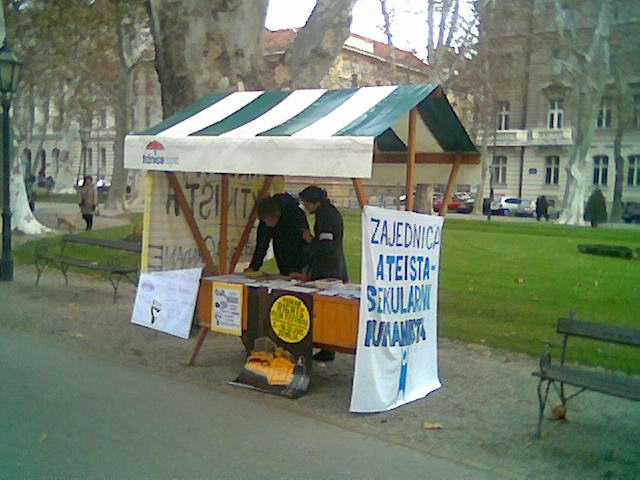
Everyone talks about "religious freedom" for the individual, or how religious groups get to be treated equally as organizations. But what about us? What about the people who aren't into the whole "God" thing? Sure, you have the right to think whatever you want, but when it comes to actually organizing, the system basically shuts the door in our faces. You can start a nonprofit, sure, but the Religious Freedom Restoration Act gives all those special perks specifically to religious groups.

Why settle for less? This isn't some new concept; more progressive countries figured this out ages ago. Back in 1950, the Council of Europe dropped the European Convention on Human Rights, and Article 9 explicitly says everyone has the right to freedom of thought, conscience, and religion. It uses the phrase "religion or belief," which covers both bases. Same deal with the Universal Declaration of Human Rights from the United Nations General Assembly back in '48. Non-religious beliefs get the same protection. Everyone should have the freedom to express their views—whether alone or together, publicly or privately—through teaching, practice, and rituals.

In several other countries, groups for atheists, agnostics, skeptics, and the American Humanist Association have achieved legal status equal to religious organizations. That’s what we need to fight for here in America. We shouldn't be stuck hiding in the shadows or just meeting in private living rooms. If we want change, we have to take the first step ourselves.

So, let's get organized! The first move is setting up an association under the Nonprofit Organization Act. It’s easy enough—you only need three founders—but we need to play bigger. We shouldn't just scrape by; we should wait until we have dozens of people ready so we launch as a real, solid organization built for growth.

The goal is to push for amendments to the Religious Freedom Act so that its provisions apply to "belief communities" too. Right now, religious groups are treated as a special class of nonprofit with extra rights.

But look at the fine print: under current laws, secular humanists could technically argue for registration as a religious group. The law doesn't strictly define "religion" as needing to believe in something supernatural or in God. People love to tell us, "You're just believers in reverse—you believe God doesn't exist." Fine. If that's how they want to play it, then we demand the same rights! We want our organization to get government funding (if that's still a thing), to offer "humanistic education" in schools, to run our own academies, and to grab those tax breaks.

The law says an association can qualify for religious status if it hits 500 members and stays active for five years. Alright then. Let's get to work.

image

There are hundreds of thousands of people in America who identify as atheists or agnostics, or just refuse to pick a side, or follow a religion just because it's what they were raised with.

If that sounds like you—if secular humanism hits home and you're tired of being alone and want to hang out with like-minded people—join us!

To join the Steering Committee, you just need to accept the Minimal Charter of Humanism and shoot an email with your name, address, and phone number to secularhumanists(at)gmail.com.