The life and work of Werner Herzog
in Movies ·
Exactly. If Werner Herzog isn't the real deal, then who is? 🤷
16 posts shown.
Dennis Martin6 said:That greenhouse scene? It’s basically the movie's whole MO—that kid John just watching his dad burn his mom's stuff after she bailed, which is exactly what he was venting about to Ben earlier. But get this: the director shows us a burning greenhouse instead of actual clothes. It's like Ben's story about those greenhouses leaked into John's head—real memory gets totally warped by John's neurotic headspace in the present.
That’s exactly the director's play here—he spends the whole movie gaslighting the audience into thinking Ben is some total psychopath. It's all based on this unproven theory that he killed Amy and dumped her body in the lake, but honestly? There isn't a single shred of actual evidence on screen to back that up. At the end of the day, the only guy we can be 100% sure is a killer is John.
The movie isn't even about the rich vs. the poor—honestly, thinking it is just some populist way of reading it. It all happens in that gap between what the director intends and how we actually see it. Ben is basically Gatsby from that classic Fitzgerald novel—our only real link to this whole Van Dyck-style world. And Amy? She’s like that girl who gets so much plastic surgery she becomes unrecognizable, using nothing but mime to try and simulate a whole new reality (not that it has anything to do with the "soul"). John is the writer behind this whole thing—he's basically crafting the story about these characters we're watching. The way these three interact—it’s all happening inside this bubble of non-stop propaganda blaring from the loudspeakers... it’s just a sign of how artificial the protagonist's whole reality and life actually is.
Jesse Thomas7 said:Yeah, sure, but a Queen is a Queen. When you talk about actual power—the ability to indulge every random whim, make the calls, change her mind on a dime, or just shut down whatever she feels like—she’s in the exact same spot at the beginning and the end. Despite being physically and mentally a wreck, her position hasn't budged. She doesn't even have to lift a finger if she doesn't want to.
She could flip the whole script tomorrow if she felt like it, and everyone else would just have to deal with it.
Abina's game is over. The tool has been used up. She’s effectively stripped herself of the one last thing—maybe the most vital thing—that she held onto even when she was at her absolute lowest point in terms of practical standing: hope.
Hope, the ghost of any idea, any plan, any desire or ambition that might actually improve her situation. She knows it's done. This is what she fought for. That’s why I think that closing scene is masterfully handled. Instead of some heavy-handed dialogue where they spell everything out three times over to make sure you get the point, they cement the entire theme through one long shot of Abina’s defeated face. You can practically feel the hopelessness, that trapped sensation, and the hint of apathy that’s going to be her permanent state of being moving forward.
And honestly, it's not just the final scene. Even with all those specific little plots, games, and twists that some people write off as the movie's "bad side" or just a bunch of nonsense, there are a few moments—like that one part about the different games the two of them are actually playing—where a single question or one seemingly throwaway sentence forces you to rewind in your head. You find yourself connecting the dots yourself, drawing conclusions based on what *wasn't* said.
When a movie pulls that off, especially with that kind of finesse, there's no way it can be total garbage.
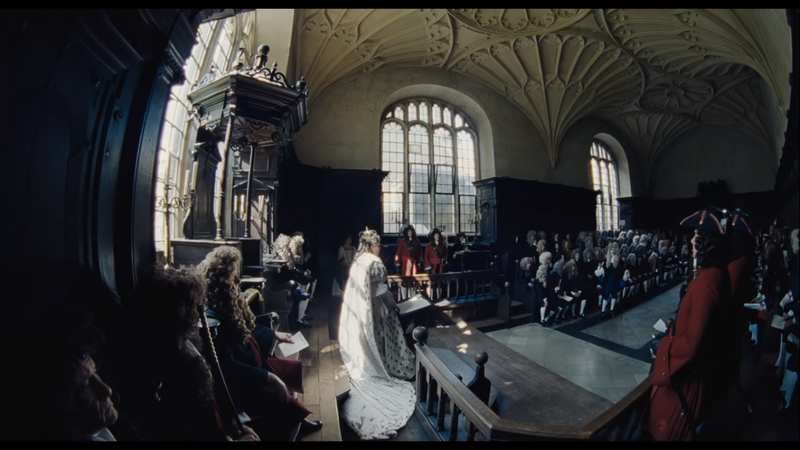
I don't know much about cinematography. You're saying wide-angle? 🤣
I mean, I know it when it looks good. 🥳
I'm not sure if I'm missing something deeper because of the specific way he chose to frame the shots, but I'm hoping he did it specifically so that even someone like me, who doesn't grasp technical stuff, can still pull the intended meaning out of it. 🙂
Jesse Thomas7 said:Yeah, sure, but a Queen is a Queen. When you talk about actual power—the ability to indulge every random whim, make the calls, change her mind on a dime, or just shut down whatever she feels like—she’s in the exact same spot at the beginning and the end. Despite being physically and mentally a wreck, her position hasn't budged. She doesn't even have to lift a finger if she doesn't want to.
She could flip the whole script tomorrow if she felt like it, and everyone else would just have to deal with it.
Abina's game is over. The tool has been used up. She’s effectively stripped herself of the one last thing—maybe the most vital thing—that she held onto even when she was at her absolute lowest point in terms of practical standing: hope.
Hope, the ghost of any idea, any plan, any desire or ambition that might actually improve her situation. She knows it's done. This is what she fought for. That’s why I think that closing scene is masterfully handled. Instead of some heavy-handed dialogue where they spell everything out three times over to make sure you get the point, they cement the entire theme through one long shot of Abina’s defeated face. You can practically feel the hopelessness, that trapped sensation, and the hint of apathy that’s going to be her permanent state of being moving forward.
And honestly, it's not just the final scene. Even with all those specific little plots, games, and twists that some people write off as the movie's "bad side" or just a bunch of nonsense, there are a few moments—like that one part about the different games the two of them are actually playing—where a single question or one seemingly throwaway sentence forces you to rewind in your head. You find yourself connecting the dots yourself, drawing conclusions based on what *wasn't* said.
When a movie pulls that off, especially with that kind of finesse, there's no way it can be total garbage.
I don't know much about cinematography. You're saying wide-angle? 🤣
I mean, I know it when it looks good. 🥳
I'm not sure if I'm missing something deeper because of the specific way he chose to frame the shots, but I'm hoping he did it specifically so that even someone like me, who doesn't grasp technical stuff, can still pull the intended meaning out of it. 🙂
Jesse Thomas7 said:SPOILERS
Plus, that final scene where they ask, "What exactly do you think you've won?" really drives home the point—that woman who fought her way to the top was never actually higher than she was in that exact moment. It’s a total Pyrrhic victory.
It’s not bad. Honestly, the ending is pretty damn good.
Paul Schrader : Quote : There ’ S an enormous sense of satisfaction i derive fra First Reformed, because it pulls together threads of what I’ve been thinking and doing for almost 50 years. The First serious writing i did on film was about spiritual Cinema, Transcendental style. That was in 1972. From that point on, I became a screenwriter and director, and I never thought that I would make that type of film. I like those films, but those films are not for me. I was much more interested in action, empathy, sexuality, violence, and these really aren’t in the transcendental tool kit. So I went on and left that world behind. i wrote was Taxi Driver (1976). Now, 45 years later, i have made a film that combines The thinking in that book with The narrative Drive of Taxi Driver. So I have my first philosophical book and my first screenplay combined in this current film. That has been very intimidating because it’s a little difficult to think of what to do next. Hopa that First Reformed is not my last film, but if it is, it’s a very good last film.
(...)
I looked at the models. You have the main character from Journal d’un curé de campagne (1951). Then you have The setting of Winter light (1963). Then i decided on The ending fra Ordet (1955). I added a levitation scene from Andrei Tarkovsky, and then i tied IT All together with The glue of Taxi Driver. look AT The model of Winter light: small empty church. A man going through the motions meets a young couple. Max von Sydow is in despair because of nuclear weapons. Well, shift that over. Take that young couple and ask yourself, “What is the current despair?” The current despair is environmental collapse. It’s more real in a way, because nuclear weapons are kind of theoretical. It may happen. Environmental collapse is not theoretical. It is happening and will happen. So that becomes the shift.
http://cinema-scope.com/cinema-scope...rch-of-cinema/
Quote: Personal as it may be, the film is about a male genius so supreme that it can choose even when and how to be weakened in the presence of a woman, who, in exchange for monogamy, is ever willing to serve it. Anderson dazzled critics into believing that they’re not reproducing power but affirming the art of the personal. Wrapped up in that fancy art-house aesthetic, the movie basically serves as a massive endorsement for the "natural" brilliance of men. "Phantom Thread" is straight-up patriarchal propaganda, plain and simple.
Amanda Robinson4 said:Just watched it. Honestly, no matter what you think of PTA, you have to see his stuff in a theater 😬 (even if I haven't caught every single one of them, still ☕ )... but, hmm, yeah... my final takeaway is... unsettling? 😁
I struggled a bit trying to figure out how to genre-label this thing, but honestly, who cares? Let's just call it a period romance drama. It’s slow-burn by nature, obsessed with the little details, and puts almost all its weight on the (romantic) relationships.
Man, if I had tried watching this at home on my laptop, I would've been totally lost. Even sitting here, I found myself waiting for the plot to actually kick into gear, but the end result was—well, surprising, to say the least. Mostly because of the pacing, which just slowly meanders through the complexity of Alma and Reynolds' relationship until it hits these sudden, intense dramatic peaks.
It's pretty clear that with Anderson, there's no such thing as a shallow theme. You can dig so much into it—everything from the director's obsession with high-end 1950s fashion and the overall vibe of that social circle, down to the uncompromising, almost neurodivergent traits of Day-Lewis's character.
I couldn't shake the feeling that some of the screen junkies were right when they said this is basically a movie about Day-Lewis himself, playing a guy who can't tell where his personal life ends and his craft begins. 😬 It feels even more symbolic considering it's his last big role.
In that same vein, PTA is just unapologetic. He doesn't disappoint, but he definitely leaves you with a bunch of questions spinning in your head. Which is great, because that's really the whole point. I get why a lot of people might not vibe with this, but for me? It gave me plenty of food for thought. 🙂