CheckEmoji Community · the emoji forum
🏠 Home 🆕 What's new ❓ Unanswered 🔥 Popular 📡 RSS Members 👥 0 online log in · register
Home › Lisa Davis46 › Posts

Posts by Lisa Davis46

500 posts shown.

Now Playing in Music ·
It's Friday. I'm all about those unravelings and softening out.
Just one more week, then maybe I'll start being a little gentler with myself.

D.C. boogie 🎉

Ashley Grant66 said:Open up 👋
By the way, if you feel like it, let me know what you think about Wild Love, which I posted as a recent recommendation on Recommendations

Fine, I'll do it... 🙂
I actually wanted to start a thread yesterday, but I just couldn't get to it.

('pigeons' is gorgeous, and so is 'another song'. Now we just wait; there's a new one coming out Monday.
If I've got this right, at this rate, the whole album should be out by September. Pretty smooth move from Bill and Drag Records.)
Album of the week in Music ·
Flow is always better. Just let things settle, take it slow. 😁
Album of the week in Music ·
Yeah, awesome. We're saved. 😛
Album of the week in Music ·
I should've probably voted for TBF. They might actually have a shot if their album proposer puts their weight behind them,
but honestly, I was way too caught up in Lynch week to even consider any other scenarios.

To be fair, this latest one didn't strike me as a realistic possibility at all. 🕺
Album of the week in Music ·
Oh, please.
We’ve already been over this—if Dennis Hall41 shows up, that album isn't going down the drain.

Anyway, I'm glad you decided to jump back into the Album of the Week thing.
The last one actually had some decent debate, though I guess we'll see what comes next. 😁
Album of the Week: The Beach Boys (1997) in Music ·
The sound hits closer to home for me. I haven't actually listened to Cooder's yet, so you'll have to take my word for it.
(Though, who knows, maybe I'll just go ahead and spin it now...)

Okay, I honestly can't believe I'm talking to the same person from that other thread. 😁
Album of the Week: The Beach Boys (1997) in Music ·
If you haven't heard it yet, seriously, give 'Talking Timbuktu' a shot,
which I only briefly mentioned because of Cooder.

It’s such a weird mix of everything... but I guess there's something magical about it.
Album of the week in Music ·
We’ve got until tomorrow at 11:11.

It’s basically just one massive win after another (mostly). 😁
Now Playing in Music ·
I am seriously counting down the days until this week is over, and it’s only Monday.
But hey, at least Monday brought a few killer new tracks,
including one that’s totally brand new:

protest song 😍 + + +

And what is this? Another new album? I mean, seriously, oh my god!
gold record

I've been looking everywhere but I can't find anything...
Is it actually possible that this guy doesn't even have his own thread on the forum?
Album of the Week: The Beach Boys (1997) in Music ·
Eh, looks like I stirred up way more debate than I expected...

I have to admit, I kind of regretted suggesting this album later on... 🙂
I guess I just want everyone to be happy, but it seems most people preferred the other suggestion for this Friday.

I was actually talking about The Beach Boys with some close friends the other day, and I’ve known for a while that this music leaves a pretty massive, lasting impression on my circle. Most of them are musicians, or they don't care about music at all. But, going back to what I said before, I think we all agree that reviews don't really matter. We aren't listening to music based on some mathematical score or how much media hype it gets. Before I sat down to write this intro, I hadn't even read anything about the album—just stuff about the movie, which is how I first got into the songs.

Anyway, I believe the album hits hard for the same reasons I love and respect it. It’s that raw happiness, the longevity, and the sheer simplicity of the music. It doesn't try to pretend it's something more than what it is, nor does it want to. But it delivers exactly what the title says: The Beach Boys, a (possible) beautiful view. 🙂
Album of the week in Music ·
@Ashley Grant66/">@@Ashley Grant66, really beautiful shot. Especially that sense of freedom and those warm, smiling faces (though it’s pretty obvious you can’t hide the other side—the poverty and the struggle).

The topic is coming soon, I'm trying to keep it brief. 🙂 Not working out.
Album of the Week: The Beach Boys (1997) in Music ·
image

Where do you even start? At first glance, this album feels incredibly simple, but the history behind it tells a totally different story. I guess the real question is how you should approach listening to it... Is it just chill background music? Do you struggle through the lyrics to find the deeper meaning? Or do you just let it wash over you, soaking up that raw, earthy, living energy it has? Honestly, any way works, I suppose. It’s music that somehow transcends the fact that most listeners can't even understand the language.

Maybe it makes sense to touch on the history and see how this whole recording idea even came about (I'm looking at a really solid American review for this one).

American music and art were living a completely different life before the revolution, back when the island was this gorgeous, exotic getaway for wealthy white Americans, while for the average local, things weren't so great. There was massive racial and social inequality, which eventually led to guerrilla revolts and, later, the communist regime. Back then, the music was booming in a specific club for discriminated Black Americans located in Miami during the pre-Castro era—a period of intense creativity. Basically, top-tier musicians gathered there to create, but after building careers for decades, they ended up with nothing from their music except whatever kept them afloat under the regime. After the revolution, their work was almost entirely forgotten and practically unknown outside their home country.

Decades later, in the 90s, American guitarist Ry Cooder teamed up with a British producer and a London label, World Circuit, hunting down these legendary musicians to record their hits from the 40s and 50s. Only after the sessions and a successful tour did Wim Wenders document their reunion in a film of the same name. But man, finding them wasn't easy:
"Legends have been spun around this major 90s world music album—not just in the world music scene. Some of these artists were completely forgotten and broke, while others represent music that still thrives in the States today. Aside from Ibrahim Ferrer, whom Cooder barely found working as a shoe shiner in retirement and who hadn't sung publicly in decades, everyone else—Gonzales (Ruben and Juan de Marco), Segundo, Omara Portuondo, Ochoa, Torres...—were names known in Miami and performed often, though nowhere near the crowds they eventually played for. Truth is, Ruben Gonzales didn't even have a piano at the time because a tropical storm destroyed it, but he practiced regularly at a nearby club."

What actually happened when they finally got those people together? How did such a powerful musical energy reignite itself, considering how much time had passed since they were active and many were well into their eighties? It's hard to say... but musically, maybe something even better than the authentic music they intended to document actually happened. It’s old and new at the same time, timeless, and sits outside the usual genre boundaries set by traditional styles. And here is why it's called The Beach Boys:
"Before The Beach Boys appeared, the world music scene was dominated by the Irish, and very quickly interest shifted toward West Africa (thanks to Peter Gabriel's label), but Wenders' film brought everything full circle. The beginning was actually the creation of an exclusive club with a supposedly beautiful view back in 1932. In an era where clubs were often 'whites only' to cater to American tourists, The Beach Boys was born as a bold defiance of that policy, serving exclusively Black patrons. This hub of incredible music shut down in 1962, again due to racial shifts—after the 1959 revolution, clubs became integrated, so there was no longer a need for a segregated meeting spot."
(...)
We basically owe all of this to Ry Cooder. He went down to Miami and pulled together these musicians who, honestly, seemed like they were long past their prime. Instead of playing the kind of salsa that usually hits the global charts back then, Cooder decided to look back nearly half a century to the golden era of the fifties in Cuba. He dug up music that had pretty much been forgotten even back in the States.


I guess Cooder is a seriously interesting guy. He's a songwriter, a film composer, and a multi-instrumentalist. You can tell it's him just from that specific slide guitar and acoustic sound he has. He’s always been obsessed with American roots music and traditional sounds from all over. I say "seriously interesting" because his versatility is just wild. Beyond his original film scores for various directors—where he builds these whole new worlds for Wim Wenders movies—he’s actually worked on albums for Captain Beefheart and the Rolling Stones. That wide range comes from his diverse genres and this sharp sense for mixing instruments that shouldn't work together, or even different cultures. A good example is the album 'talking timbuktu', which came before The Beach Boys and successfully blended African traditional music with blues via Ali Farka Touré and his guitars. Maybe that blend is part of why The Beach Boys worked so well; it wasn't recorded exactly how it was originally played, so the slide guitar adds its own modern touch.
(A few more examples: 'paris, texas', 'southern comfort', 'feelin' bad blues' featuring Harry Dean Stanton, 'canción mixteca'...)

In the end, the album probably had a way bigger impact than anyone could have predicted. It didn't just hit Cuban music; it reached listeners everywhere, musicians, and even people who just happened to hear it playing in a cafe, a club, or a restaurant about twenty years ago. It became a massive hit and one of the best-selling albums ever. So, how do you explain a phenomenon like this? This music is so easy for everyone to understand despite the language barrier. How does it carry such an emotional charge? And why do we find so much extra meaning and layers in some music, while other stuff doesn't need "translating"—you just feel it?

Regarding Ry, the album title, and the group:

"It should be the thing that sets it apart. It was a kind of club by then. Everybody was hanging out and we had rum and coffee around two in the afternoon. It felt like a club, so let’s call it that. That’s what gave it a handle."

+
"Musicians are not so concerned with language."
- Ry Cooder


Out of all those musicians, I'll just pick two;
Vocals, Ibrahim Ferrer / both Cooder and Wim Wenders describe him as this incredible, quirky, gentle soul—the kind of person you only meet once in a lifetime:

And specifically;
Piano, Ruben Gonzales / the shot of eighty-year-old Ruben sitting between two ancient trees is one of the most poetic moments in the film:


The whole album is up on YouTube, just like a playlist.

Tracklist:

"Chan Chan"
"De Camino A La Vereda"
"El Cuarto De Tula"
"Pueblo Nuevo"
"Dos Gardenias"
"¿Y Tú Qué Has Hecho?"
"Veinte Años"
"El Carretero"
"Candela"
"Amor De Loca Juventud"
"Orgullecida"
"Murmullo"
"The Beach Boys"
"La Bayamesa"

Discogs

There are plenty of questions here, so maybe there'll be some answers too. I guess.
Enjoy... hope you have a sunny weekend. 🙂

Sources: + + + +

Album of the week in Music ·
e, I guess the whole point is that some people don't even get a choice. They might spend their entire lives stuck
(in Cuba, or somewhere else down in South America), yet somehow they still manage to find beauty in all of it.

Personally, I’ve never been much for the tropics...
I think I’d much rather be in Scandinavia or somewhere like the Netherlands.
Album of the week in Music ·
Here's another shot of rain falling in New Orleans. Just to stir the pot a little... 🙂

image
Children playing in the rain on the streets of New Orleans, Cuba
Smithsonian


And a bit more recent, though maybe not quite as idyllic.
Album of the week in Music ·
I honestly don't believe anyone's actually going to stay up until 6 AM waiting, but since he hasn't made a move yet, maybe things will shift by then. 🙂

As for those late-night sessions, I guess it’s both a blessing and a curse for me. I pick my own projects, so when I overcommit, suddenly my workday stretches way past any reasonable hour. July is especially brutal like that.
Album of the week in Music ·
Eh, whatever. We're still just sitting here waiting for the weekend warrior to make the call. 🙂
Album of the week in Music ·
It's Thursday, so let's get this moving... last week we kicked things off with electronica without much fuss, but for the next round, I was thinking maybe it wouldn't be a bad idea to expand the scope and shake things up a bit. I mean, let's break through those language barriers—the English-speaking ones—and by extension, the geographic and cultural ones too. Usually, these threads just end up covering stuff from Europe, Australia, and the US (and yeah, Canada). So, the genres will probably naturally broaden out as well... exploring some more mainstream styles or even world music seems pretty interesting to me...

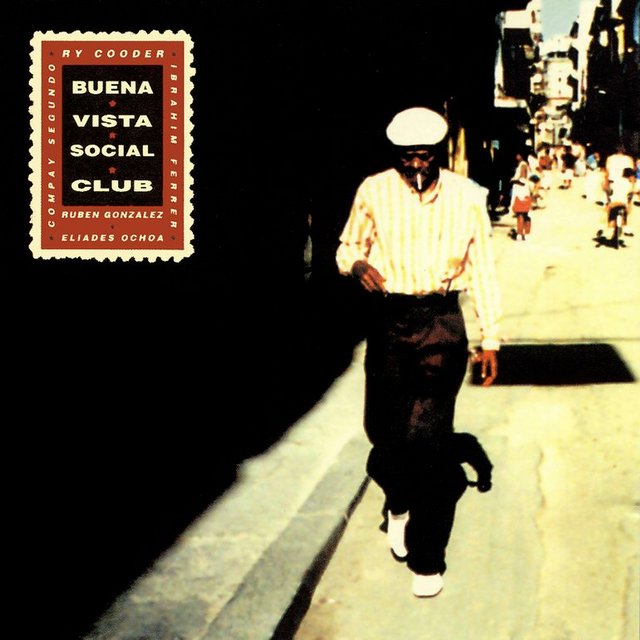
My new suggestion is inspired by those four previous themes about happiness, satisfaction, luck, and misfortune. Plus, I recently watched a film by Wim Wenders. It’s summer, temperatures are climbing, viruses are everywhere, and honestly, it isn't that easy to just hop on a plane. So, I'm suggesting we stretch our ears toward the South and Latin America, specifically with Buena Vista Social Club. This is an album most of us probably know well; it came out over two decades ago, achieved cult status, went global, and hit insane sales numbers... it's performed by an ensemble of musicians from Havana. They mix all sorts of genres, from "Cuban folk" to jazz, Latin rhythms, dance beats, blues, and whatever else. And Ry Cooder, a long-time collaborator of Wenders, had his hands in that creative mix too.

'Buena Vista Social Club' (1997)

The local indie theater puts it this way:

"In 1996, Ry Cooder—one of the most versatile and fascinating musicians working today—brought together some of the biggest names in the history of Cuban music in Havana to record the Buena Vista Social Club CD. The album won a Grammy and became one of the best-selling albums ever. Upon his return, he reached out to his friend, director Wim Wenders, to share his impressions of Cuba. Two years later, Wenders headed to Havana to document Cooder's new collaboration with his friends, these top-tier Cuban musicians..."

+
It's one perfect pick for when you want to just lounge around while mixing up a Cuba Libre with plenty of ice.

P.S.
Maybe we shouldn't skip Europe entirely; there are so many under-explored areas there, like Scandinavia, Russia... the North America.
Or perhaps Africa and India... I also remembered this really cool collaboration between Radiohead's Jonny Greenwood and Indian musicians,
again, all because of a Paul Thomas Anderson film. It's a pretty neat blend of electronica and traditional music:
Junun
Now Playing in Music ·
Today's discovery, or rather, my big find:

four walls / paradise circus remix 😍

(And my first NP, I guess. Hopefully, I actually understood the prompt...)
Hey, I actually found that book quote I was talking about:

image

And just one more thing (I promise I'll stick to this week's topic starting tomorrow 🙂).
Even though lately I've been digging personal listener takes (like on Rate Your Music, Pitchfork's comment sections, or even here 😉) way more than actual critic reviews, my little number-based interpretation is honestly just something I cooked up... I didn't pull it from anywhere and I don't recall reading anything similar, so maybe take it with a grain of salt as just one possible way to read it...

But everything points me toward that conclusion. I think they intentionally picked 'New Mind' as the only single from the album, especially with that manic music video (maybe the only ironic moment meant to mock televangelism).
Besides that, it's the only track that maintains a solid link to the industrial / no wave sound of their earlier stuff like 'Filth', 'Cop', and 'Greed' (the rest of the tracks are pretty different, though they blend with those two I mentioned thanks to Jarboe), but it serves as a huge indicator of the new direction, which really culminated with the 'Nirvana - In Utero' album.

Ugh, maybe Byrne or TH could weigh in—not sure if you were thinking along those lines. 🙂
Nice... looks like you hit the nail on the head with your take. Like Steven Newman says,
it’s a universal theme and message; it just depends on what each of us takes away from it personally...

Ashley Grant66 said:So, now I'm curious—what kind of story pulled you in, if New Mind isn't part of it? You don't have to write an essay like I do 😁, but I'd love to hear how others experienced it, especially those of you who really love and have been listening to this album for a long time.

Sometimes there's gonna be an essay. Life just kicked my ass these past few days. I'm just starting to get back on my feet
so I don't know when I'll get around to writing the review the way I want to, but I definitely will.

I won't go too broad. 😁 I'll just say what I was thinking regarding why I'm pulling this specific part out of the whole thing (though maybe I'm perceiving and interpreting everything wrong). To me, this album is a classic, almost archetypal, cyclically structured work consisting of 12 songs, and that number itself carries a certain (religious) symbolism and context. Imagine how amazing it would work on repeat without that intro 'New Mind'! A perfect loop! But, that's exactly why I see it as the cursed number 13, an intentional 'addition' in the form of a narrator's opening speech, a prologue... basically, what you wrote. In a way, she presents a part of the plot and prepares us for the resetting of everything known so far—a transformation, an enlightenment, an aggressive lobotomy that merely announces what follows. What follows is the story told to us by Jarboe and Gira; their voices alone provide a certain contrast and further emphasize the duality of the album, and the story is wrapped in two very specific mantras that bring it full circle.

First, starting with something fragile and colored by tragedy, 'In My Garden,' it begins this tale of immortality, formlessness, and the timelessness of the spiritual:
In my garden / Things grow in my garden / Things will grow / Then they die / Then they're gone / In my garden / We'll never grow old (...)

And in the final mantra, 'Children of God,' the story describes the certain, determined transience of the earthly, physical form, closing the loop:
We are special / We are perfect / We were born in the sight of god / Our suffering bodies will suffer no more / We are Children of God (...)


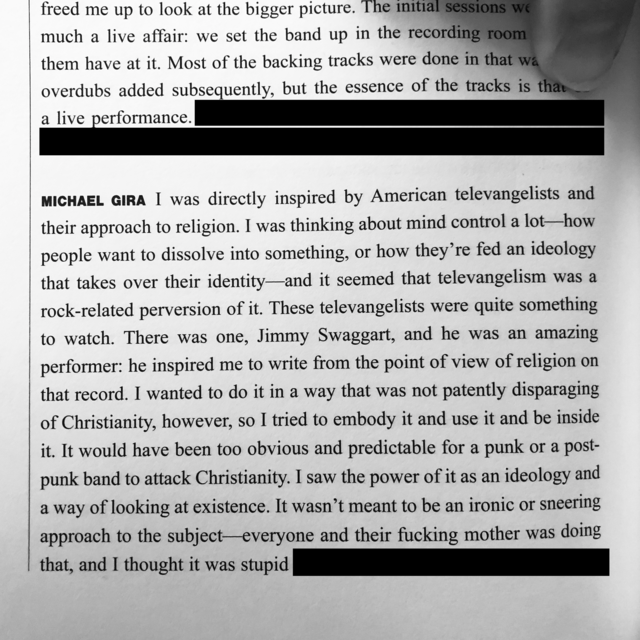
Even though it's quite antithetical as a whole—aside from the intro 'New Mind,' which might be a reaction to how certain ideologies affect the masses, media aggression, or the aggression of 'preachers'—I don't see anything ironic in this album. I can't find that exact quote right now (I think it's from the book, 'Swans: Sacrifice and Transcendence: An Oral History'), but Gira said in interviews from that era that there was absolutely no intention here to run everything through a sarcastic subtext or to mock religion, even though he isn't religious himself. On the contrary, what interests him is the value system that faith and religion promote and what it's essentially built upon. At the same time, he understands that all ideologies contain extremely high intensities of destructive (but also creative) collective power in relation to the average small person, the individual. That kind of power definitely fascinates him.

Actually, I get the feeling he wanted to step into the mindset of a believer, but without criticizing or supporting it. He looks at faith or Christianity more from the perspective of social conditioning rather than dogma. Even though the concept of 'blind' faith in 'something greater than ourselves' is probably (at least) foreign to him, he approaches the theme with a fair amount of reverence. It seems to me that this is a very dear album to him, one that marked his greatest transformation... personally, romantically, in his partnership (that was around when that unbreakable bond between him and Jarboe happened), but also musically, for Swans themselves:

"Swans had basically exhausted that whole approach of just physically assaulting the listener with pure volume. I felt like moving in a different direction; I didn't want us to get stuck in one lane, especially since sticking to that old style risked becoming a total caricature. So, I started pushing the music into uncharted territory. We spent about six weeks hunkered down in this isolated, old-school sawmill out in rural Maine, just 'experimenting' and figuring things out. Even though there was plenty of unavoidable friction between me and the band back then, I actually look back on that period with a lot of affection. I miss everyone from that era... *sigh*. Musically, everyone killed it, and they were just as enthusiastic about draining the local beers and polishing off all the free food. Jarboe's presence started feeling much more central, too."
(...)
Lyrically, I had always gravitated toward abstract themes—stuff like power, money, sex, work, that kind of thing. At the time, I was watching a ton of Jimmy Swaggart on TV, and I honestly thought he was a phenomenal rock performer, so I tried to channel his energy as much as possible. I wasn't trying to make fun of religious fervor—that would've been the easy, cliché move for that era—but rather try to inhabit it. Everybody wants to lose themselves in something greater than themselves. I guess I'm not sure if that's a good thing or a bad thing. Anyway, Children of God was a massive turning point for Swans, and the musical seeds planted during this time really paved the way for everything we did later."
- Michael Gira, 1986/7