Maria Fisher46 said:It’s a complicated situation, but I don't see a clear diagnosis emerging from it just yet. Honestly, it might be time to start a formal diagnostic workup. Since you aren't dealing with joint swelling at the moment—as I mentioned before—I'd suggest seeing a dermatologist first; from there, you'll likely need to schedule a biopsy.
Thanks for the input! My gut feeling was also that this leans more toward dermatology than rheumatology—so, hopefully, my doctor will refer me to a specialist. If not, I'll just book a private appointment myself.
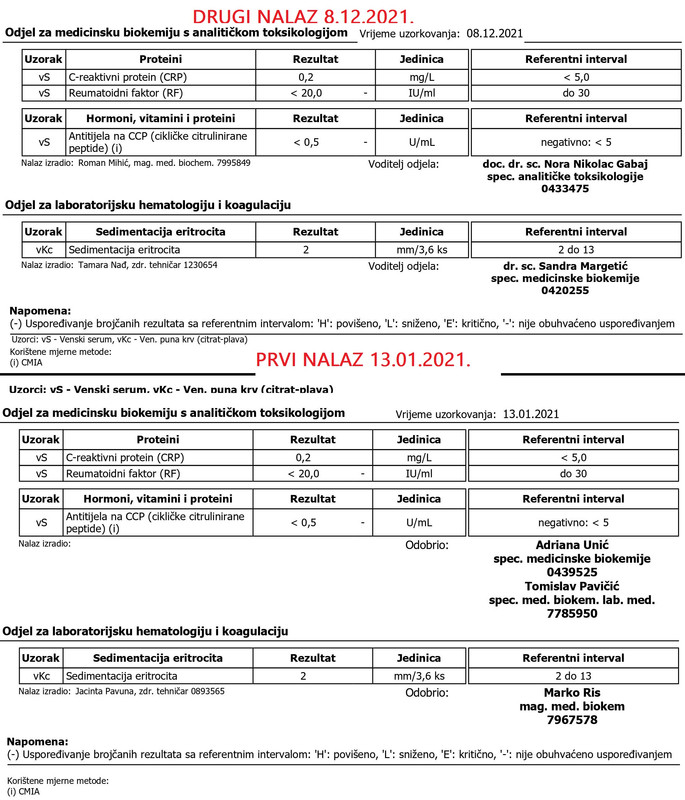
I also wanted to get your take on these lab results
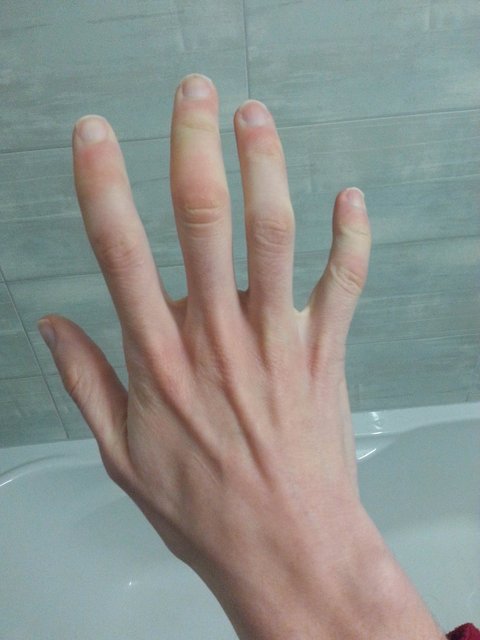
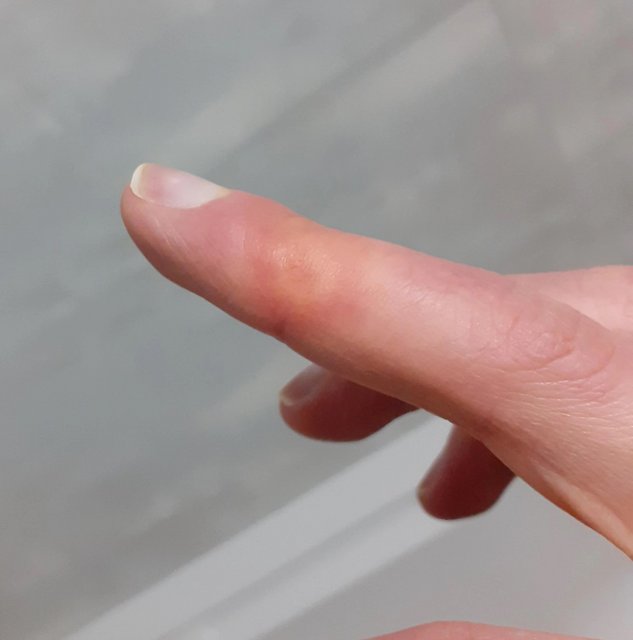
The changes shown in these photos don't quite present like rheumatoid nodules, nor do they look like Herbert's or Bouchard's nodes.
The differential diagnosis is actually quite broad—especially since I can't perform an in-person examination. Perhaps the best course of action would be to consult a dermatologist first, followed by scheduling a biopsy of these lesions to determine exactly what we're dealing with; given that fingers are such a tricky spot for a biopsy, you'll likely need a surgeon to handle that part.
If you don't mind me asking, what do you do for a living? Are you frequently exposed to extreme cold or any other physical stressors?
Thanks for getting back to me!
Well, there's a bit of a backstory here, so I'll try to keep it concise:
I'm not professionally exposed to the cold or anything of that nature—I'm currently unemployed and spend most of my time at a computer—but something potentially relevant is that in late 2019, I was performing scalp massages. They were extremely vigorous on my fingers, and while I was doing them, I could often hear popping sounds coming from my finger and hand joints.
I did this for a few weeks, and then in January 2020, my fingers swelled up for the first time—though, at that stage, there were no nodules. It looked like this.
That lasted about a week before subsiding, but after a while, those nodules appeared along with the swelling around them. The nodules would recede after a couple of days, and just as one round cleared up, a new set of 3 to 8 nodules would pop up.
There are a few more details to share, but I won't overdo it with the text; I'll leave it at that.
Since January 2020, I’ve been dealing with these red bumps that seem to flare up and then vanish on the fingers of my right hand—usually accompanied by some swelling around them. My doctor has sent me for blood work several times to check for things like rheumatoid arthritis or something along those lines; I can't recall her exact wording, just that it was something in that realm.
Anyway, here are my two sets of lab results. Do these point toward any kind of arthritis, or perhaps something else entirely?
My doctor ordered some routine blood work and a urine sample, but it turns out my referral has already expired. Do I actually need to head back into the office to have her issue a new one, or is there some way to just extend the current one? Could I perhaps give her a quick call and ask her to renew it—would she be able to see the unused order in her system, or am I going to have to spend half an hour explaining exactly why I was sent for these tests in the first place?
In my experience, I’m consistently looking at a minimum of three weeks—and frankly, it often stretches much longer than that—so I find myself wondering if this is an anomaly, a standard baseline, or perhaps even a bit better than the average. What does the typical wait time look like for the rest of you?
David Flores68 said:I'm looking for a solid ophthalmologist in Washington, D.C. For quite some time now, my eyes have been aching for a few hours once a week, and the last eye doctor I saw basically brushed me off with a disinterested, "maybe it's just your prescription." So, I'm searching for someone who actually has the patience and willingness to dig into what's going on—someone who wants to do more than just check my pressure and send me on my way.
One more attempt at this. I tried scheduling through the Rib clinic, following someone's suggestion, but they gave me an appointment date in 2022. 😁
I asked if that was perhaps a typo—if they meant 2021, for instance—to which they replied:
"It isn't a mistake; general exams are handled at the community health center, while the specialists are over at the hospital. We only have one general clinic and the waitlist is massive."
So, I suppose I'll need a referral for a decent ophthalmologist at a local health center here in Washington, D.C.
I’m on the hunt for a decent ophthalmologist in Washington, D.C. For quite some time now, I’ve been dealing with eye pain that hits once a week and lingers for several hours at a time. The last specialist I saw basically brushed me off—just gave me a disinterested "it might be your prescription" before sending me on my way. I'm looking for someone who actually has the patience and genuine interest to dig into what's going on; someone who will actually investigate the issue rather than just checking my eye pressure and telling me to get lost.
swiftbear86 said:There are definitely compounding pharmacies out there that make personalized formulas based on a dermatologist's prescription. That would include stuff like specialized shampoos or lotions containing caffeine. You'll just need a private prescription from a doctor to get them to make something like that.
Is there any way I can get someone to whip one up for me without a prescription?
I'm planning on switching dentists soon, and I was told I need to fill out some paperwork at their office first and then drop it off at Medicare. I'm wondering if the process has changed at all lately given everything with the pandemic? I know some Medicare matters are being handled electronically now.
rustymason82 said:Right—your primary care physician can certainly write a prescription for a compounded formula, but you’ll have to hunt down a pharmacy that actually keeps those specific ingredients in stock to mix it for you. In my experience, my local CVS was actually willing to compound a prescription listed on my insurance coverage—they mixed Elocom with a plain base. The reasoning provided was that since my doctor couldn't prescribe both creams separately under my current plan, they'd just blend them together. Later, when a dermatologist prescribed a salicylic acid facial cleanser with certain additives, my usual spot didn't have the components on hand; however, I found a specialized pharmacy in Visa that already carried that exact formulation as part of their ready-made inventory... So, the move is to ask your doctor for the prescription first, then track down a pharmacy capable of doing the compounding.
But would a doctor even be willing to write something like that? This isn't some standard-issue treatment protocol; it's something I came across in a specific research study. Honestly, I doubt a typical GP would have even heard of it.
I recently came across a study detailing the use of 0.001% caffeine as a treatment for hair loss. I am genuinely interested in starting a regimen, but I am completely at a loss as to how to actually acquire it.
I reached out to a local pharmacy to see if they could compound a solution for me, but they informed me that they only fulfill orders via prescription. Is there any realistic chance that a dermatologist—whether through a private practice or via Medicare—would write a script for this based on that specific research?
Beyond the traditional pharmacy route, is there any other way to get my hands on this? Perhaps through some sort of private lab or specialized facility?
The market is currently flooded with shampoos and topical products containing caffeine, but the concentrations are either significantly higher or simply unlisted. For me, hitting that precise 0.001% mark is critical—the data suggests that anything higher might actually trigger a counterproductive effect.
Do pharmacies actually perform custom chemical compounding based on specific orders? I’ve noticed a few different threads where people mention having certain mixtures prepared for them at a local drugstore—is this some kind of off-the-books operation, or just standard procedure?
I’m looking to have a liquid formulated with a 0.001% caffeine concentration—would a pharmacist be able to whip that up, or is it even within their wheelhouse? (Specifically for hair loss prevention)
Anthony Carter5 said:Students were rebelling precisely because the regime wasn't leaning far enough to the left for them. For the most part, they were following the Praxis school of thought—essentially critiquing the bureaucratic socialism of the era from an even more radical leftist perspective. They were actually worried about certain pro-capitalist formations starting to emerge within society.
Much like how Chinese students protested against pro-market reforms rather than fighting for some Western-style democracy.
So, what exactly was it that those American students wanted?
I’m admittedly pretty weak when it comes to the historical and musical nuances of this era, so I could really use some help untangling this.
I’m watching a documentary about that period right now, and they mention how The Dirty Theater wasn't exactly fond of the old regime—how they and various other bands were critical of the system—but they don't get very specific about what, exactly, they were protesting against.
Most musicians lean left, and since communism is basically the extreme end of the left spectrum, what was actually bothering them about life in the country back then?
On top of that, I know there were student protests, so I'm wondering: what were the students—who were also largely leftists—actually pushing back against?
I recently watched that documentary *generation 68*, and throughout the entire film, they only mention the cause of their protests ONCE. Some girl on TV said something along the lines of how they liked the social equality provided by the state, but they hated the censorship and the constant surveillance—if I recall correctly.
So, what was the actual grievance of the New Wave musicians and the students during that time?
The last time I sat down to sign a supplemental insurance policy, if I recall correctly, there was a two-week waiting period between the moment the contract was finalized and when the coverage actually kicked in. Is that the standard across the board? I assume everyone deals with some kind of mandatory gap—it seems almost inevitable—but I wonder if anyone else encounters a shorter window than that.
I’m not entirely sure I follow the implication of that particular phrase.
Does it suggest—if I'm reading this correctly—that if too many people adopt that "grandparent approach" to parenting (where everyone just coddles the child and gives in to every whim), the kid ends up spoiled, lacking both grit and independence?
Does anyone know where I might track down a small glass bottle—say, around 0.5 liters, or something in that general ballpark? And, naturally, it could come pre-filled with water if that makes things easier 🙂
What does it actually mean when someone kisses their palm and then waves it or makes a gesture as if they’re blowing a kiss?
I’m currently working on a piece and I'm trying to capture that specific movement—I can't quite find the right descriptive way to frame it—and I'm feeling a bit stuck.
If I simply write that "someone blows a kiss," the reader might just picture the standard cliché: a person puckering their lips and exhaling air toward someone else.
Kate Morgan66 said:Hmm, that’s strange—my sister-in-law actually managed to get an appointment at Vinogradski within two months... It might have something to do with the "dg" notation on her referral; they seemed to suspect a malignancy regarding some moles she has.
As for me, being an oncology patient, I can get in for all my necessary screenings (even mole checks) within three weeks—I honestly can't find anything to complain about there.
Yeah, there's definitely a connection there. I know they have priority scheduling protocols, and I assume those are triggered in cases just like hers.