Michael Ortiz68 said:While the ultimate goal is set for 2030, there was a planned reduction of 20-30% targeted by 2023. Consequently, we will see very soon whether the European Union actually follows its own roadmap.
actually 2027 😉
George Robinson43 said:What really matters here is this: Gazprom storage : critically Low levels
This isn't a new phenomenon; it's been building for quite some time. It feels like a deliberate move to drive prices up!
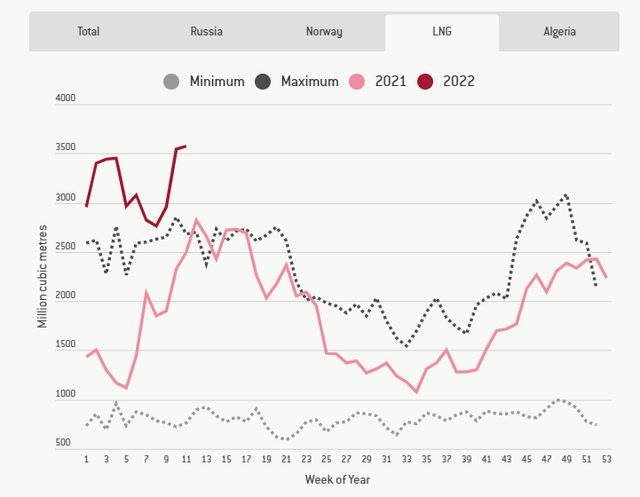
However, you can clearly see a shift was already happening even before this war broke out. We saw LNG surging while Russian gas plummeted. For instance, the Yamal pipeline dropped by 47%.
There was a massive surge of 100 billion cubic meters of LNG in 2022 compared to 2021.
If we successfully substitute 50% of Russian gas in 2022, Russia will find themselves in a total economic meltdown as early as 2023.
Especially regarding gas, since it's nearly impossible for them to make up for those lost exports to the European Union. They just don't have the pipeline capacity to theoretically export to China instead.
Michael Ortiz68 said:I don't think anyone implementing these sanctions actually believes they’ll trigger Putin's downfall; if that happens, it's just a side effect, not the primary objective. The actual goal is to bleed the Russian economy dry over the long haul, specifically targeting their energy exports, which serve as the lifeblood for both their military machine and their general economy to the European Union. Anyone under the impression that Russia can simply pivot its entire export infrastructure overnight and maintain the same revenue streams clearly hasn't looked at the math.
True, the sanctions are gutting Russia's ability to intervene—whether in Ukraine or anywhere else globally.
George Robinson43 said:Inflation is a reality that has arrived and is here to stay, much like something European Union citizens have come to expect.
Everyone understands that these costs represent the price tag for breaking free from Russia and those types of threats being broadcasted on TV regarding nuclear fallout across the European Union.
As for what happens with Russia in 2025 when they're barely exporting any hydrocarbons at all? Who cares. That's their business.
I look at this on a daily basis—it seems pretty obvious to people here in the West why fossil fuel prices spiked in the first place: it was Putin's invasion.

Moscow was banking on these price hikes triggering mass protests (think a new wave of Yellow Vests) and general chaos across the West, hoping politicians would cave quickly just to avoid an angry electorate. Instead, what we're seeing is people in every neighborhood pooling money and supplies for Ukraine; you walk down any street and see Ukrainian flags everywhere...
It’s a fundamental misunderstanding on the part of autocrats—they seem to operate under the assumption that democracies are inherently
weak...