Forgive me, I rarely encounter such poorly written posts, so I couldn't let this slide. Besides, you didn't even bother to look up the clubs on Google first—which takes about five seconds—before asking for opinions or if we knew anything more about them.
Starting your own private practice right out of the gate is just bad math. You're looking at hundreds of thousands of dollars in overhead before you even see your first patient, and finding a steady patient base is easier said than done. Even if you find a turnkey clinic to rent, covering those monthly operating costs is a massive uphill battle. Most people start by working for someone else, or if they get lucky, inheriting an existing practice or landing a spot at a community health center. I know plenty of colleagues who spend years just doing locum work without ever securing anything permanent. For beginners, the field isn't exactly easy going.
You first need to have enrolled 950 patients, and after a year, I expect that number to climb to at least 1,500 or 1,600. They aren't just handing out money for nothing. Plus, you clearly don't realize how much supplies and equipment actually cost
Apparently, some ladies on this forum are genuinely offended if they don't get an immediate reply. I suppose other things in life must have been incredibly trivial for them.
To reiterate my previous point: if we're talking about my own teeth, I’d head to a specialist to have a custom mouthguard made for maximum protection. Prices tend to be inflated, though I did find a colleague who offers a better rate, around $133. Since that’s likely out of budget for most people I've spoken to, just pick up a store-bought one designed for braces. With a decent bite—meaning the top teeth overlap the bottom—a single upper guard absorbs most of the impact, which explains why Karantena held up so well. But again, this is subjective; there's no one-size-fits-all solution. You have to try them and see what works.
If you're willing to drop $300, just throw in another hundred. A dentist will make you a legitimate, professional custom mouthguard that offers better, longer-lasting protection than anything else on this list 😉 Not everyone offers this service, though, and you’ll frequently run into people charging $333 for something that could be fixed for $400. Don't waste your money on cheap crap for $6.75. Between these four options, it honestly doesn't matter which one you pick; they all use roughly the same technology and provide the same level of protection.
With KM, you learn how to hit people in the groin. With Ninja stuff, you learn how to vanish in a cloud of smoke. 😁
If you prefer hitting things and wanting to be "street ready" ASAP, go with KM.
Honestly, Ninjutsu never appealed to me. Especially after reading all the drama about instructors on this forum. Kind of like the situation with Jiu-Jitsu here...
KM is a system designed for speed and simplicity in self-defense, whereas Ninjutsu is an expansive discipline covering vast terrain that requires years, if not a lifetime, of study.
Brazilian Jiu-Jitsu Moving forward, you can also find us at the Police Academy, as well as through classes offered at the College of kinesiology—covering judo and self-defense. 👍
nimblemarlin6 said:Within a single month at your gym, that’s only about 8 hours of training. If you subtract the warm-ups every single time, you're looking at roughly 7 hours of actual technique work. Over three months, that adds up to maybe 21 hours of learning.
Can you actually lay out what your specific plan and curriculum looks like? I'd love to know which exact techniques are supposed to be taught and mastered during those first three months—within that 21-hour window, specifically.
For the specifics, your best bet is to go down there, talk to the head instructors, and see which class fits your needs. What I can give you is a general idea: basic striking mechanics (hands, feet, elbows) performed solo, with partners, and eventually in light sparring; footwork and guard; positioning against one or multiple attackers; breakfalls; maybe some takedowns; and basic self-defense like blocking common strikes and countering. You'll also work on coordination, reflexes, situational drills (like 2-on-1 or 3-on-1), conditioning, and explosiveness. It’s essentially building a foundation that you then refine and build upon. To be clear, these aren't the complex, ritualized techniques you find in traditional arts like Aikido or Ninjutsu that require endless repetitive drilling; the training philosophy here is different. Also, just a heads-up: if you're looking for something less of a "martial art" and more of a short-term course you take for a few months and call it quits, look into Krav Maga instead.
nimblemarlin6 said:How many sessions of Brazilian Jiu-Jitsu—let's say one hour, twice a week—would it take for a low-key, peace-loving urban intellectual with a sedentary lifestyle and zero cardio to successfully pacify a muscular, six-foot-six, aggressive construction worker who’s had way too much tequila?
You’ll have more training sessions later; it always starts this way. The training style here is different from most gyms—you just have to experience it. There aren't any overly complex techniques that require two-hour sessions. We warm up for ten minutes, then crank the intensity to maximum and keep it there until the end. By the finish, you'll be gasping for air and your shirt will be soaked through. You'll definitely feel the fat 😁 leaving the body. Stretching happens at the very end, so if you want to spend another thirty minutes stretching, go for it. As for how many sessions it takes... five, 5,000... there is no math for that. You pick up the fundamentals immediately—theory, strategy, positioning, basic strikes, targets, etc.
Alfa should be at New Vesel, as far as I know... I'm not entirely certain if they have anyone over at the Police Academy in Dubrava, though. If you have a contact number handy, just give them a call and ask. Also, regarding what > said, you won't regret choosing Cro Ryu. It’s a slightly different vibe—more connected, more "real," if I do say so myself. Just move quickly; spots are filling up fast.
Personally, I’d opt for a specialized Krav Maga course tailored specifically to your line of work, led by an instructor who actually knows their stuff. You want to avoid some rookie who thinks they’re an expert just because they’ve done a few classes and three years of training. I’m not sure what the current scene looks like in NYC; you should check the Krav Maga thread. If you’re serious, maybe you could even arrange some private coaching? In my view, that would focus on techniques you can actually use on the job, whereas classic Jiu-Jitsu operates on a different logic altogether. I won't dwell on it.
ironhawk3 said:Also known as: Ju-Jitsu, Jujitsu, or Jiu-Jitsu
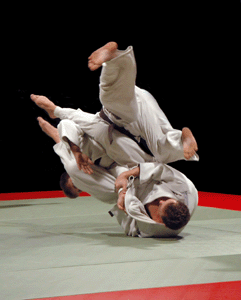
I’ve been training Brazilian Jiu-Jitsu for about two years now, and I’m really looking to branch out and try some actual Judo, specifically if there are full-contact sessions available... I was chatting with some guys who are planning to join the special forces soon, and they mentioned an outfit called 'Alfa' being pretty much the go-to spot in the city... But I’m wondering what the rest of the landscape looks like, you know? Are there more laid-back, recreational clubs out there for someone just looking to train without all the intensity...
To wrap things up, I’d love some solid recommendations on where to go, especially looking for the most budget-friendly spots—maybe even some student discounts—and where they're located... I’m mainly interested in traditional, code-based training rather than those various self-defense classes you see everywhere, since I don't exactly have a ton of faith in those, though I haven't actually tried one myself yet...
That's right, Alfa is the one. I’d also suggest checking out my Dennis Survival Jujitsu over on Subiceva Street. You won't find harder contact in JJ than here. Beyond the sport aspect, we offer fairly realistic self-defense—something classic JJ often lacks. It really comes down to the instructors, their experience, and how they select and modify techniques, but I won't ramble. I'm just not sure if you can jump in mid-semester; usually, enrollment happens in September, but ask around and go check out a session.
Other clubs exist, though I'm not sure how up-to-date this list is: