Well, there’s actually some discussion about Weltschmerz on the forum here:
Isn't it just... I don't know, phenomenal? To think that while citizens in the US—or maybe just around 5% of the global population—consume 50% of everything on the planet (fuel, food, clothes, all that), they still feel this immense pressure? It's like, even with all that, everyone is obsessed with losing weight and suffering through it.
I suppose there must be some kind of glitch in that real-symbolic-imaginary triangle we talk about. Maybe because jouissance is always pushing for transgression within the imaginary—the more you have, the more you crave, and that's where the suffering starts. I guess someone with very little doesn't necessarily crave more, but they suffer because, well, they lack it. Like how the North doesn't really want to show solidarity with the South, and the South just can't reach the level of the North. Actually, my question is... I wonder if we are destined to be perpetually trapped in that triangle, or if perhaps we can step outside of it for a moment, then return, nourished by that realization?
He definitely carried himself with that air of a spiritual teacher or a philosopher—very much in that Socratic tradition, I suppose. He wasn't really interested in jotting down clear aphorisms; instead, what he did write is often so cryptic and mumbled that you almost need a divine spark just to grasp the basic point of what he’s talking about.
Take his famous, elliptical little phrase: "La femme n'a pas." What is it she doesn't have? The phallus? *Jouissance*? Her own language? There are endless interpretations out there. (Not to mention that jouissance, which is one of those rather cheeky French words, isn't actually a synonym for plaisir, or pleasure, at all. It refers to a kind of transgression that leads straight into suffering. Or, if you ask Søren Kierkegaard, it might just be despair).
I guess this kind of approach works best for followers. First, you end up with an entire army of interpreters, and then those who are particularly inspired take the ideas even further, like Slavoj Žižek. For anyone a bit less inspired, there are the condensed versions and digests—you know, "Lacan for beginners," picture books, and things of that sort.
It strikes me as odd that we don't talk about the "real-symbolic-imaginary" triangle, *jouissance*, the mirror stage, and the rest of it quite as much on this forum lately. There is so much discussion about what the mind is or what consciousness entails, yet Lacan provided such a compelling psychoanalytic model to explain those very things. Though, I suppose one really should read the *Écrits* in the original, since the American translations aren't exactly great.
Jeffrey Gray4 said:If you stood before God at the final judgment, what would you actually say to Him about whether God and the judgment itself even exist?
Hmm... I guess maybe just, "Look, we're getting old here, can we just reach a compromise?"
Regarding this whole issue of controllers... I suppose a controller has to be managed by another controller using some sort of IF-THEN logic (if he does this, then I do that), and then that one is watched by another, which leads us right into an infinite regression. The one at the very top only steps in when the entire system is facing total catastrophe. Or, you know, when they have to hit the red "self-destruct" button. I suspect the controller at the top is just as biased as the one at the bottom.😲
If an observer is inherently biased—even if they decide not to pass judgment—perhaps we could have an observer watching that observer, who might be slightly less biased, and then another observer watching them, becoming increasingly neutral, until we eventually arrive at a (nearly) perfectly unbiased observer, which would be God. Unlike the relationship of control, the act of observation isn't tied together by causal links like an IF-THEN loop😉, so I think the infinite regression of observers collapses into a single observer, which might be equated with divine consciousness
I believe J. Krishnamurti mentioned that we primarily come to know ourselves through others, much like looking into a mirror. I suppose you can't really take just one piece of what he said and look at it in isolation from the rest of his context.
I guess our era doesn't really need more geniuses—we've had plenty of those already—but rather martyrs, people who could teach others how to be obedient, even if it means being obedient unto death themselves. What we truly need right now is an awakening... I never forget how God helps me, so I suppose my final wish is that all of this might be done in His honor.
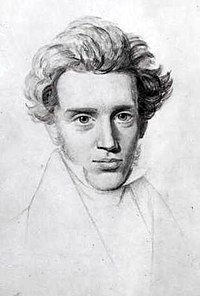
Søren Kierkegaard
He inspired many, though perhaps very few actually understood him. To some, he seemed quite mad, while to others, his religious devotion felt somewhat off-putting. .... Back in August 1922, Jiddu Krishnamurti underwent a spiritual awakening involving psychological transformation and physical conditioning. He and those close to him referred to it as "the process," which continued with varying intensity until his death. It all began on the 17th, when Krishnamurti complained of intense pain at the base of his skull and a hard, spherical swelling. Over the next few days, things seemed to worsen, with increasing pain, extreme physical discomfort, sensitivity, a total loss of appetite, and occasional bouts of delirium. Then, it appeared as though he were slipping into unconsciousness. Actually, he mentioned that he remained very aware of his surroundings, and in that state, he experienced a mystical sense of oneness.
...I was incredibly happy, because I saw. Nothing could ever be the same again. I drank from clear and pure waters, and my thirst was quenched.... I saw the Light. I touched a compassion that heals all sorrow and suffering; it wasn't just for me, but for the world. ...Love in its full glory has intoxicated my heart; my heart can never be closed again. I drank from the well of Joy and eternal Beauty. I am intoxicated by God.
Jiddu Krishnamurti
Many tried to grasp what he was. At the moment of his death, he said only: "Nobody."
One could probably list other examples, like Friedrich Nietzsche or Fyodor Dostoevsky, but even with these two, one can prove the following truth: that great insight comes with a heavy price. Would you ever want to experience—not just hear about—what the world might look like if all evil and suffering were suddenly "lifted" from it, like a veil? Evil exists only within the human mind.
Aha, I see how it is. It all looks like a transparent trap, doesn't it? Like some suspicious moderators are just trying to bait us into discussing paranoid personality disorder on Reddit, just so they can claim we actually have it. That's the plan, I suppose.
🤣
If I were to paraphrase Lao-cea:
I put my faith in everyone who writes under their own name, including the anonymous users and all the clones out there. That is what I call the virtue of faith.👍
I suppose friendship is really just the desire and the sheer willpower to give someone more than you ever expect to get back from them. If you're just playing nice because you want a return on your investment, or if you're just using someone's influence and talents to get ahead... well, then I don't think that's friendship at all. It’s just a selfish calculation. And honestly, just returning good for good and bad for bad... that doesn't really feel like a virtue to me.
There was this Zen master who once said:
To those who have nothing, I will take, And to those who have plenty, I will add even more.
At its core, I think friendship relies on honesty. Maybe love can exist without being completely honest, but I don't think friendship can. A "friend" who just flatters you or lies to your face just to stay in your good graces isn't really a friend. A true friend is someone who tells you the truth, even when it hurts.
Love tends to be possessive, whereas friendship isn't. You can share a friend with others.
It makes me wonder... is love actually greater than friendship? Jesus said: "Greater love has no one than this: to lay down one's life for one's friends."
Friendship... it might never truly end, maybe not even after death, while love often does. Sai Baba once remarked: "If a friendship doesn't last until the very end, then it perhaps never truly existed in the first place." It is quite sad, I guess, if you have to go through life discovering who your real friends are and who wasn't, but I suppose everything comes to light eventually.
Perhaps I should ask someone who understands people better than I do. Someone like:
Enes Kišević
Everything is—well—like....
The day is, like, sunny You are, like, cheerful Moving along, like, unnoticed
Everyone is, like, doing great Everyone is, like, alright Everyone is, like, wild..
And you are, like, happy!
Life feels, like, being at sea The birds are, like, free The future is, like, in your hands
Conscience is, like, clean And the sun is, like, bright Oh heart, like, sing
Everyone, like, cares for everyone Everyone is, like, a friend Everyone, like, cares about you And about the world..
And the day, like, passes And you, like, keep smiling And nothing, like, hurts you....
Donna Campbell6 said:Didn't old man Immanuel Kant pretty much tackle that whole thing already? 😁
I suppose we owe a debt to Professor Kant. He spent so many years trying to grasp the nature of the mind, sacrificing not just his mental energy, but his material comforts too—I feel a certain deep empathy for him, I guess. He didn't even land his first job until he was forty-seven, serving as a philosophy professor back in his hometown. And it’s true, he believed the mind is essentially bounded by experience—by what we sense and how we reason.
I actually found myself getting quite tangled up in a different discussion recently, one regarding the natural sciences, wondering if it’s even possible to prove certain parapsychological phenomena through physical, rigid laws of physics. Is objective proof even within reach? There is the lived experience and the thought processes of people who have gone through these things, but... I don't know, is that actual reality or just some "play of the mind"? There is this one theory suggesting that space might actually possess eight dimensions rather than four, which could potentially allow such phenomena to align with our current understanding of physical laws and theories.
Ramzes13 is a bit of a magical genius, really; he knows everything there is to know about crystals, crystal lattices, and that famous "as above, so below" principle. One shouldn't underestimate him. 🙂 It all seems more and more to me that our multi-dimensional universe might realistically resemble a Metatron cube in a four-dimensional projection, or maybe it is something even more complicated. Somewhere in that space, drifting between the "above" and "below" of those countless dimensions, our mind hovers, wondering if the universe is built upon laws, sheer chance, or God.🙏
Laws have their limits, but I suppose those limits actually live inside our own heads. A person really ought to try and figure out where the boundaries of their own perception end, and to do that, one probably needs to study how the human mind actually works. Starting with the brain, at least. But, it seems like even for American science, grasping the mechanics of the human brain is still a bit too much to handle, even if we are seeing some small steps forward.
As it stands, the furthest reach of what we can grasp regarding the laws of nature is quantum theory and relativity. That is quite a lot, I guess, because it’s similar to the level of understanding a two-dimensional being might have if they suddenly realized they were living on a three-dimensional curved surface rather than just a flat plane—that's the classic physics example for beginners, right? Up until that turning point, which was Einstein's introduction of the theory of relativity, Newtonian physics felt pretty much unquestionable. The real question is how much further we can push our understanding, or if we perhaps need to undergo some kind of evolution if we want to expand it.
If we find ourselves unable to explain every single phenomenon through scientific laws, then I suppose we are left with either pure coincidence or God, just as Seneca once suggested.🤷
Someone might ask, "What good is philosophy if everything is already fated? What's the point if God is running the show? Or even if life is just a series of random accidents?" After all, certain things simply cannot be changed, and there’s no way to prepare for the unpredictable. It seems either my decisions have already been mapped out by God, or fortune won't let me act on my own plans anyway.
Whatever the case may be, Lucilius—and I suppose it's all one of those things—we have to keep philosophizing; whether we're bound by the unyielding laws of fate, or if God acts as the ultimate arbiter who has arranged everything, or if human affairs are just being tossed around by mindless chance, philosophy is meant to be our shield. (Seneca, Epistle XVI)
I guess it doesn't really matter if we're being driven by pure luck or by God... even if we're nothing more than tiny pebbles on some distant coastline being tossed by the waves, or maybe just leaves scattered by the wind. We still have to turn to philosophy. It's our protection, because, well, what else is there left for us to do?
It might seem strange by today's standards, I guess, but back then, the entire Jewish community was deeply convinced that a Messiah would eventually arrive. They even had this ritual where they would essentially "load" a lamb with their sins before sacrificing it, which served as a symbolic way to cleanse themselves. Even now, Jewish people maintain that hope for a coming Messiah, whereas Christians believe he has already arrived. Personally, I feel like Jesus fit the description of the Messiah far too perfectly for it to be some kind of coincidence, though I suppose there were likely many others back then claiming to be him, whether out of pure madness or just seeking personal gain. You can still see similar things happening today—if you ever found yourself wandering through Jerusalem, you might encounter someone acting like a modern-day John the Baptist, roaming the desert in nothing but animal skins to preach. It’s often referred to as "Jerusalem Syndrome."
I find myself somewhat preoccupied by this whole typology of scum. I suppose one has to wonder... is it better to be a total scoundrel through and through, or just act like a decent person simply to avoid being targeted by even worse people? Looking at things from a distance, it seems to me that most of us fall into that second category. If we don't, then why on earth do we tolerate our own government? It feels like this second type is just your run-of-the-mill, everyday loser—a true *Americanus domesticus cretenensis*, if you will. 😂 The person who avoids being a jerk doesn't actually do it out of any real compassion for those they might otherwise mistreat. No, I think it's more because they fear being the one closest to the situation who ends up getting sacrificed—sort of like how they used to sacrifice a scapegoat, or Peter, to appease a conscience. They do it just to maintain a sense of public peace after all the wealth has been redistributed from the common folk to the real elite. ☕
I find myself agreeing most with Lola here; I think having a clear and lucid mind is an extraordinary value, something you might only realize once it’s gone, if ever. It is actually quite a significant achievement that Veronica decided to fight for her own mental clarity, which could lead to a certain kind of victory within her inner world—a sense of life satisfaction that is far greater than any conquest of enemy forts or some violent skirmish on a hillside. 😁 The real issue, I suppose, regarding why some people feel so defeated even when they haven't done anything wrong, is that our entire society is structured like a strategy of violence, though it's falsely presented as a strategy for development, promised progress, or victory. It's this winner-take-all system where, in the end, it isn't just humanity that loses, but also nature, which we diligently pollute with all our chemicals. 😲 On the other hand, those hardline types seem to love this state of affairs, but I guess it's just a form of addiction that clouds the brain—an addiction to adrenaline, or perhaps to the sheer meaninglessness of their own lives, and so on. They just aren't aware of the limitations of their own minds or the damage they inflict on themselves and others, because they shut themselves off from a different kind of humanity—one that isn't reduced to aggression or the idea that "man is a wolf to man," or things like that. 😍 Otherwise, I suppose everyone should collectively admire the courage and humanity of those guys in Rwanda who, right before the eyes of the whole world, ordered machetes to slaughter a million of their own fellow citizens. They tested belonging to a certain group by sticking fingers up victims' noses; if the nostrils were wide enough, then they were deemed worthy of death. It makes about as much sense as anything else. 🤣 Even a cannibalistic dictator like Idi Amin - Dada would probably envy us such a method of therapy, especially since he used to hide cowardly from the army before he took power, which is where his nickname comes from, I guess. Maybe even Julius Nyerere wouldn't have minded it, nor Robert Mugabe, who decided to toss all the white people into the river and seize their property. Oh, yes, they were all proponents of some sort of communism, or at least the expropriation of private property. 🤣 😂