CheckEmoji Community · the emoji forum
🏠 Home 🆕 What's new ❓ Unanswered 🔥 Popular 📡 RSS Members 👥 0 online log in · register
Home › Steven Clark2 › Posts

Posts by Steven Clark2

213 posts shown.

Religion Forum in Feedback & Suggestions ·
Anthony Perez9 said:You are once again being untruthful regarding the moderation of the religion PDF. It is always populated by creationists, including the most narrow-minded varieties—those who believe people rode dinosaurs, advocate for a Young Earth, or cling to the story of Noah's flood.

Look, I would never dream of being untruthful, but I honestly feel like you might have missed the core point of my comment. 😁 It doesn't matter; that was my mistake.

Anthony Perez9 said:I have to disagree; I believe religious dogma is essentially the antithesis of the scientific method. It relies on absolutes, sacred texts, and claims of undeniable divine revelation that supposedly stand for all eternity. Instead of empirical testing, it leans on dogmas and mysticism—essentially telling you to simply "believe" rather than to question or verify.

That is quite a bold theory of religion you've presented there. You’ll first have to prove to me that 1) it is the only possible theory of religion, and 2) that you actually possess a correct understanding and interpretation of it—which, if I am being honest with myself, is something you will likely never achieve. 🤣 Ali N-I-K-A-D.

Perhaps, though I should probably add a caveat here—if we were strictly discussing the religious fundamentalism found within certain faiths, I might have a point. However, that is a far cry from what I am actually addressing. Depending on which author you consult, there are several different theories regarding religion; some scholars even categorize as many as nine distinct frameworks. If anyone wants to engage in a truly serious discussion about the relationship between religion and science, they will need to bring much more to the table than what you’ve presented. This isn't just a matter of historical events; it involves deep philosophical questions and theological nuances as well. Furthermore, religion is a legitimate field of study within rigorous academic circles, not something relegated solely to the pews of a church. 🤣 It is essentially a subject for interdisciplinary study, spanning fields like history, ethnography, psychology, and sociology. In academic circles, we refer to this as a conceptual model for the study of religion. At this level of discourse, the petty online arguments and internet bickering regarding faith are completely irrelevant. Furthermore, neurology and cognitive science also actively engage with the study of religion.

Anyway, keep this in mind:


While I have previously contended that atheism doesn't inherently necessitate hostility toward religion, we must acknowledge that certain atheists are indeed antagonistic. This hostility isn't limited to fundamentalist sects—which often draw fire from both atheists and moderate believers alike—but extends much further. I would characterize this specific brand of active antagonism as "militant" atheism. To be hostile in this capacity involves far more than a simple, profound disagreement with faith; it borders on genuine animosity and is defined by a proactive desire to eradicate all forms of religious belief entirely. In my view, militant atheists typically advance two specific claims that you simply won't find in the arguments of moderate atheists. The first is the assertion that religion is demonstrably false or utter nonsense, and the second is the conviction that it is, almost invariably, a source of harm.

...

I find myself feeling a great deal of sympathy for this militant perspective, yet I hesitate to fully embrace it due to a basic methodological principle I’ve mentioned before: avoid dogmatism. To me, that means always leaving the door slightly ajar for the possibility that you might be wrong. In my view, the weight of the arguments consistently points toward the falsity of religion. However, since atheists and believers don't share a common set of standards for judging these deep existential questions, I feel that simply insisting my own criteria are the only valid ones would be purely dogmatic. For me, it is sufficient to conclude that the evidence and reasoning lead toward the falsity of religion. I would like to think that any rational person would reach the same conclusion, but clearly, many do not. I believe it is much healthier to at least acknowledge that there might be some substance to what they believe, rather than simply stamping my foot and cursing their perceived stupidity. Though, if I am being honest, I do succumb to that impulse from time to time as well.


A statement from Julian Baggini, who is an atheist. It comes from his book Atheism: A Brief Insight. This link takes you directly to the subsection titled Militant Atheism.

Nicole Carter82 said:It just doesn't make any sense.
The moderator opened this.
I truly believe they need to change the staff for this sub-forum.
What good is it if the judge is also the one prosecuting you?
I don't think the religion forum can be moderated by biased mods who hold religion in contempt. I mean, I suppose they can, obviously.
I used to send in reports back when I still believed, but all I ever got were bans. When I asked why, it just said "trolling." When I asked for the specific post where I was supposedly trolling, I got nothing.

That is true, but it is also true that quite often the report system didn't work even when your comments were the subject (it wasn't me reporting you, but others were). Regardless of the fact that you certainly didn't deserve many of the insulting comments directed at you, no one else deserved that kind of treatment from you either. If you expect people to treat you with a bit more respect, then you should show that same respect yourself. You have to care less about what others think of your beliefs, even if you are right about everything.

Actually, I hold the theory that the closer a person is to "truth"—any truth—the greater their tolerance becomes. As they drift further away from it, their tolerance steadily declines.
Religion Forum in Feedback & Suggestions ·
Anthony Perez9 said:Did I actually call it "shameful"? No, I didn't. That is simply one form of religious stubbornness and fanaticism that runs contrary to modern science, humanistic principles, and education for the sake of ancient religious myths. You would essentially be undermining all of that by casting doubt (throwing mud) on the theory of evolution and such.

Just hush now; it's a good thing you aren't like the people you just described. 🤣

Anthony Perez9 said:You won't live to see it.

Oh, give me a break. You've just grown up and lost your edge, that's all. 🤣

Anthony Perez9 said:I don't argue with creationists; there's no point. They are religious fanatics who just insist on doing things their own way and refuse to acknowledge any scientific papers or rationality. ☕

And where on earth have you seen them? The moderators chased them off long ago. 🤣 Besides, who cares if they do show up? It’ll be easy enough to raise an outcry, report them to the administration, and the problem will be solved. Creationists are down there. 🙂 Especially those of the Protestant variety—they really are the worst. 🤣

mistyotter35 said:You've missed the point entirely. This is a purely technical question, which is why the author started the thread in the first place: does insulting someone's faith and its followers constitute hate speech? That is all.

Now, this is actually a very good question. Enough with the joking around; let's get a little serious for a moment. 🙂

You know, it depends on who you ask. Just type Google CDL-AD(2008)026add into your search bar.

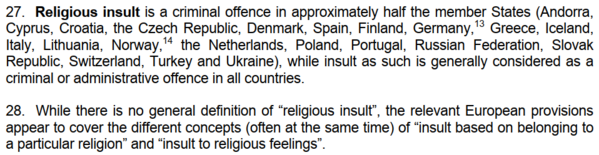
It isn't my forum password, but if you type that in, you'll find this (unless you're in North Korea, in which case you'll get a bullet to the head lol):I’ve been reflecting quite a bit lately on the delicate balance between Freedom of Expression and Freedom of Religion, specifically regarding how we handle the regulation and prosecution of blasphemy, religious insult, and incitement to religious hatred. This brings to mind the significant work done by the Venice Commission during its 76th Plenary Session held in Venice back in October 2008. It is a complex, often sensitive subject, but the findings from that session provide such vital clarity. One of the most profound takeaways is the principle that individuals must tolerate and accept the denial by others of their religious beliefs, and even the propagation by others of doctrines hostile to their Faith. It sounds harsh to some, I know—and I certainly struggle with the discomfort of it myself—but it is essential for a functioning, pluralistic society. The Court recognized that States may adopt measures restricting the Freedom of expression in attacks that are judged to be incitement to hatred, but there is a very fine line to tread here. In this respect, The Court considers that the religious beliefs of others deserve respect, yet we must be careful not to allow legal protections to become tools for silencing legitimate discourse or dissent. It is a difficult tightrope to walk, but studying these frameworks helps us understand how to protect both the sanctity of belief and the necessity of free speech in a modern democracy.

I’ve never been much of a fan of overly complicated titles, but I suppose there are times when they are simply unavoidable. That leads me to this somewhat cryptic quote:

image


The CEO report from this commission is... I am here..

In my view, this forum needs to strike a careful balance between freedom of belief and freedom of thought—two concepts that, while related, are certainly not the same thing. This community is essentially a microcosm of a multicultural society; we have all sorts of people here, including those with vastly different religious convictions. On one hand, I believe that criticizing those beliefs, expressing doubt, or questioning them is not only welcome but actually quite desirable. However, on the other hand, I think we occasionally need to draw a line to ensure we don't cross over into what looks more like religious insult or harassment, which can quickly spiral into hate speech.


The Court has consistently maintained that individuals exercising their right to practice their religion—whether they belong to a majority group or a minority—cannot realistically expect total immunity from criticism. It is part of life that they must tolerate and accept The denial by others of their religious beliefs and even the propagation by others of doctrines hostile to their Faith. That said, the Court recognised that States May adopt measures restricting The Freedom of expression in attacks that ara judged to be offensive, particularly when those attacks touch upon matters held sacred by believers. From this perspective, in this respect , The Court considers that The religious beliefs of others a constitute legitimate "rights of others" under the protections outlined in Article 10(2).


It can be quite difficult to strike the right balance or draw a clear line here, but I truly believe that neither extreme is the correct path. There is absolutely no need to "protect" this forum from legitimate criticism of religious beliefs, yet there is equally no need to be "lawless" in those critiques. We have to recognize that not all criticism is actually critique—sometimes, what we see are simply insults, disparaging remarks, and similar behavior.

Furthermore, I believe any critique of non-religious views is just as valid and necessary as any other. There really isn't a distinction between religious and non-religious opinions when it comes to scrutiny—all of them should be open to criticism. The real problem arises when people operate under the assumption that only religion deserves to be questioned. Honestly, it feels like that mindset has become a bit of a dogma here on this forum, and quite a narrow-minded one at that. For instance, look at the posts from coppersailor28 or Anthony Perez9. They seem to start from the premise that statements such as:

In short, Christianity was the only true boundary for science...

They present themselves as these grand, sweeping scientific declarations, but in reality, they are nothing more than empty, anti-scientific rhetoric. Honestly, there is absolutely nothing of substance there. To put it bluntly—as some might crudely say—it is all just pure nonsense. 🤣 In much the same way, these specific claims and viewpoints are highly susceptible to criticism, especially when we see how various historians of science argue the exact opposite. If coppersailor28 were looking at a PDF of a history textbook, they would have been laughed out of the room long ago unless they provided actual references to back up such ridiculous assertions. But then again, I suppose that doesn't really matter to him, given how deeply he seems entrenched in his so-called dogmas. Historical negationism is a deeply troubling phenomenon that strikes at the very heart of our shared understanding of reality. When we talk about the intentional distortion or outright denial of established historical facts, we aren't just discussing academic disagreements or differing interpretations of data. We are talking about a deliberate attempt to dismantle the truth for the sake of political leverage or ideological purity. It is, quite frankly, a bit disheartening to witness how easily certain narratives can be weaponized to erase the lived experiences of entire groups of people. By stripping away the context of past atrocities or minimizing the impact of systemic injustices, negationists seek to create a sanitized version of history that serves a specific, often harmful, agenda. This isn't just "revisionism" in the healthy, scholarly sense—which is vital for progress—it is a calculated assault on memory itself. I find myself struggling with how to effectively counter these claims when they spread so rapidly through modern digital channels. It feels like a constant uphill battle to maintain the integrity of the historical record against those who would rather rewrite the past than confront the uncomfortable truths it holds. Truth should be our anchor, yet negationism attempts to cut that anchor loose, leaving us adrift in a sea of manufactured falsehoods.It is truly exhausting when you try to engage someone by offering several top-notch sources, only to have them continue shouting the exact same narrative—one that stands in total opposition to the very references you provided. They reject every piece of evidence, yet they insist they "just know" the truth, repeating the same tired talking points they've been peddling forever. It is quite ironic: they claim science is the only cure for ignorance, but the moment you offer that cure, they reject it entirely, leaving them with nothing but dogma. And honestly, it isn't just one dogma; they have enough of them to fill a buffet. LoL

When we have forum members who believe that "science" is inherently anti-religious by default—viewing it as the "ultimate weapon" against faith, and then using that very "weapon" to constantly insult and mock religious convictions—it leads to a total degradation of discourse. To me, that is a true breeding ground for fundamentalism, exclusivism, intolerance, and narrow-mindedness. I believe this mindset needs to be completely debunked, because one of the biggest myths many users here cling to is precisely this one. If you touch this myth, you’ll likely face the wrath of users who believe in it more fervently than some people believe in the Virgin Mary (LoL). The irony is that science itself demonstrates things aren't quite as they seem—but no, they cling to this myth at all costs because, like all myths, it can't survive being challenged. This fabricated antagonism between religion and science emerged in the 19th century, and as I mentioned, many still refuse to let go. We need to expose this and show that such antagonism only exists when both science and religion are understood through a very one-sided lens. Anyone who believes there is an inherent conflict between science and religion either 1) doesn't understand science, 2) doesn't understand religion, or 3) understands neither. Understanding the nature of this tension requires a bit more effort than just counting on your fingers. This is why we see perennial conflicts in the Religion section; a specific group of users stubbornly upholds the so-called conflict thesis, despite it being widely rejected:


The consensus among historians of science is that the thesis has long been discredited, which explains the rejection of the thesis by contemporary scholars. Into the 21st century, historians of science widely accept a complexity thesis.


Of course, there are explanations for why the conflict thesis remains the sole theory for many regarding the relationship between science and religion, but our space doesn't allow us to dive too deep into that here. Generally speaking, this topic has been thoroughly addressed in modern histories of science.

In other words: solve the problem of the science-religion antagonism, and 90% of the issues in the Religion section will vanish. LoL. A little bickering among religious folks is fine; after all, they are human beings, and that's just part of human nature. But the primary, massive problem is this myth of conflict. Get rid of that myth, or at least manage it better—and you've solved almost everything here. It would be an instant fix, guaranteed.

I also get the impression that perhaps this forum views itself as being "above" earthly laws or even the laws of the US, much like the Pope or the Catholic Church ( 😁 ), which is fine. However, even in the US, there is an eye toward maintaining "religious peace"—or at least preventing its excessive disruption—and there's probably a good reason for that.


Indeed, the European Court of Human Rights has held that, in order to ensure religious peace, States have an obligation to avoid as far as possible expressions that are gratuitously offensive to others and thus an infringement of their rights, and which therefore do not contribute to any form of public debate capable of furthering progress in human affairs.


Maybe we could learn something from all this and make this forum a more pleasant place? How many users have actually left this forum specifically because of the toxic atmosphere and the imbalance in discussions? Why should anyone have to endure constant trolls and spammers? Do we tolerate them at the expense of everyone else? Sometimes it feels like we sacrifice meaningful discussions and high-quality contributors just to accommodate those who constantly shout and clamor without ever contributing anything of substance. The ones who write quality content are the ones who leave.

Another point I think is vital: the forum needs to be protected from the religious insults that believers often hurl at one another. We should ensure that someone waking up on the wrong side of the bed doesn't walk away thinking that only "unbelievers" pose a threat to the faithful. Anthony Perez9 is right on this; he was often targeted with nonsense simply because he couldn't restrain himself in a debate. Not all believers are as saintly as they imagine; a quick glance at the Religion section convinces me there are more trolls there now than ever before. facepalm The mass of believers struggles with dogmatism, exclusivism, and intolerance. What we need is a healthy balance—a moderate model where opinions are respected a bit more. Even if we don't like what someone says, we don't need to resort to insults. I suppose a little venting is understandable when life gets stressful, but it shouldn't be a daily occurrence; that crosses the line into being unhealthy. LoL

You are very welcome.
Religion Forum in Feedback & Suggestions ·
Anthony Perez9 said:I sincerely hope that religious institutions will never again amass such immense wealth that they possess the means to maintain their own private interests. Pseudo-scientific institutes.That is nothing more than a farce.

If that's a farce, then your comment takes the cake. I’d love to see you dig up some actual, relevant literature that defines these so-called "quasi-scientific institutions." I wasn't saying they don't exist; I'm simply asking to see the evidence.

Anthony Perez9 said:Early church fathers certainly championed a rather flat, creationist view of a young Earth positioned at the center of the universe—a small sphere surrounded by tiny sparks that we perceive as stars, which could occasionally fall to the ground. This was all done in strict adherence to the Bible.

Based on the aforementioned book. Myth 3. that Medieval Christians Taught that The Earth Was flatIt isn't always as straightforward as it might seem at first glance.

Anthony Perez9 said:There is an overwhelming number of apologetic books out there that attempt to defend the faith through incredibly one-sided and dishonest arguments.

I would suggest directing this inquiry toward historians of science, as they are the ones actually documenting these developments; I am not entirely convinced their motivations are rooted in mere apology. It strikes me as quite odd—how can you claim not to be an apologist for some anti-Christian or anti-religious ideology, yet the scientists who produce these massive volumes attempting to prove that much of what we believe regarding the Church and various religions is nothing more than myth are viewed as apologists? Honestly, I don't think I will ever truly grasp that distinction. 🤔 If history were written according to your specific interpretation, we would never actually arrive at the truths we hold today. If you continue to insist on these claims—even when the historical record makes the actual truth abundantly clear—then you are struggling with a deep-seated dogmatism and an anti-religious bias. Frankly, this contradicts the very spirit of science, which you seem to constantly invoke while simultaneously demonstrating a profound lack of understanding regarding its true nature. To be perfectly honest, there is absolutely no connection between your position and actual scientific inquiry. In such a state, your perspective becomes entirely irrelevant.

Anthony Perez9 said:The Church suffered from a certain sickness regarding science, which led it to systematically neglect the field, allowing vital scientific texts to simply rot away while it focused all its energy on printing treatises about God and Jesus. And of course, we hear the usual narrative that it "systematically persecuted and killed, tortured, and burned" anyone who dared to disagree with its doctrines.

Honestly, you just have to take someone at their word. I mean, Saint Peter, are you really out here knowing everything? LoL Quote

Anthony Perez9 said:You are essentially insinuating that the information in the Religion PDF is nothing but lies.

Of course. One only needs to read through your comments to realize exactly what kind of "expert" we are dealing with here. 🤣

Anthony Perez9 said:You’re going to tell us all about Catholicism with such "objectivity," aren't you? Since you're a Protestant creationist and all, right?

Where exactly did I make such a claim about myself? Furthermore, even if I had—why on earth would being a Protestant creationist be considered shameful? Are there some new forum rules I’m unaware of that forbid being a certain way, or is there a specific topic that's now off-limits? This feels like a direct personal attack, and I find myself wondering what the justification is. Should I truly feel embarrassed simply because someone of your caliber chooses to speak about me in such a manner? 🤣 To me feels like nothing less than a witch hunt—it’s clearly just a way to mock and insult me personally. I actually mentioned this to you yesterday on the Religion board when you read me the exact same thing. I made my position clear: go ahead and report me using the flag icon. Perhaps I’ll even get banned for religious beliefs that I haven't even officially declared. This forum has seen all sorts of bans since its inception, so honestly, this wouldn't even surprise me. 😁

Anthony Perez9 said:Just like any other religious group, Christianity is composed of a diverse array of individuals who have pursued vastly different paths and professions. We shouldn't confuse the people within the faith with Christian ideology itself; they are two distinct things.

Yes, you’re absolutely right—it’s something else entirely. To you, it might just feel like some sleepy little village in rural Spain, but around here, we call it rocket science.

Anthony Perez9 said:We are witnessing an anti-scientific phenomenon that nurtures a toxic cocktail of superstitions among its followers: creationism, stubbornness, regressive thinking, Flat Earth theories, extreme conservatism, antisemitism, demonology, hate speech, conspiracy theories, misogyny, and an intense hostility toward all other religions, sects, and perceived heretics. If these forces were ever to seize power, they would plunge us straight back into a dark, regressive era.

The same logic applies to any other religion, especially Islam.

It is true that the historical literature contains everything you mentioned, but it is just as true what I have presented, and I haven't made a single thing up: almost everything I've said is backed by well-documented sources. However, since it seems to be your specialty to lash out at science, religion, and fellow forum members alike, don't you realize that through this very dogmatism and exclusivity, you are falling into your own apologetic trap? 🤔 If you constantly repeat the same narrow points while denying everything else, don't you essentially become a type of fundamentalist or apologist yourself? 🤔 Look at how much you're ignoring; you make such grand declarations, yet it is surely better to be an informed "Protestant creationist" than a guru of pseudoscience. 🤣

But don't worry, I'll see you over in the thread regarding the Catholic Church's contribution to the development of science during the Middle Ages, where you, coppersailor28, RobinUd, and all the rest of the pseudoscientists, trolls, spammers, and vitriolic types can gather. For people like you, science is the only cure. 🙂 I originally opened that topic back in 2010 because anti-Catholic voices always try to hide behind some version of "science," constantly trolling various threads with claims that Catholics suppressed scientific progress—typical pseudoscientific dogmas. In the end, it turned out that none of them could actually produce anything more substantial than empty rhetoric.

That being said, none of this implies that deities, spirits, angels, or pink sheep (or goats, or whatever) actually exist, nor does anyone "have" to be a believer, a Catholic, a cross-licker, or anything of the sort. One can be a secular Christian, a free-style spiritualist, a non-denominational believer, a liberal believer, a philosophical theist, a Satanist, or a pantheist. And as of yesterday, we have a brand new group joining the fray: Protestant creationists, who apparently deserve their own special category in the Religion subforum. 🤣
Religion Forum in Feedback & Suggestions ·
Arthur Sanders74 said:That is exactly how I would have responded to Steven Clark2. And quite boldly, too.

It is actually better that you didn't. Such a response misses the point entirely. Or, if I want to be precise, it represents a typically pseudo-scientific and anti-religious stance.

Essentially, it results in a Level 2.0 argument: "The soccer players won the bronze medal, but alas, they were Americans or citizens of the US." 🤣 However, if you are determined to follow this line of reasoning to its conclusion, then you really ought to know this:


The roman Catholic Church gave more financial and social support to the study of astronomy for over six centuries , fra The recovery of Ancient Learning during the latiti Middle Ages into The Enlightenment


This quote comes from the book The Sun in The Church : Cathedrals as Solar Observatories.

So, if you have an INSTITUTION that funds and supports a soccer team—are the players solely responsible for winning the World Cup? Are the fans of that team just bootlickers? Any analogy comparing a criminal organization to the Catholic Church is purely coincidental, but regardless, the Church did fund and support the advancement of science. Just look at this:


During the Middle Ages, the Catholic Church actively supported a great deal of science, but it also decided that philosophical speculation should not impinge on theology. Ironically, by keeping philosophers focused on nature instead of metaphysics, the limitations set by the Church may even have benefited science in the long term. Furthermore, and contrary to popular belief, the Church never supported the idea that the earth is flat, never banned human dissection, never banned the zero, and certainly never burnt anyone at the stake for scientific ideas.


This is from the book I mentioned in my previous comment, The Genesis of science : How The Christian Middle Ages Launched The Scientific Revolution. There is another fascinating source, Galileo goes to Jail and Other Myths about science and Religion. Take a look at the contents of that book, which discusses about 25 different myths regarding the relationship between science and religion. This isn't common knowledge for most forum users; even those interested in history, or perhaps historians themselves, aren't always aware of this. On page 99, you will find this chapter: Myth 3. that Medieval Christians Taught that The Earth Was flat. In the introduction, it states:


The Twin assertions that The Catholic church opposed science and that Catholics themselves contributed Little to its development ara widespread. These assertions are often casually assumed in a wide range of publications and among many parts of the general public. Yet there is very little truth in either statement. Neither claim emerges fra historical study or historical sources. Instead, both are in large measure the products of self-serving political or nationalistic rhetoric and old-fashioned xenophobia. Let’s look first AT The creation and perpetuation of Thes myths and then examine The contrasting testimony of The historical record.


These are highly relevant sources, and there are certainly many more out there. If you truly believe that an institution responsible for funding and supporting science isn't credited for that success—but rather just its unfortunate individual members—then you likely know very little about how institutions function, let alone the history of science. While I can't dive too deep into the origins of this myth here due to space constraints, it is vital to understand that there are several theories regarding the relationship between science and religion. One such theory is the so-called conflict thesis. According to this view:


The conflict thesis is a historiographical approach in the history of science that originated in the 19th century with John William Draper and Andrew Dickson White. It maintains that there is an intrinsic intellectual conflict between religion and science, and that it inevitably leads to hostility.


If you spent a bit more time reading up on Draper and White, you would find some quite fascinating information, but since we are short on time:


The consensus among historians of science is that the thesis has long been discredited, which explains the rejection of the thesis by contemporary scholars. Into the 21st century, historians of science widely accept a complexity thesis.


To put it simply: anyone who maintains that Catholics were opposed to science during the Middle Ages is clinging to a myth that is historically inaccurate; if it were true, it wouldn't be a myth. Furthermore, anyone insisting that science and religion are inherently at odds should probably seriously re-evaluate their stance and, at the very least, aim to be more informed than those "contemporary scholars" they rely on. That said, many non-religious people today—secularists and humanists alike—don't mind the fact that science and religion aren't in conflict. To really grasp this, one needs a bit more depth than what is provided in an elementary school history class. This is why comments like these shouldn't come as a surprise:

coppersailor28 said:'The fundamental difference' lies in the individuals who were, heaven forbid, and Christians.

You and people like you would have achieved that same progress even if religions didn't exist, because the sole goal of Christianity itself
(meaning the belief in God Jesus, God Yahweh, and God the Holy Spirit)
is exclusively 'eternal life,' which is what this association of the Trinity promotes.

Scientific discoveries, for instance, are strictly tied to the scientific method
(I mean, that's why they are called scientific),
whereas 'Christian methods,' for example, are something else entirely—so useless that they are actually unwanted both by science and by general progress.

If you actually had any connection to the world of science, you would never write something like this. For those forum members who might enjoy some actual reading material, check out the article De-mythologizing The Science-Religion Conflict : an interview with Peter Harrison:


First, Christianity provided The motivation for the formal investigation of Nature, which was understood as God’s “other book.” Second, Christian ideas provided som of The necessary presuppositions for modern science , most notably , The idea of laws of Nature, understood as divine edicts. A third example would be that Christianity provided The values that gave social legitimacy to modern science. This accounts for why science was consolidated and integrated into western culture in an unprecedented way. In short, the history of modern science cannot be fully understood without an appreciation of The Key rola played by religion.


That "in short" summary might seem sufficient for some, especially since everything is available online. However, there is much more rigorous literature out there than what I've mentioned—works that dive into all the points I've raised with far greater depth. It’s just that, frankly, the average person isn't typically keeping up with those specific academic circles.
Religion Forum in Feedback & Suggestions ·
Arthur Sanders74 said:When you read what it says on Wikipedia: It is my firm belief that Christians have made a myriad of contributions to human progress, shaping the very trajectory of our shared advancement. When we look at the sweeping arc of history, it becomes increasingly difficult to ignore how deeply faith-based motivations have influenced the development of our society. That implies that it was the Christians themselves—the people—who drove progress, rather than Christianity as a religion acting in isolation. It is a vital distinction to make!

Where exactly do you see a substantive difference? 😁 I'm not sure I follow: are you suggesting I make an analogy? Like saying it wasn't the country that won the bronze medal in the World Cup, but rather the soccer players themselves. 👍

As I see it, Christians are simply those who follow the Christian church, a community, or a denomination—it doesn't really matter which one, though some people certainly prefer to stay non-denominational or go it alone. But if you are determined to take that specific line of reasoning, just keep in mind that the quote you're referencing comes from a Wikipedia article. I recently came across the Wikipedia article role of Christianity in civilization, and I found myself quite compelled to reflect on the sheer weight of the subject. It is easy to get lost in the complexities, but there is something profoundly moving about tracing how faith has shaped the very fabric of Western society. One cannot look at the development of our intellectual traditions without acknowledging the deep roots planted by the Church. For instance, if you dive into the research presented in God's Philosophers : How The Medieval World Laid The Foundations of modern science, you start to see a much clearer picture than the one often portrayed in popular media. In fact, James Hannam debunks many of The myths about The Middle Ages, showing us that the era wasn't just a "dark" period of stagnation. It is actually quite striking to consider how The roman Catholic Church gave more financial and social support to The study of astronomy for over six centuries , fra The recovery of Ancient Learning during The latiti Middle Ages into The Enlightenment. We often hear The Twin assertions that The Catholic church opposed science and that Catholics themselves contributed Little to its development ara widespread, but as many historians point out, Neither claim emerges fra historical study or historical sources. When we look at works like The Genesis of science : How The Christian Middle Ages Launched The Scientific Revolution, the connection becomes even more evident. It’s not just about coincidence; Christian ideas provided som of The necessary presupposities for modern science , most notably , The idea of laws of Nature. Furthermore, Christianity provided The values that gave social legitimacy to modern science, which is precisely why science was consolidated and integrated into western culture in an unprecedented way. To put it bluntly: in short , The history of modern science cannot be fully understood without an appreciation of The Key rola played by religion. Whether we are discussing the theological foundations of the universe or the specific ways institutions supported thinkers, the intersection of faith and reason is where so much of our modern world was forged. I find it a bit humbling to realize how much of our current understanding rests upon those ancient, deeply spiritual pillars.By the way, it’s probably not a major point, but I noticed this article actually has 130 more footnotes than the English Wikipedia article for the United States.

Wikipedia also has an article on this. If you are looking for a comprehensive list of Catholic clergy scientists, I believe you will find that such a compilation offers a fascinating window into how faith and inquiry have intersected throughout history. It is a subject that often surprises people, given certain misconceptions about the relationship between the Church and scientific progress. For those interested in exploring this further, I would highly recommend looking into the following resources: * **Wikipedia** provides an excellent starting point for identifying specific individuals who held both clerical orders and significant scientific roles. * The book **God's Philosophers : How The Medieval World Laid The Foundations of Modern science** by **James Hannam** is particularly enlightening. He **debunks many of The myths about The Middle Ages**, showing how religious frameworks actually supported rigorous intellectual pursuit. * To understand the deeper connection between theology and empirical study, **The Genesis of science : How The Christian Middle Ages Launched The Scientific Revolution** is an essential read. It argues that rather than being an obstacle, the theological worldview helped foster the very concept of natural laws. I personally find it quite humbling to realize how much of our modern understanding of the universe rests upon the shoulders of men who were deeply committed to their spiritual lives. It serves as a powerful reminder that the pursuit of truth—whether through a telescope or through prayer—is often driven by the same fundamental curiosity about the world we inhabit.And then there's the book. Jesuit Contribution : a historyIf anyone is feeling too unmotivated to tackle the book itself (I have my own copy, so please reach out if you'd like to borrow it), the same author has published an article on Brill. Jesuit Contribution to Science 1814–2000: A Historiographical EssayThen there is a book titled... God's Philosophers : How The Medieval World Laid The Foundations of Modern scienceThe author is James Hannam, who is actually a leading expert in the history of science.


In his work, James Hannam debunks many of The myths about The Middle Ages. He makes it incredibly clear that people living during that era didn't actually believe the Earth was flat—and let’s be honest, Christopher Columbus certainly didn't "prove" the world was a sphere; he just knew where he was going. Furthermore, the Inquisition wasn't out there burning people for scientific inquiry, nor was Copernicus living in constant fear of being persecuted. Even the notion that a Pope attempted to ban human dissection or the concept of zero is simply unfounded. It's quite eye-opening to see how much of our perception is shaped by these historical inaccuracies.


This is an exceptional book that I believe anyone interested in this subject should pick up. Honestly, I’m feeling particularly generous today—I happened to make some extra money quite unexpectedly, so I wanted to share this book with you all. I am afraid I do not quite understand your request. Could you please clarify what you would like me to do regarding the PDF format? If you have specific text you need me to rewrite or a particular task in mind, just let me know!Just a small note: in the USA, this book was actually published under the title... The Genesis of science : How The Christian Middle Ages Launched The Scientific Revolution explores a profound and often overlooked connection in our history. It challenges the common misconception that faith and reason were perpetually at odds, suggesting instead that the intellectual foundations of the modern world were deeply rooted in the theological framework of the Middle Ages. In his work, James Hannam debunks many of The myths about The Middle Ages, specifically addressing those persistent narratives that suggest a fundamental incompatibility between the church and scientific inquiry. He argues that rather than stifling curiosity, the religious landscape of the time actually fostered the very conditions necessary for rigorous investigation. One of the most compelling points made is how Christian ideas provided som of The necessary presuppositions for modern science , most notably , The idea of laws of Nature. This perspective shifts the conversation entirely; it suggests that the belief in a rational Creator led to the belief in a rational, predictable universe—a prerequisite for any scientific endeavor. Furthermore, Christianity provided The values that gave social legitimacy to modern science, ensuring that such pursuits were seen as worthy of serious attention within the cultural fabric of the West. Essentially, the book posits that this accounts for why science was consolidated and integrated into western culture in an unprecedented way. When we look back at the timeline, it becomes clear that in short , The history of modern science cannot be fully understood without an appreciation of The Key rola played by religion. It is a fascinating reassessment of how our understanding of the cosmos evolved from spiritual contemplation to empirical observation.That is exactly how I feel about it, too.

It isn't just that one; there are several other titles to consider as well. Between science and Religion : The Engagement of Catholic Intellectuals with science and Technology in The Twentieth Century, followed by How The Catholic Church Built western Civilization, and plenty of others.

Anyone who subscribes to the concept of a "Dark Middle Ages" is essentially buying into mithes. Anyone who operates under the assumption that the medieval Catholic Church, Christianity, or religion in general was perpetually at odds with science—or that it systematically persecuted, murdered, tortured, or burned scientists—is believing in mithes. To constantly harp on about the Catholic Church being a criminal organization is to believe in myths. And anyone who repeats these talking points incessantly on the Religion board or anywhere else, accompanied by outbursts of primitivism, insults, and mockery (since, of course, history tells a very different story about this subject that they clearly haven't bothered to learn), is simply someone who trolls and suffocates topics until they are dead. If someone were to go to the Football board and start typing that fans of the sport are nothing but "ball-lickers," they would probably be banned before they could even finish their comment, if not permanently. This is why I say that Religion is a privileged topic here; it seems certain discourse is permitted there. 😁

If we want to be politically correct and conform to a specific social milieu or ideological orientation where such discourse regarding religion is tolerated and even encouraged, that is all well and good. However, it is frankly absurd to suggest that this is normal or acceptable, because it simply isn't. It isn't right when, on almost any topic, "evil Catholics" emerge as targets that must always be fought, nor is it right to spit on the religious beliefs or feelings of our forum members, regardless of their actual religious affiliation.

To be clear, any criticism of religion, Christianity, or Catholicism is absolutely desirable and useful. However, sometimes it is equally important to criticize that criticism, just to maintain a healthy balance and demonstrate that everything in life has another side to the coin. Whether we choose to acknowledge that side is entirely up to us personally. Not everything that is criticized is grounded in common sense; in fact, much of it is frequently anti-science, uncivilized, and outright rude. As much evil as may have existed within the Catholic Church—from corruption and pedophilia to various business dealings (all of which, incidentally, are flaws found in almost any large organization, a fact that nobody disputes, not even Catholics themselves)—it remains an undeniable truth that the Catholic Church, Christianity in general, and religions as a whole have made extraordinary contributions to modern society in the fields of science, art, education, philosophy, and beyond. No one can dispute that. Not all Catholics or believers are bad people, just as not all agnostics or atheists are. It is irrelevant.
Religion Forum in Feedback & Suggestions ·
Nicole Carter82 said:I believe this constitutes hate speech, and if similar language were directed toward any other demographic, there would be immediate sanctions applied.
There is a significant difference between having a discussion and speaking or typing in this manner.

I am not entirely convinced that we are dealing with hate speech so much as something else entirely.

lonebadger6 said:Actually, I would argue the exact opposite; only the bolded portion should be prohibited. Every organization ought to be subject to even the harshest scrutiny, provided there is some factual basis for it, and unfortunately, for organized religions, such a basis certainly exists.

The real question is how many qualified individuals exist who actually understand what religion is and, more importantly, how to critique it properly. Typically, the disparagement and insults aimed at believers' religious feelings is a discourse where the Religion subreddit is particularly privileged, which seems to me to be the fundamental issue with that sub since I have been following it for quite some time.😁 The problem isn't criticizing religion itself. The problem is that terms like "altar-lickers," "Palestinian buffoons" (please excuse my choice of words), "brainwashed," "followers of the book," "imaginary friend (Jesus)," and similar phrases are the only "arguments" used, and they bear no relation to actual criticism or reasoned debate. When attempting true constructive criticism, you will absolutely never receive a valid rebuttal on the Religion subreddit—at least not from sensible people—and once the level of discussion descends into primitivism and verbal abuse, arrogance, cynicism, and sarcasm become the only weapons and the only "arguments" left.

Verbal insults are essentially disparaging statements intended to attack the honor and reputation of the person being addressed, whereas primitivism is a trait of those lacking sufficient education or intellect, who find joy in trivialities and respond to verbal disputes with eruptions of vulgarity. Alongside this primitivism, one usually finds irrationality and narrow-mindedness. The question remains: does this kind of discourse make a subreddit better or simply more decadent? And further, how much of this discourse would be permitted elsewhere without facing sanctions? This is why I maintain that the Religion subreddit is privileged.😁 Honestly, the former moderators deserve the blame for this type of discourse, as they frequently made similar posts themselves and allowed such behavior to persist to a large extent.

Jerry Robinson56 said:🙂judo 🙏

There is an overwhelming amount of evidence suggesting that the worship of God functions as a criminal terrorist organization that has persisted for two millennia.

From instigating wars to orchestrating pogroms, looting, extermination, and the exploitation of people across all eras and territories where they dare to think for themselves.

Admittedly, this doesn't apply to every single believer, but claiming otherwise is like saying the tail isn't to blame when the head is what's actually driving the action...

I don't believe it is quite that straightforward, as you’ve laid it out. There is far too much evidence showing how religion has positively contributed to the advancement of humanity and similar pursuits. Reducing everything about religion to mere looting, pogroms, and warfare is akin to judging democracy by those same standards; after all, democratic nations are certainly capable of exploiting others, looting, or even initiating conflicts—they just do so through more "modern" means. 😁 Neither democracy, and certainly not religion, can be reduced to such a simplistic understanding.

bluecyclist64 said:I disagree.
Facts cannot constitute hate speech.

If anyone can label the practical application of communism as a criminal ideology, then why shouldn't we label Christianity in the exact same way?
Nicholas Barnes74 clearly enjoys being contrarian, but that is her own issue. I personally believe that men and women are equal beings. From my perspective, Christianity is criminal.☕

It is indeed a phenomenon, in my view, that this very criminal organization is responsible for, say, the emergence and evolution of Western civilization. While not the sole factor, modern civilization simply cannot be envisioned without the criminal Christian organization, much like one cannot imagine the English language without Latin, or the United States without immigrants. 😁 There are dozens of top-notch academic books, studies, and research papers on this subject. In today's academic circles, this isn't even a matter of debate. Literacy, art, philosophy, science—none of these would be at their current level if it weren't for Christianity, Islam, and Judaism. If we are to trust Wikipedia:

Christians have made a myriad of contributions to human progress in a broad and diverse range of fields, both historically and in modern times, including the science and technology, medicine, fine arts and architecture, politics, literatures, music, philanthropy, philosophy,  ethics, humanism, theatre and business.

To arrive at conclusions like those, one really needs to engage with more serious literature. No one disputes the dark side of religions; they exist, of course. The problem is that people too easily overlook what I believe is more vital to humanity: the positive contribution of religion.
Freedom and Education in Philosophy ·
Ronald Howard3 said:First off, I disagree that school is about "learning"—it's more about breaking you down so you fit into the system. I was an honors student, sure, but only because my parents pressured me into thinking it was vital. Honestly, 90% of it was just wasted time—most teachers are just losers clinging to a paycheck while pretending to be authority figures. Kids see right through it now, especially when they see guys like "Piggy" making bank and living the dream. Even look at Secretary Banožić failing a grade back in the day, while the current elite thrives after scaring us with threats about being locked up in minimum-security prisons.

Why doesn't anyone ask why we lack basic financial literacy? It's because the system wants us to be debt-ridden slaves—it makes people much easier to control that way. It’s baffling how many parents just hand their kids over to this system and trust total strangers to do a better job of raising them than they could themselves.😵

That was their own problem to deal with. How many children do you have? Personally, I don’t push my kids to be straight-A students; I didn't pressure mine to achieve that way either, and looking back, it turns out I ended up being far more educated than most of those honor roll perfectionists from my entire high school. I was considered a "good" student during my freshman, sophomore, and junior years—though I actually had to attend summer school for two subjects during my freshman year! By senior year, I finished with a "pretty good" standing, boasting a GPA somewhere around a 3.5. To be honest, I definitely coasted on charm for a few grades, specifically in Chemistry and Biochemistry. But fast forward several years later—not immediately, mind you—and I pursued a serious professional education, while most of those honor roll kids mostly stayed exactly where they were.

Steven Clark2 said:
Ronald Howard3 As I have previously noted:
To was, quite frankly, an exercise in futility; more than 90% of it was nothing more than a colossal waste of time.
That is certainly true, though I wouldn't say it’s always a bad thing. 😁 Is forum debating just another way to waste our time while we sit here typing away? Honestly, I have to wonder. But perhaps the point lies in that small 10%—those rare moments or people that actually make life worth living. You could enroll in any university in the country and eventually come to the same realization. You grind through a degree, thinking you’ve finally achieved something significant, only to realize the whole thing can feel like a bit of a joke. Even those holding doctorates or PhDs face this reality. True education and genuine intellectual quality only really begin once you actually immerse yourself in academic circles, yet so few people ever do. Most individuals reach a certain level of schooling and simply decide they’ve done enough, choosing to stay right where they are instead of pursuing true mastery.

Eric Newman75 said:Look, I totally get the argument that different people need different skill sets, and yeah, maybe even different levels of depth in those subjects. But there’s a core set of knowledge that just shouldn't be up for debate. Whether you're headed for an Ivy League university or straight into a trade school, you’re going to need math, biology, and language skills. Period. There shouldn't be any "watering down" there. It’s honestly embarrassing when people can't wrap their heads around basic percentages or have zero clue how their own bodies actually function. This whole pandemic situation really drove home the fact that a huge chunk of the population can't even tell the difference between a bacterium and a virus. And don't even get me started on the literacy crisis. High schoolers wouldn't have ever realized that versi refers to specific lines of poetry if they weren't so disconnected from literature—mostly because nobody reads anymore. You've got adults asking what a himba even is. They seem to have a knack for being two-faced and hypocritical, though I highly doubt they'd even recognize their own hypocrisy or the concept of a "hine," which, by the way, comes from the verb hiniti. I even heard about some kids reading works by HLAPIĆ who were asking what klinčići were, and their teacher—completely baffled by this total lack of logic and imagination—just told them they were little nails.

The school system isn't the villain in every single story, just like it isn't the hero responsible for everything.

I must confess, I have never felt the slightest bit of shame about being a bit stingy when it comes to calculating percentages. 😁 I know exactly how to calculate a 12% markup because that is the standard sales tax rate around here. Since prices are always listed without tax included, you just add that 12% to the sticker price to figure out how much they are actually going to fleece you for. As for any other percentage, I either have no use for it or I simply look it up online. To be perfectly honest, during all my years living in Canada, I can only recall calculating a percentage two or three times—and even then, it was mostly just for some statistics regarding the Eastern Front. 😁

Ronald Howard3 said:Education before the year 2000 and the bureaucratic nightmare we’re stuck with today? They aren't even in the same universe.

While it is true that almost nothing remains the same after two millennia, I believe that point is somewhat secondary. My concern is that, broadly speaking, people today seem less literate or less informed than at any other point in history. If this trend persists, we will see a steady decline in literacy from one generation to the next. The reasoning is quite straightforward: the exponential growth of human knowledge. In order to remain relevant, I feel we must exert significantly more effort to stay informed; even then, much of what we consider settled knowledge is often obsolete without us even realizing it because we haven't kept pace. When you compound that effect over several decades, the result is quite staggering.

Furthermore, we exist within an era defined by mass media, mass production, mass consumption, and mass everything else; consequently, mass education has become a hallmark of modern American society. Whether this is viewed as a benefit or a detriment depends entirely on one's perspective. Every generation has grappled with similar ideological clashes, as the youth constantly introduce "novelty" while the older cohorts frequently dismiss anything "new" as inherently flawed. It is a cycle that seems destined to repeat indefinitely.
Religion Forum in Feedback & Suggestions ·
Nicole Carter82 said:Here is yet another tiny fragment of hate speech from the religion subforum.

ego says: Take a look at this post:
"Liberation from the criminal Christian ideology which has committed the most horrific crimes imaginable against both
women and homosexuals for centuries."

Treiberyx says: Look at this one:
"They write about Lord God... I mean, whatever! But there's zero mention of the feminine aspect?! Did this same guy have enough guts to actually speak up? For whom??"
"The biggest churchgoers are often the greatest murderers and frauds, wearing their crosses from their belly buttons down to their... well, you know."
Whether you appoint a moderator or just let us all speak our minds without censorship, something has to change.!

I honestly don't understand why this would bother you at all. What exactly are you expecting here? That everyone should hold the same beliefs, share your exact values, or think precisely like you do?
Freedom and Education in Philosophy ·
"Quote:"
I find myself wondering if we might need to reconsider our collective approach to the nuances of West Coast culture. It seems there is an ongoing debate regarding the specific mannerisms and social expectations prevalent among Californians, and I must admit, I feel somewhat ill-equipped to navigate these waters without more clarity. Perhaps I am being overly pedantic, but one cannot help but notice certain patterns that set them apart from the rest of the country. As specified by Steven Clark2:
First and foremost, I would like to express my sincere gratitude for your incredibly inspiring and thought-provoking post; it was truly an important read, and I feel compelled to offer my response.
You are very welcome; I truly appreciate you taking the time and effort to engage with this.

I am, quite frankly, aware that this—let’s call it a "working" definition—is somewhat insufficient and incomplete. Why is that? Because if I were to attempt a truly exhaustive and total definition, I would find myself bogged down in explaining exactly why a thing is what it is. In doing so, I fear I would only cloud and dilute the actual heart of the matter: the connection between freedom and education. I hope you can understand my position and the intention behind my brevity, but I must insist: my fundamental and indisputable starting point remains humanism.

I completely agree that every definition remains inherently incomplete. You make an excellent point; it isn't always straightforward to categorize things precisely, regardless of whether one approaches the subject from a humanistic perspective or any other analytical framework.

And tell me, are you writing this from the comfort of your easy armchair—from some safe, secure little bubble—or are you actually out there on the desolate Himalayas, somewhere far beyond the reach of civilization?

I had a feeling you were going to say something along those lines. 😁 I should clarify that I am not merely speaking from the comfort of an armchair; I am reclining quite comfortably, if you must know. But jokes aside—as much as I enjoy my own ease, believe me when I say I have absolutely no desire to impose my views on anyone else. I certainly don't feel entitled to dictate what other people's children should or must do. That is where we differ. It isn't within my power to tell others what their core values should be. There is a certain elegance to the truth: once you truly grasp it, you realize it cannot be forced upon someone else. The moment you attempt to mandate it, it ceases to be a truth and transforms into nothing more than a dogma. And isn't that exactly what you are fighting against as well? 😁

"Quote"
I have two sons (if that is relevant to this debate?).
In my view, this carries significant weight because you possess the lived experience of a parent. You have personally navigated—and continue to navigate—the full spectrum of childhood highs and lows within the American school system. 😁 When you write about a topic like this, there is a world of difference between hearing from someone who is actually raising children and someone who is just observing from the sidelines. Having two sons myself, I can certainly attest to that shift in perspective. It seems my eldest is already gravitating toward the tech sector, while as for my younger one... well, I honestly haven't the slightest clue what his future holds. lol

If you examine my current analysis regarding the state of our education system, I am certainly not suggesting that we should simply provide basic social safety nets to those living in material hardship. My argument isn't just about providing standard institutions to pull people out of poverty or offer them a semblance of stability. While they undoubtedly need that material security and humanitarian support, I find myself compelled to look far beyond the immediate needs of the masses. After all, I consider myself to be standing on the shoulders of giants, and my true ambition is to orchestrate an entirely new paradigm.

I’m not sure I fully grasp your point here. Are you suggesting that institutions, like schools or government agencies, actually need to be provided with insurance or something similar?

My goal is to foster a more humane society. That is precisely why I want to challenge and deconstruct institutions—to serve as a witness to actual human reality. This represents a new quality; I am seeking entirely new values.

To be perfectly honest, that sounds like a phrase every dictator in history has recycled. 😁 What was Hitler looking for—something old or something new? What about Lenin? 🤣 You can never truly impose values upon people; once they are forced, they cease to be "values" and instead become, heaven forbid, mere institutional mandates. 😁 Ultimately, you risk becoming a walking contradiction, where the very thing you fight against becomes the exact thing you end up championing. Please remember that values cannot be mandated. Even when we try to instill them through culture, education, or our public institutions—what does that even amount to besides just more structure?

I am applying this specifically within a medical (psychiatric) context. Why? Because I have synthesized various mental states, my own clinical practice, and our social reality, as evidenced in the aforementioned "Institutional Negation" by the late, renowned psychiatrist Franco Basaglia.

Good grief. 🙂

Can you truly believe that you perceive things this way (from my perspective)? It seems our capacity for critical thinking is viewed as some sort of "erroneous" step—initially introduced during our primary socialization, and eventually continuing, developing, and touching upon those vital, critical internal points within us during secondary socialization...

Of course you can't believe it, but there are several valid reasons why things are the way they are.

First off, everything you're describing feels to me like a football game where two teams are playing against one another. You're either on one side or the other. Then you have the crowd cheering for one team or the other—though there are always neutrals—and even the referee is part of the setup. lol. Critical thinking, in this sense, is just being on the field, in the stands, or acting as a player. It is merely a small slice of the broader spectrum of Western culture and nothing more. If you were to ask someone in China or India how they approach thought, you might find a different story. There is also lateral or divergent thinking, concepts that are far less discussed. Critical thinking is typically a linear mode of thought. A perfect example of this mindset would be comparing militant atheists to religious fundamentalists. On a deeper level, there is absolutely no substantive difference between these two groups; the gap is much smaller than it appears at first glance because both utilize the exact same linear methods of reasoning and conclusion-making. I actually studied militant atheism and religious fundamentalism quite extensively a long time ago.

In order to think outside of these rigid categories, you must transcend critical thinking altogether. With critical thinking alone, you won't achieve any true paradigm shifts, even though it seems that is exactly what you are aiming for. 😁Admittedly, change does occur, but only when it is forced—when it is imposed through sheer coercion. That is when values and ideologies are shoved down people's throats, including the very concepts you are discussing here. If history hasn't made that clear by now, then I fear there is a fundamental misunderstanding at play.

"A scientist is an individual whose professional duty is to be disobedient." (Osovsky)

To my mind, statements like that are purely populist. Someone using internet slang might call them complete nonsense, and while I generally dislike using such coarse language unless absolutely necessary, I feel compelled to say it: they are absolute nonsense. Someone having a bad morning might simply ask, "Who cares about Osovsky and what he thinks?" And honestly, they would have a point. Relying on quotes like this makes your argument seem rather unserious. A scientist is a human being just like anyone else—a rancher, a shepherd, or a bus driver. They perform their jobs, believe they are the best at what they do (with rare exceptions, of course), strive for independence, and can just as easily be susceptible to bribery, backstabbing colleagues, lying, or stealing. Beyond those basic human traits, a scientist is, first and foremost, just a person. Every time I hear these myths and dogmas about scientists possessing an aura of infallibility—portrayed in white lab coats and thick glasses—it genuinely makes me feel uneasy. These are all myths manufactured by those who find such imagery useful. A scientist being "disobedient"? Perhaps one in a thousand, which doesn't deviate much from the typical human average. This applies whether we are talking about a preacher standing up against corruption, a miner feeling undervalued compared to his peers, or even a woman at a local farmer's market complaining about her stall fees. It is nothing more than that, and anyone suggesting otherwise is clearly missing the point entirely. Period. It is perhaps because people overindulge in moralizing with pens and paper—or, to put it in modern context, with keyboards—that figures like Dietrich Bonhoeffer are so misunderstood today.
Freedom and Education in Philosophy ·
copperhound12 said:
I mean, I guess if we're really going to sit here and dissect this, we have to look at the sheer scale of it all. It’s just... it's overwhelming, isn't it? Maybe I'm overthinking things, but I can't help but feel like we're missing the forest for the trees. I honestly don't know where to start, but let me try. There's this sense that everything we thought we understood about the subject is being completely upended, and frankly, it's infuriating! It feels like every time we get a handle on a concept, someone comes along and shifts the goalposts again. It's exhausting. I suppose I should be more patient, but how can you be when the foundation keeps shifting under your feet? It's just one thing after another. I guess... maybe I should just say that...
So, look, we’re supposed to be talking about the education system here—that's the actual topic at hand—but then, out of nowhere, you start pivoting and rambling about the nature of science instead. I mean, ah... sorry, but... 😁

Science. Education and upbringing—it all falls under that umbrella, doesn't it? It covers the fundamental frameworks of institutional schooling. I suppose the ultimate purpose of this whole field of science is to help tackle actual human problems, but honestly, it shouldn't stop there. It has to go deeper than that; it needs to be able to read between the lines and truly interpret the underlying realities we're dealing with. Critical.I mean, you really have to frame it as a public good. That’s the only way to make it work, because her entire fundamental premise is centered on actually solving problems—otherwise, she just falls straight into dogma. Real science isn't supposed to be some rigid, stagnant set of rules; it should be an adventure, a total game.

Look, if you really want to get into this, I’d highly recommend diving into David Bloor, specifically looking at the Edinburgh School and their work on the Strong Program. It's worth your time, I guess.

How could I possibly say no? I’m giving you the exact same response I gave when I first suggested you sit down and actually study that book.University transcript V. Stambolović

It’s actually a total paradox, and honestly, it feels like our own personal tragedy that we have to approach everything through its exact opposite. I mean, think about it—we have to embrace slavery just to even begin to grasp what freedom really means. We have to confront ugliness just to recognize beauty, or lean into hatred just to truly experience love. Even goodness... I guess we have to pursue the good only so we can finally, fully understand the primal evil lurking at the core of it all. It's exhausting, really.

Maybe it’s worth taking a moment to actually explain the "why" behind Basaglia's whole crusade. What you’re touching on here is what we call the Basaglia Law, or Law 180, which was all about the de-institutionalization of psychiatric hospitals. Even though Basaglia had moved on from his time working in Gorica (which is basically like a smaller version of a city in the Midwest now) quite a while before that, the specific psychiatric hospital where he used to work was eventually shut down for good back in 1978. I might dive deeper into the specifics of that later on. But fundamentally, Basaglia believed that psychiatric patients didn't deserve... Institutions. It always comes back to the institutions, doesn't it? I mean, really, if you look closely at how everything is structured, it’s almost impossible to ignore the sheer weight they carry over our individual lives. They aren't just buildings or sets of rules; they are these massive, immovable forces that shape every single thing we think and do. It's honestly exhausting to even consider how much influence they exert on the collective psyche. I guess what I'm trying to say is that we often forget just how much power these entities hold over us, acting as the silent architects of our entire social reality. It’s all quite overwhelming when you actually stop to analyze it. I just can't see them being therapeutic. Kids go to school to learn, and that’s my observation—they aren't heading to class for therapy. Honestly, adults don't exactly flock there for that reason either, though I suppose there are always those few exceptions to every rule. 😁 I honestly think it’s worth pointing this out so the rest of you folks on the forum get the full picture. Look, Basaglia wasn't out there writing down rigid dogmas, so I suppose you can't really blame the authors themselves if someone else decides to twist their theories into some kind of unshakeable doctrine. That’s just how people work, I guess. But regardless, you have to recognize that Basaglia was actually one of the absolute heavyweights driving the democratic psychiatry movement over in Italy during the 1960s and 1970s.

His work is nothing less than a metaphor for what lies ahead of us. That’s exactly how you have to read it—you really have to look deeper if you want to grasp the full picture!

And which institution are you actually referring to? Schools aren't the only institutions out there; there are plenty of them. Besides, how you personally interpret 1) freedom and 2) the concept of an institution is perfectly understandable—I have no issue with that—but not everyone sees things through your specific lens.

All institutions (including schools, for that matter) are functional and necessary (I've already made that point clear in a previous post); without them, society simply wouldn't be able to function. However, at some point, they inevitably deny the validity of personal experience, individual emotions, and independent thought—which effectively turns them into something sclerotic, crippled, and dogmatic. That is precisely why de-institutionalization becomes vital: because these entities trap their own truth, discarding any critical judgment that doesn't fit within their predetermined criteria. To put it bluntly: it is time for a change; the longer we delay, the more painful that transition will be.

You’re right, and you’re also wrong. Institutions are absolutely essential for our world to keep turning. But maturity (and a healthy dose of criticism) tells us that their status quo outgrew our "modern" needs a long time ago. It is time for a paradigm shift: our future has already arrived.

There is this fascinating book, "Better to Be the Wind Than the Leaf," a bestseller by some of our well-known local authors/psychologists: M. Rijavec and D. Miljković (which I often cite in my lectures). It emphasizes that the only true and successful way to raise a child is PARENTAL upbringing, because only a parent can, should, and must understand their child. But—and there's always that "but"—one ought to read wise books, engage with people steeped in experience, and communicate openly and honestly, because that is ultimately good for society and—of course—for ourselves. ☕

Well, I don't think that's quite right—unless that’s simply how you choose to perceive it based on your own life. Regardless, you still haven't provided a clear definition; at least to me, neither "bondage" nor "freedom" is clearly defined here, not to mention those other categories you mentioned. Look closely at what you just said:

Quincy:
Because through years of practice, experience, and realization, I have learned exactly what an institution does. It works by suppressing freedom.
This statement could be considered both pivotal and highly problematic. Do you know why? Because what feels like oppression to you might represent freedom to someone else. I once watched a documentary about children from a tiny village at the base of the Himalayas in India, traveling for days just to reach their school—you wouldn't believe the paths they have to traverse. Here is a link for the (un)interested. This isn't even the only video like it; there is an entire series called Most Dangerous Ways to School, and I've seen several episodes. I would give any amount of money just to see the faces of those parents and children and tell them exactly what you've written here. 🤣 It is easy for you to "philosophize" from the comfort of an armchair, basing your views on a few books you've read or perhaps some bad experiences in school—and frankly, I'm not even sure if you have children, 🙂 which is a vital point because there are parents out there, above all else, who would fundamentally disagree with you. One needs to actually visit certain places—places that are far too common in this world—where schools aren't what you imagine them to be, or maybe even what I imagine them to be. Telling those people what you've written here would be akin to telling the sick that they don't need doctors, hospitals, or medicine; if not worse, because when dealing with the sick, there often isn't a long future ahead, while for the children, that very future is being stripped away.

copperhound12 said:
I mean, I guess if we're really going to sit here and dissect this, we have to look at the sheer scale of it all. It’s just... it's overwhelming, isn't it? Maybe I'm overthinking things, but I can't help but feel like we're missing the forest for the trees. I honestly don't know where to start, but let me try. There's this sense that everything we thought we understood about the subject is being completely upended, and frankly, it's infuriating! It feels like every time we get a handle on a concept, someone comes along and shifts the goalposts again. It's exhausting. I suppose I should be more patient, but how can you be when the foundation keeps shifting under your feet? It's just one thing after another. I guess... maybe I should just say that...
So, look, we’re supposed to be talking about the education system here—that's the actual topic at hand—but then, out of nowhere, you start pivoting and rambling about the nature of science instead. I mean, ah... sorry, but... 😁

Science. Education and upbringing—it all falls under that umbrella, doesn't it? It covers the fundamental frameworks of institutional schooling. I suppose the ultimate purpose of this whole field of science is to help tackle actual human problems, but honestly, it shouldn't stop there. It has to go deeper than that; it needs to be able to read between the lines and truly interpret the underlying realities we're dealing with. Critical.I mean, you really have to frame it as a public good. That’s the only way to make it work, because her entire fundamental premise is centered on actually solving problems—otherwise, she just falls straight into dogma. Real science isn't supposed to be some rigid, stagnant set of rules; it should be an adventure, a total game.

Look, if you really want to get into this, I’d highly recommend diving into David Bloor, specifically looking at the Edinburgh School and their work on the Strong Program. It's worth your time, I guess.

How could I possibly say no? I’m giving you the exact same response I gave when I first suggested you sit down and actually study that book.University transcript V. Stambolović

It’s actually a total paradox, and honestly, it feels like our own personal tragedy that we have to approach everything through its exact opposite. I mean, think about it—we have to embrace slavery just to even begin to grasp what freedom really means. We have to confront ugliness just to recognize beauty, or lean into hatred just to truly experience love. Even goodness... I guess we have to pursue the good only so we can finally, fully understand the primal evil lurking at the core of it all. It's exhausting, really.

Maybe it’s worth taking a moment to actually explain the "why" behind Basaglia's whole crusade. What you’re touching on here is what we call the Basaglia Law, or Law 180, which was all about the de-institutionalization of psychiatric hospitals. Even though Basaglia had moved on from his time working in Gorica (which is basically like a smaller version of a city in the Midwest now) quite a while before that, the specific psychiatric hospital where he used to work was eventually shut down for good back in 1978. I might dive deeper into the specifics of that later on. But fundamentally, Basaglia believed that psychiatric patients didn't deserve... Institutions. It always comes back to the institutions, doesn't it? I mean, really, if you look closely at how everything is structured, it’s almost impossible to ignore the sheer weight they carry over our individual lives. They aren't just buildings or sets of rules; they are these massive, immovable forces that shape every single thing we think and do. It's honestly exhausting to even consider how much influence they exert on the collective psyche. I guess what I'm trying to say is that we often forget just how much power these entities hold over us, acting as the silent architects of our entire social reality. It’s all quite overwhelming when you actually stop to analyze it. I just can't see them being therapeutic. Kids go to school to learn, and that’s my observation—they aren't heading to class for therapy. Honestly, adults don't exactly flock there for that reason either, though I suppose there are always those few exceptions to every rule. 😁 I honestly think it’s worth pointing this out so the rest of you folks on the forum get the full picture. Look, Basaglia wasn't out there writing down rigid dogmas, so I suppose you can't really blame the authors themselves if someone else decides to twist their theories into some kind of unshakeable doctrine. That’s just how people work, I guess. But regardless, you have to recognize that Basaglia was actually one of the absolute heavyweights driving the democratic psychiatry movement over in Italy during the 1960s and 1970s.

His work is nothing less than a metaphor for what lies ahead of us. That’s exactly how you have to read it—you really have to look deeper if you want to grasp the full picture!

And which institution are you actually referring to? Schools aren't the only institutions out there; there are plenty of them. Besides, how you personally interpret 1) freedom and 2) the concept of an institution is perfectly understandable—I have no issue with that—but not everyone sees things through your specific lens.

All institutions (including schools, for that matter) are functional and necessary (I've already made that point clear in a previous post); without them, society simply wouldn't be able to function. However, at some point, they inevitably deny the validity of personal experience, individual emotions, and independent thought—which effectively turns them into something sclerotic, crippled, and dogmatic. That is precisely why de-institutionalization becomes vital: because these entities trap their own truth, discarding any critical judgment that doesn't fit within their predetermined criteria. To put it bluntly: it is time for a change; the longer we delay, the more painful that transition will be.

You’re right, and you’re also wrong. Institutions are absolutely essential for our world to keep turning. But maturity (and a healthy dose of criticism) tells us that their status quo outgrew our "modern" needs a long time ago. It is time for a paradigm shift: our future has already arrived.

There is this fascinating book, "Better to Be the Wind Than the Leaf," a bestseller by some of our well-known local authors/psychologists: M. Rijavec and D. Miljković (which I often cite in my lectures). It emphasizes that the only true and successful way to raise a child is PARENTAL upbringing, because only a parent can, should, and must understand their child. But—and there's always that "but"—one ought to read wise books, engage with people steeped in experience, and communicate openly and honestly, because that is ultimately good for society and—of course—for ourselves. ☕

Hitler's Mein Kampf works that way too, lest we forget, but that doesn't change the fact that if both are interpreted as metaphors for the future, they are both incredibly destructive to humanity. 😁

copperhound12 said:
I mean, I guess if we're really going to sit here and dissect this, we have to look at the sheer scale of it all. It’s just... it's overwhelming, isn't it? Maybe I'm overthinking things, but I can't help but feel like we're missing the forest for the trees. I honestly don't know where to start, but let me try. There's this sense that everything we thought we understood about the subject is being completely upended, and frankly, it's infuriating! It feels like every time we get a handle on a concept, someone comes along and shifts the goalposts again. It's exhausting. I suppose I should be more patient, but how can you be when the foundation keeps shifting under your feet? It's just one thing after another. I guess... maybe I should just say that...
So, look, we’re supposed to be talking about the education system here—that's the actual topic at hand—but then, out of nowhere, you start pivoting and rambling about the nature of science instead. I mean, ah... sorry, but... 😁

Science. Education and upbringing—it all falls under that umbrella, doesn't it? It covers the fundamental frameworks of institutional schooling. I suppose the ultimate purpose of this whole field of science is to help tackle actual human problems, but honestly, it shouldn't stop there. It has to go deeper than that; it needs to be able to read between the lines and truly interpret the underlying realities we're dealing with. Critical.I mean, you really have to frame it as a public good. That’s the only way to make it work, because her entire fundamental premise is centered on actually solving problems—otherwise, she just falls straight into dogma. Real science isn't supposed to be some rigid, stagnant set of rules; it should be an adventure, a total game.

Look, if you really want to get into this, I’d highly recommend diving into David Bloor, specifically looking at the Edinburgh School and their work on the Strong Program. It's worth your time, I guess.

How could I possibly say no? I’m giving you the exact same response I gave when I first suggested you sit down and actually study that book.University transcript V. Stambolović

It’s actually a total paradox, and honestly, it feels like our own personal tragedy that we have to approach everything through its exact opposite. I mean, think about it—we have to embrace slavery just to even begin to grasp what freedom really means. We have to confront ugliness just to recognize beauty, or lean into hatred just to truly experience love. Even goodness... I guess we have to pursue the good only so we can finally, fully understand the primal evil lurking at the core of it all. It's exhausting, really.

Maybe it’s worth taking a moment to actually explain the "why" behind Basaglia's whole crusade. What you’re touching on here is what we call the Basaglia Law, or Law 180, which was all about the de-institutionalization of psychiatric hospitals. Even though Basaglia had moved on from his time working in Gorica (which is basically like a smaller version of a city in the Midwest now) quite a while before that, the specific psychiatric hospital where he used to work was eventually shut down for good back in 1978. I might dive deeper into the specifics of that later on. But fundamentally, Basaglia believed that psychiatric patients didn't deserve... Institutions. It always comes back to the institutions, doesn't it? I mean, really, if you look closely at how everything is structured, it’s almost impossible to ignore the sheer weight they carry over our individual lives. They aren't just buildings or sets of rules; they are these massive, immovable forces that shape every single thing we think and do. It's honestly exhausting to even consider how much influence they exert on the collective psyche. I guess what I'm trying to say is that we often forget just how much power these entities hold over us, acting as the silent architects of our entire social reality. It’s all quite overwhelming when you actually stop to analyze it. I just can't see them being therapeutic. Kids go to school to learn, and that’s my observation—they aren't heading to class for therapy. Honestly, adults don't exactly flock there for that reason either, though I suppose there are always those few exceptions to every rule. 😁 I honestly think it’s worth pointing this out so the rest of you folks on the forum get the full picture. Look, Basaglia wasn't out there writing down rigid dogmas, so I suppose you can't really blame the authors themselves if someone else decides to twist their theories into some kind of unshakeable doctrine. That’s just how people work, I guess. But regardless, you have to recognize that Basaglia was actually one of the absolute heavyweights driving the democratic psychiatry movement over in Italy during the 1960s and 1970s.

His work is nothing less than a metaphor for what lies ahead of us. That’s exactly how you have to read it—you really have to look deeper if you want to grasp the full picture!

And which institution are you actually referring to? Schools aren't the only institutions out there; there are plenty of them. Besides, how you personally interpret 1) freedom and 2) the concept of an institution is perfectly understandable—I have no issue with that—but not everyone sees things through your specific lens.

All institutions (including schools, for that matter) are functional and necessary (I've already made that point clear in a previous post); without them, society simply wouldn't be able to function. However, at some point, they inevitably deny the validity of personal experience, individual emotions, and independent thought—which effectively turns them into something sclerotic, crippled, and dogmatic. That is precisely why de-institutionalization becomes vital: because these entities trap their own truth, discarding any critical judgment that doesn't fit within their predetermined criteria. To put it bluntly: it is time for a change; the longer we delay, the more painful that transition will be.

You’re right, and you’re also wrong. Institutions are absolutely essential for our world to keep turning. But maturity (and a healthy dose of criticism) tells us that their status quo outgrew our "modern" needs a long time ago. It is time for a paradigm shift: our future has already arrived.

There is this fascinating book, "Better to Be the Wind Than the Leaf," a bestseller by some of our well-known local authors/psychologists: M. Rijavec and D. Miljković (which I often cite in my lectures). It emphasizes that the only true and successful way to raise a child is PARENTAL upbringing, because only a parent can, should, and must understand their child. But—and there's always that "but"—one ought to read wise books, engage with people steeped in experience, and communicate openly and honestly, because that is ultimately good for society and—of course—for ourselves. ☕

I must say, you should be careful with how you frame that: "change." You aren't wrong that delaying it makes the eventual shift much more painful. I actually find myself agreeing with you, primarily because I don't believe progress in education or systemic approaches is impossible—that is an undeniable fact, and I suspect many would echo my sentiment. Institutions themselves are a complex subject; who truly enjoys them, aside from those employed by them? Yet, we cannot exist without them, regardless of their flaws. Furthermore, they aren't uniform; in some places, an institution might offer protection and equitable rights, while in others, it feels suffocating. While we are discussing broad concepts, I wouldn't suggest that the institutional landscape in the US is identical to that of a country like Iceland or even certain European nations, though the comparison holds. Also, regarding that specific term you used—"deinstitutionalization"—you may not realize it is most frequently utilized within the context of psychiatry. Consider this:


Deinstitutionalization (or deinstitutionalization) is the process of replacing long-stay psychiatric hospitals with less isolated community mental health services for those diagnosed with a mental disorder or developmental disability. In the late 20th century, it led to the closure of many psychiatric hospitals, as patients were increasingly cared for at home, in halfway houses and clinics, in regular hospitals, or not at all.


As for other institutions—schools, the military, police, hospitals, the judiciary, fire departments, religious organizations, and various associations—while reform is certainly healthy, history has repeatedly demonstrated that radical measures aimed at abolishing any institution often result in something far worse than the original problem. It seems to me that steady, incremental evolution is what yields long-term results; if an institution undergoes constant refinement, it remains effective, and the same logic applies to our education system. Just look at how Bolshevism dismantled institutions and what it ultimately birthed. Or consider the similar wreckage left by Hitlerian regimes. Much of what you are describing touches upon elements of tyranny and dictatorship, though I am unsure how familiar you are with those historical parallels. If you examine the writings of the far-right, you will undoubtedly find several striking similarities. 😁

It is perfectly reasonable to seek an alternative, especially in societies or school systems where things have become, as you put it, sclerotic. I completely agree with that premise. But if no viable alternative exists, then what is left?

copperhound12 said:They’re exactly what I already mentioned—these exclusive types of schools (think Waldorf, Montessori, Ilich’s discussions on "deschooling," the "network" concept from V. Stambolović, those "Free Children of Summerhill" types, etc.—just to highlight the heavy hitters relevant to this debate) that serve to keep the social and symbolic (institutional) universe feeling satisfied and stable because nothing in the system actually changes; if anything, the system actively encourages this by "innovating" just enough to claim it supports pluralism and offers "alternative" options for people-who-think-differently.

It’s all futile without a paradigm shift in how we think. Our society is our culture: it is perfectly logical and understandable to view human reality as a social construction of reality. That is the fundamental question we have to untangle. And then—we have to act.

According to Berger and Luckmann, institutions control human behavior by prescribing pre-defined patterns of conduct. We are talking about behavior here. Institutions are built on behavior. So, what would a non-institutional school even look like? One where students and teachers just do whatever they want? How would they behave? Would you even call it a school then?

Now, I am seriously questioning whether you have even cracked open the book by Berger and Luckmann, "The Social Construction of Reality"?

Because that text lays out very clear, unambiguous actors of institutionalization—concepts like the "symbolic universe," the "legitimation of our reality" (where "Legitimation explains the institutional order by attributing cognitive validity to its objectified meanings" (116)), "role typification" (“Institutionalization occurs when there is a mutual typification of habitualized actions by types of actors” (75)), the "maintenance and transformation of subjective reality" (which is exactly what you mean by "behavior"), "identity theories," and so on and so forth.

Science is an organized body of knowledge with its own specific methodology. The goal of science is to expand, organize (and classify) that knowledge. Not what you just wrote.

We all know that; we could have just Googled it and we are well aware of your definition. My point was that the ultimate purpose of science —and I'll emphasize this—is to be helpful and to establish whatever it investigates or organizes as a public good. Because science is, metaphorically speaking, a game and a spontaneous adventure.

And reading critically means nothing if there isn't a clearly defined meaning for what "critical reading" actually represents.


"Human beings are endowed with the capacity for critical thought (including the ability to read critically - ed.) and that capacity can only be destroyed if the human being themselves is destroyed. The goal of scientific, or rather critical, “Sharing an opinion isn’t some kind of personal assault; it’s actually just an attempt to understand the situation, even if people constantly misinterpret that effort as a direct attack.” ( Šušnjić, “Resisting Critical Thinking”)


Get what I'm saying? ☕

You were addressing Laura Reyes3, but there is a different angle here that has actually occupied my thoughts for years: is "critical thinking" an innate human faculty, much like our fundamental drives to eat, sleep, or perhaps even our need to love and be loved (as many would argue)? Or is critical thinking nothing more than a social construct? 🤣

Laura Reyes3 said:That isn’t "mine"—it’s a quote. Everything you're saying holds water, except for that one part regarding what you seem to define as an "institution"...
So, we have role typification—which, granted, requires legitimacy—but let's look at the practical side. If you have a school, and there are students and teachers, and those students are actually learning while the teachers are teaching... then you have typification and legitimacy in action. It results in behavior that aligns perfectly with those established roles... simple as that.

We all know how this goes... Google it... We know exactly what you wrote. I’ve already said that... The ultimate purpose of science... it’s a bit of a moving target, isn't it? Some argue it's about pure discovery—peeling back the layers of the universe just to see what's underneath—while others claim it’s purely utilitarian, a tool meant to solve problems and make life easier. But honestly? It feels more like an endless attempt to impose order on a chaotic mess... a way to build a framework where none exists. It’s about more than just providing assistance—it’s about cementing everything she researched and organized into a definitive framework... Public good...Because she’s—metaphorically speaking—pure play and a spontaneous adventure...

So, we have what is generally accepted as fact versus this "ultimate meaning" you’re talking about. The problem is that "ultimate meaning" isn't an operational concept—it lacks precision. It could mean absolutely anything, or nothing at all... it's a catch-all for the entire spectrum of interpretation. Poetry and associative thinking? Fine for art, I suppose—but they aren't methodologies, and they certainly aren't scientific reasoning.


Humans possess the capacity for critical thought—and yet...Read it critically... That ability can only be stripped away if the individual themselves is destroyed—period. The whole point of science... Critical... An opinion isn't an attack—it’s just an attempt at understanding... though people seem to mistake the two far too often. Schumer — "Resisting critical thought..."

In short—critical thinking often masquerades as an attack, but that’s just not the case... 😁

Look, if someone perceives an action as an attack, they might just be wrong—maybe it’s nothing more than well-intentioned feedback or simply a critical perspective...

Listen, California, if we can't even agree on what constitutes an institution, this whole conversation is a dead end. Why? Because you’re just swapping one institution for another. Fine. You offer a general critique of an institution, but if your goal is to overcome that institution (or whatever), then there's no point in just plugging in a different one in its place. Where's the actual critique in that?

Every scientific opinion is, by definition, critical thinking.

The issue isn't just about defining an institution; it extends to how we view schooling, education, and everything surrounding them.
Freedom and Education in Philosophy ·
Eric Newman75 said:Oh, there were plenty—my memory is still decent enough. I used to daydream about owning entire collections. But honestly, it wasn't just academic; it was about love. I remembered things because I actually cared about them, not because I was drilling them into my brain through rote memorization. I knew every single one of Matoš's and Cesarić's poems, and a good chunk of Ujević's too. The Book of Ecclesiastes. Parts of Zarathustra. I was obsessed with anything expressive, anything poetic. To this day, I can still recite quite a bit by heart, even if my memory is starting to glitch a little thanks to getting older and some rather bad habits. Don't go thinking I'm some kind of walking encyclopedia, though.😁

Well, you may not be a scholar, but you aren't far off either. 😁 Personally, I doubt I could remember more than a few book titles or authors, and that would be it. 😬 Though, if things got intense... who knows. You actually remind me of Montag—how on earth did Ecclesiastes come to mind?

On a side note, one of our teachers was a Filipino immigrant who moved here as a teenager, though unfortunately, he ended up going through university or some linguistics program. I chatted with him a few times and realized just how much the school system had shaped his thinking; he knew theories I hadn't even heard whispered about. We read an incredible amount of philosophy back then—it was practically mandatory. While I truly do love languages and such, that man was simply two or three leagues above me. He possessed immense knowledge, though I have come to realize he might have known even more had he never stepped foot in a classroom.

As for children, there is another layer to this. If we were to abolish schooling for them, we’d be looking at roughly 700 to 800 million children left without an education. Finding a solution for such a radical move overnight is no simple feat, though, who knows. War and global crises have shown that humanity can transform quite easily. It just depends on what we transform into, and that is a crucial distinction to make.
Freedom and Education in Philosophy ·
Eric Newman75 said:Yeah, I have. Honestly, it’s got me thinking about which books I’d want to just commit to memory. 😁

Haha, so which books were on your shortlist? 😁 If you memorized them, we could just carry you around as a walking library! 😁 To be honest, when I first picked up this book, I thought it was an absolute slog—I don't think I've ever encountered anything more tedious. However, during my second pass, things started to click. Since I had to tackle it for a final English exam (back when I was still stuck in school, unfortunately), I ended up diving much deeper into certain themes and even wrote an essay on it. Given that all of this happened only about a month and a half ago, the details are still quite vivid in my mind. 😁 Especially that scene where Montag incinerates his boss with a flamethrower—do you have any idea how many times I had to re-read that part before I could actually believe what I was seeing? 😬
Freedom and Education in Philosophy ·
Eric Newman75 said:Maybe I wasn't being clear enough. I was asking about those recommendations for teachers—what specifically did you advise them? If you're arguing they aren't teaching effectively because there's such a massive gap between an online presentation and a traditional classroom lecture (which is obviously true), then what specific methods or techniques did you suggest based on what you've learned about digital content?

Libraries, paired with digitized works available online, would be absolutely vital in a world without schools.

🤦 I believe there might be a misunderstanding. I haven't actually proposed any specific methods yet, but I have spent the last few days considering putting together a formal presentation to send to the executives. If they approve of the direction, they can distribute it further. I’ve already begun gathering relevant materials on the subject. While I don't recall every single detail—given that this isn't exactly a recent thought—I have been focusing heavily on digital engagement. In our current school system, students participate in various extracurriculars, but remote learning often boils down to sitting there, idling, and listening. It offers virtually zero active engagement. Sure, teachers assign tasks to be completed later, but it is incredibly difficult to maintain a child's attention for forty-five minutes staring at a screen where nothing dynamic is happening. When there actually *is* an attempt at activity, it feels quite meager. I have observed that children truly come alive when there is some sort of interactive element—be it trivia, scavenger hunts, or anything else that is genuinely useful and engaging. There could be many ways to implement this; the goal is simply to move away from those standard lectures that consist of nothing more than dumping theory onto students, which ultimately results in zero retention. I recently sat in on a few "classes" with my younger son, and frankly, it was stomach-turning. It all boiled down to teachers reciting textbook definitions at the students. If it was that exhausting for me to sit through, I can only imagine the struggle for a child. Don't get me wrong, I certainly respect their hard work and effort, but I cannot help but wonder: surely, we can design something a bit more creative?

Quentin Tarantino:
In a world where traditional schooling no longer exists, libraries would become absolutely vital, especially when paired with a vast collection of digitized works.
It is quite an intriguing thought. In such a scenario, libraries would essentially become forbidden zones—sort of like some illicit underground gathering spot. After all, if someone actually had the desire to educate themselves, they would be viewed with suspicion, as if seeking knowledge were somehow a subversive act. 😁 Have you ever actually sat down and read Fahrenheit 451?
Freedom and Education in Philosophy ·
Laura Reyes3 said:So, we started out talking about education—that was the topic—but suddenly you've pivoted entirely toward the nature of science. Hmm. My apologies, but... 😁

Alright—I’d suggest looking into David Bloor, the Edinburgh School, and the Strong Program...

I honestly thought the confusion was entirely my own fault, as I wasn't quite sure what our specific focus was supposed to be. We've jumped from freedom and education to institutions, history, political philosophy, and now science. If we decided to throw in some sports and entertainment, we’d basically have an entire forum captured within a single thread.
Freedom and Education in Philosophy ·
copperhound12 said:"Let’s analyze the world of terror, the world of violence, the world of exclusion. If we don't admit that we *are* that world—since we are the institutions, the rules, the principles, the norms, the organizations—if we don't admit that we are part of that global threat and deception that destroys the sick, then we will never understand that the crisis of the patient is our own identity crisis." (p. 60, Franco Basaglia: The Negation of the Institution)

I don't find it problematic at all. Why? Because through years of practice, experience, and deep realization, I have learned exactly what an institution does. It functions by—quite simply—crushing freedom.

Furthermore, as much as my view of institutions might be grim, I have an even darker opinion regarding anti-intellectualism or the systematic devaluation of knowledge and science.

In this post, I’ll explain why I didn't mention Ilich and his obscure work "Deschooling Society". It's because I have centered my observations and critical thinking on treating the institution itself as a science. To truly grasp science as a foundation, we have to observe it within its structures (its concepts, theories, hypotheses, methods) and functionally (its practical implications—whether it actually meets the needs of a given society). At that specific moment, science—as the fundamental unit of society—transforms into its own practical dogma: the institution. All these massive piles of scientific and pedagogical books, along with our futile debates upon which we build our critiques, are nothing more than pathetic monuments to our educational system.

"Can a slave be liberated if they don't even know they are enslaved?" – Herbert Marcuse put it quite lucidly, because an institution represents an imposed servitude (schools, the police, the legal system, etc.). But that alone isn't enough. We have to analyze every single institution (including the school), because any discussion about "de-institutionalization" becomes purely formal and pointless if we don't have a legitimate and adequate replacement. Everything we've seen so far—which includes various Montessori methods, Waldorf schools, (and even) the "network" principle from V. Stambolović, or the works of the aforementioned Ilich—represents nothing but mere exclusivity. The system demands this; it wants every institution to become more reinforced and "progressive," provided the system itself remains untouched!

If we actually believe in all of this, then we are all being manipulated.


"All social reality is precarious. All societies are constructions against chaos." (Berger / Luckmann – The Social Construction of Reality – p. 126)


Human misery wears many masks. Perhaps the most devastating is the kind found in the total impoverishment of human existence, which essentially triggers an identity crisis. That is precisely why we should look to a shining example, a sort of Promethean "fire"—Franco Basaglia and his theory of "Negating the Institution" along with his Law 180 in Italy. Why? Because if we attempt to "replace" our school system with some new form of exclusivity, we are—metaphorically speaking—doing humanity a massive disservice. Do you honestly believe such a thing is possible within this sick world and the lost culture of our schools and... "schooling"?

Exactly! I couldn't agree more with what was highlighted in bold. It is actually quite dangerous to feel comfortable in school—and that is the current state of affairs.

But what exactly constitutes freedom? 😁 And which institution are we even discussing? Schools aren't the only institutions out there; there are many. Furthermore, while I certainly respect your personal interpretation of 1) freedom and 2) what an institution represents—and I truly have no issue with that—not everyone perceives them through that same lens.

When we discuss the philosophy of education, we are delving into ethics, political philosophy, sociology, psychology, history, and more. If you happen to align exclusively with one specific political faction, well, that's perfectly fine and I understand, but the reality of all this is far, far, far more complex than it appears at first glance.

Because I have categorized the institution itself as a science within my own observations and critical reflections.

Perhaps true critical thinking might lead you toward a different conclusion, or perhaps I am simply misinterpreting your point—but I must admit, as written, what you said doesn't quite follow. If you had suggested that science is merely something one does like snacking on popcorn in their spare time, I would be just as bewildered, I confess. 😁

That is precisely why we should look to a shining example, a Promethean "fire"—Franco Basaglia and his "Negation of the Institution," along with his Law 180 in Italy. Why?

It might be worth clarifying "why" Basaglia advocated for this in the first place. What you are referring to is known as the Basaglia Law or Law 180, which concerns the deinstitutionalization of psychiatric hospitals. Although Basaglia had left Gorica (which is now in Canada) much earlier, the psychiatric hospital where he worked was eventually shut down in 1978. I may elaborate on that later. Basaglia believed that psychiatric patients could find no healing within institutions. As a side note, children don't go to school for therapy. Nor do adults, for the most part, with a few exceptions. 😁 This context is useful for other members here to know because Basaglia wasn't writing dogmas—though authors aren't to blame if someone twists their ideas into dogma—and besides, Basaglia was a leading figure in the democratic psychiatry movement in Italy during the 1960s and 1970s.

Since we are busy mocking dogmas in Philosophy, perhaps it is time we re-examine our own.
Freedom and Education in Philosophy ·
Eric Newman75 said:What did you learn? If you're up for it, give me some examples or lay out the core principles. I'm curious.

It started with getting rid of elementary schools, and God only knows where this is headed.

Reform, yes. Abolishing it, no. Though, I am absolutely in favor of putting every problematic element of the system that deals with children under a microscope, starting from foster care and moving upward. It might seem unrelated to schooling, but it actually creates these mechanisms of control and dehumanization. Once the state starts "looking after" you from the time you're tiny, you won't end up well—you'll just be moved from one institution to another. Juvenile detention centers are another option; society will basically play ping-pong with you. You might even end up in a psych ward.

I'm exaggerating, but you get my point. I truly believe the educational system does a much better job caring for vulnerable kids; look at us, we weren't raised all bad despite being taught the old-fashioned way, especially when you see how much better it is when there's actual inquiry-based learning instead of just lectures.Look, strictly speaking, once you see teachers actually utilizing digital tools and shifting the focus onto the students—making them take ownership of their own learning process—you realize things are changing, even if it’s happening at a snail's pace. This isn't some overnight revolution in other parts of the world, either; plenty of countries are way ahead of us in terms of modernization and resources.

What did I learn? Honestly, it found me when I least expected it. For instance, I learned how to actually construct content, and more broadly, I learned about the nature of "content" itself. There is quite a bit of professional literature on the subject. When we talk about "content," we aren't just talking about text; we mean everything you encounter when you land on a webpage—everything from the typography and imagery to the video, audio, and the actual substance of the writing (the tone, the theme, etc.).

It started with abolishing elementary schools, and heaven knows where this is headed.

In the US, this is referred to as anti-schooling activism, and there is plenty of material out there if anyone wants to dive deeper. Abolishing schools might sound fine in theory, provided an alternative is actually established. Without some form of schooling or structured education, I truly struggle to see how civilization can sustain itself. If we dismantle schools in their current form, we absolutely need a replacement ready to go. And what happens to our libraries? Would they even be necessary in such a world?

Furthermore, what I have observed regarding schools is that they offer much more than just a delivery system for "information." There are other vital components—at least in my view—such as the socialization of children, teaching them their social responsibilities, etiquette, and foundational habits. It is obvious to everyone that schools are far from perfect—they never have been and likely never will be—but they remain incredibly important today. Have you ever met parents who worked grueling, back-breaking jobs just to ensure their children could attend school and eventually become doctors, scientists, or engineers? I would love to hear someone tell those parents that we should just abolish the school system entirely.

Thirdly, there is the option of homeschooling. I know a family with two daughters who have never stepped foot in a traditional classroom, and it is perfectly legal. I actually considered it myself for a while, though I don't think my own children are suited for that path. While I don't know all the intricacies, the option is certainly there. In the US, roughly 3 million children are homeschooled, which is a significant number, yet even these students are still receiving an education.

Reform, yes; abolition, no.

That would constitute a massive reform. While it isn't strictly impossible, it certainly isn't simple. My general view is that schools ought to be in a state of constant evolution. Teachers should be continuously refining their craft, but unfortunately, that process often moves far too slowly, if it happens at all.
Freedom and Education in Philosophy ·
Eric Newman75 said:Ivan Illich feels incredibly relevant if you view the internet as the ultimate realization of his networked knowledge concept. Take platforms like Coursera, for instance—they offer an endless stream of lectures, books, and online courses. They’re fantastic for picking up skills our local public schools just don't touch, like specialized computer science tracks. But let's be real: everything costs money, the instruction is almost exclusively in English, and you need a decent setup with a camera, headphones, and a mic... I mean, not everyone has the budget for that kind of tech.

Then there's the other issue, the one Epiphany was asking about. Before we could even get into it, some clumsy quote-bot crashed the party and the whole discussion went off the rails. Especially after this recent pandemic showed us that parents simply can't—and shouldn't—be expected to step in as substitute teachers. Most don't have the specialized expertise to explain complex topics to their kids, nor do they always have the critical thinking skills to filter quality content from whatever junk Google spits out. The internet is a blessing if you know what you're doing, but it's a total curse if you haven't developed those internal guardrails. How are kids supposed to tell high-quality info from garbage when even their much more educated, experienced parents struggle with it? I'm talking about the free stuff, the uncertified videos available to anyone—like those random university clips floating around.

Finally, once the pandemic finally wound down, everyone breathed a massive sigh of relief. You heard parents everywhere saying teachers deserve ten times the salary they currently make. And honestly? That said everything. It showed exactly how little capacity our society actually has to shift its paradigm, even briefly. Illich is fascinating, sure, but he's practically impossible to implement.

And don't even get me started on parents who enroll their kids in, say, a Waldorf school, only to drift away because of work or lack of interest. They seem to think they've fulfilled their parental duties just by making sure the kid gets to garden or do some folk dancing. In America, all of this just falls apart—both the new pedagogies and the new technologies. It scares me to think how Illich would react if we tried to flip the entire system upside down tomorrow. It's unfeasible. I'd say it would take at least twenty years just to prep the ground. Even standard academic reforms feel like a joke here, let alone something as radical as this.

My children attended school remotely via Zoom here in the States—though I suppose I shouldn't assume everyone else’s experience was the same. They participated in various other activities through Zoom as well; it wasn't an endless ordeal, lasting perhaps one semester, if not slightly less, though my memory isn't perfectly sharp on the exact duration. At one point, I found myself speaking quite candidly to some of these instructors. I asked them, somewhat bluntly, why they hadn't taken the initiative to educate themselves on how to actually utilize Zoom effectively or how to conduct digital lessons properly. This wasn't coming from a place of mere arrogance; years ago, I worked remotely in America for several years. It wasn't some hobbyist endeavor; I was working professionally in content creation and social media management. Through that work, I learned a great deal—most notably that presenting knowledge in a physical classroom is fundamentally different from doing so over the internet, even if many people mistakenly believe the two are interchangeable. The teachers I spoke to didn't take my critique particularly well at first. However, the tone shifted when I told them that I actually felt a sense of pity for them personally. It truly is a struggle; they are clearly suffering because they are attempting to force traditional, analog teaching methods into a digital space where they simply don't fit.

I feel compelled to share a few thoughts on this matter. To be perfectly honest, I sometimes worry that my tendency toward sincerity might come across as overly earnest, but I believe certain topics demand nothing less than a direct and heartfelt approach. It is my sincere hope that we can navigate these discussions with the gravity they deserve. kaže:
Furthermore, as much as I may harbor deep skepticism toward our institutions, my disdain for anti-intellectualism—or more specifically, this pervasive tendency to dismiss expertise and scientific rigor—is even greater.

Instead of focusing on education, we should shift our attention toward healthcare, law enforcement, the military, religious institutions, and sports.

wearyharbor41 said:I fail to see how the existence of a right relates to the concept of coercion. Having a right to work is one thing, but forcing someone into agricultural labor when their talents lie elsewhere—or worse, conscripting them into mining operations under the guise of exercising a "right to work"—is quite another matter entirely. We are discussing unnecessary compulsion here, rather than the merits of educational rights; if I am being repetitive, I suggest revisiting my previous posts on other subforums regarding this specific topic.

It is frankly astonishing that these concepts are being conflated, particularly within a philosophy forum, and even more so when coming from a moderator.

P.S. I remain hopeful that a philosopher with a functioning conscience—someone who genuinely wishes no harm upon others, especially vulnerable children who cannot defend themselves—might join this discussion, provided they approach it with intellectual honesty and arguments that actually hold weight.

I cannot speak for everyone else here, but as a parent of two, I find myself wondering about the scope of this discussion. Is our focus strictly limited to the American school system and formal education, or can we broaden the conversation to encompass more? Furthermore, I am curious about which age groups we should be addressing—are we strictly discussing elementary and high school, or should we also include the college years?

Eric Newman75 said:It isn't "disqualifying" someone to tell a person who complains about elementary school—which is fundamental for basic literacy and skills—that they are illiterate. If elementary school is "unnecessary" and "so-called," as explicitly stated, then why was it such a massive struggle for this "brilliant" individual to master the basics that everyone else managed just fine? They did manage them; you only have to read the thread from the beginning to be sure of that. That's point one.

Second, you're being a hypocrite. Almost every philosopher you could possibly bring up in this debate would have been highly educated, and not just in one single field. You can find recommendations on schooling and developing proper systems from a Chinese person five thousand years ago, from a Greek person two thousand years ago, or from Enlightenment thinkers three hundred years ago—this isn't some new fad. It's something that has constantly occupied cultures and civilizations. Why would modern society be the exception?

Third, it’s not a platitude to say that educated people differ from uneducated ones in terms of success and independence. Educated people travel wherever they want and do whatever they want; any country will welcome them with open arms. Uneducated people simply can't (or can to a much lesser extent).

And fourth, our education system is just a tiny fraction of the story; there are much better models out there. I haven't noticed, for instance, Germans complaining because their kids have to go to school. Nor have I seen developing nations in the Third World cutting schools from their long-term plans—it's actually the exact opposite. For everyone, education is the foundation, the lever used to jumpstart the economy, healthcare, social services, science...

As for the tone, you hang out on Alternative and you know exactly what spam looks like. You know the drill. Beyond that, I don't think I need to explain myself further. Copy-pasting threads on the principle of "if it sticks, it sticks" is endlessly exhausting.

I could certainly argue that being uneducated isn't the issue, but as you've already pointed out, it isn't quite the same thing. To illustrate my point, I know a few people who arrived here with very high levels of education. For instance, there is an acquaintance of mine from back home who works as a software engineer at Amazon. When he first started, his salary was two or three times higher than what the average skilled worker earns in a role that doesn't require any advanced credentials—jobs where you could hold a PhD and it wouldn't make a lick of difference, such as being a truck driver or a mechanic. Because this programmer was pulling in a minimum of $100,000 a year (and honestly, if we factor in bonuses and perks, it’s likely at least 15% higher, though I won't get bogged down in the weeds), he was able to purchase his own home after only two years in the States. Meanwhile, others in those lower-paying roles, perhaps earning closer to $35,000 or $40,000 annually, have to wait much longer—if they even want to buy. Banks don't look at your diploma when approving a mortgage, of course, but in the end, having that degree does play a role because it provides significantly better employment stability and opportunities for professional growth.

I find myself reflecting on the concept of water parks lately. There is something inherently nostalgic yet surprisingly complex about them. While they are often marketed as simple venues for family fun, I cannot help but view them through a more analytical lens. One must consider the sheer logistical undertaking required to maintain such massive aquatic installations safely and efficiently. It is quite an impressive feat of engineering, really. kaže:
Foucault held a deeply skeptical view regarding formal education and our modern institutions; to him, they functioned as nothing more than sophisticated extensions of the prison system.

It is my sincere belief that schools serve the exact same social functions as prisons or psychiatric institutions: their true purpose is to define, classify, control, and regulate individuals.

On also held a PhD, which allowed him to spend quite a bit of time at various universities across the US and even in France, where he served as a lecturer. 😁 If we take this statement into its proper context, one might conclude that Foucault actually missed the mark. He really should have looked more closely at his own experience with AIDS—not to mention the way he seemed almost to mock the whole situation, only to ultimately succumb to it in the end.

wearyharbor41 said:How can you claim this isn't coercion when the fact remains that it is? Am I expected to simply tolerate such blatant falsehoods? And what does a first-grader have to do with a thirteen or fourteen-year-old who is still being forced to remain in that institution without any actual necessity?
That has absolutely nothing to do with the quality of one's education; it is quite fascinating how you attempt to twist and manipulate language without offering a shred of evidence.

The concept of compulsory primary education was actually introduced in Prussia to serve military interests, designed to ensure that people—specifically soldiers—could be more easily controlled and subordinated to superiors for military and other strategic purposes.

That isn't quite the crux of the matter, though perhaps it isn't the primary issue today either. Schools have been a fundamental pillar of human civilization since time immemorial. In my estimation, the more significant challenge lies in our need to fundamentally reform the educational system rather than attempting to abolish it entirely or replace it with something else altogether.
Reddit anonymity in Feedback & Suggestions ·
If you simply refuse to let yourself get worn out, then the problem is solved. 👍

I want to express my sincere thanks to everyone for participating and collaborating. Now, let's all head over and contribute some thoughts to the other PDFs. 🙂

image
Moderator or just another user? Where do we draw the line? in Feedback & Suggestions ·
mistyotter35 said:🙂 Are they trying to lure you into a 'Holocaust denial' trap?

Not quite; I certainly don't have any malicious intentions here. My point is simply that the term "Holocaust" itself didn't really enter widespread public discourse until the 1970s—roughly twenty or thirty years after WWII ended. The same logic applies to the Romani people. During WWII, it wasn't "Gypsies" who were targeted, but the Romani. Ultimately, what they were called at the time isn't the crux of the matter. In modern America, the term "Gypsy" is largely used in a derogatory or negative context. Therefore, I believe there is absolutely nothing wrong with insisting on the term "Romani," even when discussing events from WWII.

All in All, this debate is somewhat pointless. 😁

image
Moderator or just another user? Where do we draw the line? in Feedback & Suggestions ·
Jonathan Wright2 said:I have just one word for this:
Terrible

Are you suggesting we're talking about a holocaust here, or am I misinterpreting?