CheckEmoji Community · the emoji forum
🏠 Home 🆕 What's new ❓ Unanswered 🔥 Popular 📡 RSS Members 👥 0 online log in · register
Home › Society › Politics › War in Ukraine › Sanctions on Russia

Sanctions on Russia

Started by Richard Wilson4 · · 👁 631 views · 9.5K replies

📡 Subscribe to replies

Participants Richard Wilson4velvetcyclist95Jeremy Peterson4silentsurfer3rowdytiger13Carol Newman2William Anderson5Carl Cookfrozencobra50Paul Patel95Michael Davis10Gary WilsonGregory Ramos3slyfox43dustywolf13Tyler Jones6Larry Walker24Ashley Ramirez4Paul Clark80Adam Lee13northernangler8Nancy Ruiz5James Chavez91neonheron9 …
Richard Wilson4 Richard Wilson4 VeteranOP
2K messages
joined Sep 2009
#4061 ·
rowdymaker17 said:Well, Venezuela is blocked just like Iran is. The USA won't even let them sell their oil on the NATO market. If anyone actually believes that Saudi Arabia is going to step up and fill the gap left by Russian production capacity, they are dreaming. Just look at Slovakia—they declared an economic emergency yesterday, halting oil and gas deliveries to three different countries because they calculated there is absolutely no way they can finalize trade deals with Norway and Saudi Arabia before winter hits. They’re projecting they won't have enough to cover their own needs this season, and a slow-motion panic is already setting in. Meanwhile, Saudi Arabia seems completely indifferent to any "humanitarian" gestures, especially since they've decided to pivot away from the dollar in their dealings with Asia, opting instead to pay in rubles and yuan while totally ignoring Biden. And if they do decide to export more to the EU, the price is going to be fucking astronomical because now the entire world can screw us over with pricing; we have no leverage and will be forced to buy the most expensive oil and gas on the planet. So much for the luxury lifestyle—the middle class is headed straight for the gutter. And who should we thank for having zero options? The USA and NATO. It wasn't Russia that slapped the embargoes on Venezuela and Iran; it was us.

It is quite evident that NATO has made a massive blunder here; first, they hit Latin America and the Middle East with embargoes, and now they've turned that same logic toward Russia. So, where exactly is the EU supposed to get its oil and gas? Does anyone else exist besides Saudi Arabia, the USA, and Norway? And keep in mind, Norway itself has stated that they couldn't replace the EU's requirements in their wildest dreams, nor do they intend to try. As for Saudi Arabia, they couldn't care less about the USA or its allies, given that their exports to Asian and African states have increased regardless. Even if they do decide to export extra to us, Saudi Arabia, Russia, China, and India will eventually surpass the entire EU in terms of trade volume and the purchasing power of their citizens. I realize people here want to cheer for our side, but I am telling you... we are going to be freezing this winter. 👍

Canada is becoming the main player within the EU; they've even managed to push America out of the competition and position themselves as a leading supplier of oil and gas. Regarding renewable energy sources, it will take at least twenty years to reach the level we currently enjoy with Russian oil and gas, and in the meantime, demand is only going to rise. We could argue that we will never reach a point where renewables can "finance" demand unless we destroy every bit of flora and fauna on the planet—honestly, I don't even know where we'll import food from once we've slapped sanctions on the world's largest food producers. Those delusional dreams coming out of Brussels will remain nothing more than dreams.

The EU and America can always just put an arms embargo on Saudi Arabia.

Let them go deal with their problems with Iran instead.

Iranian proxies in Yemen are tearing them apart, so they definitely shouldn't be turning their backs on America.
Linda Collins3 Linda Collins3 Active Member
65 messages
joined Jun 2013
#4062 ·
hollowdriver13 said:Why didn't the Russians secure an embargo then? Not their fault if they're running a "special operation"—Ukraine has every right to get help, so keep whining.

https://twitter.com/visegrad24/statu...04777551421442

Hey, feel free to come over here and explain how Russia did everything for its own good and people just showed up to help them out.

But please, tell me more about NATO. There’s honestly nothing better than using Soviet-style whataboutism as a "valid argument."

Let me break it down for you:

"Whataboutism is a logical fallacy where you try to discredit your opponent by accusing them of hypocrisy instead of actually addressing their point."

That definition of a "logical fallacy" is actually a logical fallacy in itself.

Look, when one side accuses the other of doing exactly what they’re doing—without even bothering to disprove the claim—it isn't a logical fallacy. It just shows they lack the moral high ground to be pointing fingers in the first place, so they don't even deserve a response.

If you're going to point the finger at me, you better have the receipts to prove I’m doing the same thing—or worse. You can't just assume I'm guilty and demand an explanation without showing your hand first.
hollowdriver13 hollowdriver13 Regular
705 messages
joined Feb 2022
#4063 ·
Linda Collins3 said:That definition of a "logical fallacy" is actually a logical fallacy in itself.

Look, when one side accuses the other of doing exactly what they’re doing—without even bothering to disprove the claim—it isn't a logical fallacy. It just shows they lack the moral high ground to be pointing fingers in the first place, so they don't even deserve a response.

If you're going to point the finger at me, you better have the receipts to prove I’m doing the same thing—or worse. You can't just assume I'm guilty and demand an explanation without showing your hand first.

What exactly am I supposed to refute here? The arms embargo on Libya that went through the Security Council where Russia holds a veto? If they were so problematic, why didn't they block it?
Or the delivery of weapons to Ukraine, which isn't under an embargo, so they have every right to buy them and countries can choose whether or not to charge for them?

Or the NATO intervention, which is definitely questionable from a moral standpoint but legally shares the same foundation as a UN resolution dating back to 1973?
Go ahead, tell me what legal basis Russia has for invading Ukraine.
Give it another shot and try to draw that false equivalence with "what about NATO/USA."
urbanheron4 urbanheron4 Active Member
56 messages
joined Mar 2022
#4064 ·
@zaks.cro

I won't bother quoting everyone right now.

The market is a total mess at the moment. Right now, things look pretty good for Russia because they actually prepared for this while the European Union just wasn't ready. They should have seen this coming—it was staring them in the face—but they ignored it until it hit them hard. We might see more of what you described this winter. But honestly? As time goes on, Russia's position is only going to get worse. This war is draining them dry. The military isn't free, and their export revenues are eventually going to tank. The European Union is way too massive a market for anyone to ignore long-term; they'll find alternatives to Russian imports sooner or later. There are plenty of opportunistic players jumping into the fray right now, but I don't think this chaos can last forever. I seriously doubt Russia can just swap out European trade for exports to China, India, and the like. The Chinese don't care about Russia; they’re just playing the situation for all it's worth and will ditch them the second it becomes convenient. Plus, they have enough energy reserves of their own that they don't need to rely on imports. Long-term, Russia is screwed, but we won't really see the full fallout for a few years. All they've gained is some trashed territory that's going to require massive investment just to make it profitable again. Whether they can even afford to do that is the real question.
Nancy Gomez26 Nancy Gomez26 Regular
787 messages
joined Jan 2018
#4065 ·
Arthur Watson4 said:This guy is straight-up making stuff up and building his own little universe, yet people are actually taking him seriously.

It’s impressive, though honestly a little concerning.

Yes, I just realized we're looking at a highly imaginative style of writing based on the "anything goes" principle. It’s quite something to witness the work of such a creative young talent.
urbanotter urbanotter Regular
431 messages
joined Oct 2020
#4066 ·
Richard Wilson4 said:Sanctions basically mean that civilized nations (the EU, or at least the Western side, the USA, and Japan) just don't want to do business with you.

The West can't exactly slap sanctions on itself, but nobody's stopping other countries from walking away from the table.

North Korea tried that little experiment... let them share what they learned.


But what happens when there are plenty of "uncivilized" players who are more than willing to keep the trade flowing?😉

India has taken in 34 million barrels of Russian oil at discounted rates since February. That is roughly ten times their total annual imports from Russia, and if you look at the monthly numbers, it’s actually twenty-five times higher than what they were seeing this time last year.


https://croativ.net/sankcijama-europ...1mlcP7U39yraQw

And they are paying in rubles, too.

ExxonMobil has finalized its list of European companies that refused to settle their gas bills in rubles.

We are looking at six companies across five different countries that stood their ground against the Russian demand to pay exclusively in rubles, though the vast majority of European firms and nations did ultimately go along with the new payment scheme. Since the May deadlines have already passed, it doesn't seem likely that any other European companies will back away from importing Russian gas.
William Cooper11 William Cooper11 Active Member
129 messages
joined Mar 2013
#4067 ·
Can someone please point me to a single era in history where people in Europe lived worse than those living in Russia?
I’m waiting on an answer from the Putin fan club.
Linda Collins3 Linda Collins3 Active Member
65 messages
joined Jun 2013
#4068 ·
hollowdriver13 said:What exactly am I supposed to refute here? The arms embargo on Libya that went through the Security Council where Russia holds a veto? If they were so problematic, why didn't they block it?
Or the delivery of weapons to Ukraine, which isn't under an embargo, so they have every right to buy them and countries can choose whether or not to charge for them?

Or the NATO intervention, which is definitely questionable from a moral standpoint but legally shares the same foundation as a UN resolution dating back to 1973?
Go ahead, tell me what legal basis Russia has for invading Ukraine.
Give it another shot and try to draw that false equivalence with "what about NATO/USA."

I was just pointing out the logical flaw in how you define whataboutism as a fallacy.

You're just imagining the rest of the implications...
rowdymaker17 rowdymaker17 Member
27 messages
joined Jun 2022
#4069 ·
urbanheron4 As stated by:
rowdymaker17

I think I'll spare us all the trouble of quoting every single thing right now.

We are currently witnessing massive disruptions within the global markets, and frankly, the current landscape appears quite favorable for Russia simply because they have been preparing for this exact moment while the European Union has remained caught completely off guard. It was painfully obvious what was coming, yet the leadership in Europe chose to ignore the warning signs until the situation hit them squarely in the face. There is a distinct possibility that we will see a repeat of the conditions you described during this upcoming winter. However, as time progresses, Russia’s position will inevitably deteriorate. They are bleeding themselves dry through this conflict; maintaining a massive military machine is an enormous drain on resources, especially as their export revenues begin their inevitable slide downward. The European Union represents a market far too vast and significant for anyone to ignore indefinitely, and in time, they will successfully pivot away from Russian imports toward more reliable alternatives. While there are plenty of opportunists currently circling the wreckage and trying to exploit these fluctuations, I find it highly unlikely that this state of affairs can be sustained. I harbor serious doubts that Russia can ever truly compensate for the loss of the European market by relying on exports to China or India. To be blunt, the Chinese don't actually care about Russia; they are merely capitalizing on the current chaos, and they will abandon their partners at the first opportunity, particularly since they possess sufficient domestic energy reserves to avoid any real dependency on imports. In the long run, Russia has effectively sabotaged its own future, though the full weight of that failure won't be felt for several years. All they have achieved is the acquisition of some devastated territory that will require immense capital investment to become even remotely profitable, and one has to wonder if they will even have the financial stamina to sustain that effort.

I find myself in agreement with that assessment, though one must also consider the broader geopolitical symmetry at play here; just as the European Union seeks to maintain its lines of communication and cooperation with Russia through the specific channels provided by Germany and Canada, it stands to reason that Russia will likely pursue its own continued engagement with the European Union by leveraging the strategic influence of China and India.

When it comes to the question of exports, the answer is inherently complicated, involving both a definitive yes and a resounding no. If the European Union fails to secure food imports from Russia, we are looking at a future defined by skyrocketing prices for anything derived from grain, primarily because there isn't a single nation on this planet capable of meeting the sheer scale of demand required by the European Union. It is a mathematical impossibility to find any other supplier that can fill that void. Furthermore, Russia remains insulated from such vulnerabilities because the Eurasian Economic Union stands as the premier global exporter of agricultural products, which essentially means they possess the inherent capacity to sustain their own population without consequence.

Will exports of oil derivatives and natural gas suffer? Yes, they absolutely will, but even if we account for that damage, it won't exceed a quarter of their total output. This remains a massive hurdle for the Russian economy, certainly, but it isn't going to force them to their knees—unless, of course, one completely ignores the fundamental principles taught in any standard American high school geography class.

Take note of this reality: the United States stands alone as the only nation on this planet possessing such an overwhelming abundance of resources that it achieves true, absolute self-sufficiency. This level of autonomy is dictated by sheer scale, as the country spans an entire continent and harbors a diversity of assets that other nations can only contemplate in their wildest dreams.

The entire Russian economy is fundamentally structured around self-sufficiency, prioritizing their own domestic market needs and stockpiling essential resources before they even consider exporting anything that isn't purely surplus. They ensure their production capabilities remain untouched by external shifts, whereas Western nations tend to only build up significant reserves when they sense some level of market instability on the horizon. It is important to recognize that Russia does not operate as a trade-oriented entity in the same way the USA or the European Union does, given that our economies are almost exclusively built upon processing industries. If all trade with Russia were to cease tomorrow, yes, they would certainly suffer financial losses, but we would be the ones facing the true crisis. We are the ones who rely on them for the very things we need to heat our homes, feed our populations, and sustain our way of life; without those resources, we would find ourselves staring at products and services that have become entirely unaffordable.

Do you actually comprehend how Russia intends to offset the bulk of its losses from the European Union? It is quite simple, really. They will merely hike the domestic prices of their fuel derivatives to a psychological threshold that remains tolerable for the average American citizen. Problem solved. While certain parties will inevitably have to swallow those losses, one cannot overlook the fact that Russians possess decades of experience navigating sanctions. I am firmly convinced they will find a way to engineer a sustainable development program; they are a capable nation, and I highly doubt they will face freezing temperatures or starvation.

On the other hand, we don't even have those elections to contend with here. The European Union exists solely as a commercial construct, essentially a group of nations that merged into a single trading bloc just to facilitate the exchange of goods and services, primarily because none of its individual members possesses resource wealth on the scale of Russia. In fact, many EU nations wouldn't even be able to sustain themselves through their own domestic food production if left entirely to their own devices. You should also keep in mind that the Eurasian Economic Union is currently imposing sanctions on all hostile states, which means food exports will be restricted; while this implies the market might stabilize starting next year, nobody seems to be addressing the actual cost of that stability. I guarantee you that food prices will climb throughout the remainder of the year before seeing a marginal dip, yet they will remain stubbornly high because we will simply be forced to pay a premium for basic sustenance.

Furthermore, one must consider that the Eurasian Economic Union stands as a primary exporter of fertilizers and pesticides, meaning the West will inevitably have to source these products, or their semi-finished components, at significantly inflated costs. It is an undeniable fact that Russia is the only nation globally maintaining an external debt ratio below 19%, yet we are discussing the largest country on Earth, an entity whose entire economic foundation is built upon raw production, whereas the USA and the European Union possess economies almost entirely predicated on the processing of materials, making them far more vulnerable to fluctuations in imports and exports than Russia is. Consider this example found at the link below:

https://www.statista.com/statistics/...ies-worldwide/

Given that the European Union is certainly not Russia's primary market—accounting for perhaps one-fourth or one-fifth of Russian exports, while China commands half of the total, and the remaining quarter is split between the USA and the rest of the world—I can guarantee you that the USA will not halt trade with Russia. Their entire food production infrastructure relies heavily on Russian fertilizers and growth enhancers. This is not a deficiency that can be rectified overnight; it will take years to secure alternative sources or to initiate domestic production. In the interim, Russia has ample time to stabilize its commercial ties with Latin America and Africa.

Additionally, look at Elon Musk; he used to joke and needle the Russians, but since the Americans implemented those initial sanctions, his demeanor has shifted quite drastically. He has suddenly become deathly serious because he can no longer procure the parts and raw materials for his rockets and automobiles that he previously sourced from Russia—or rather, he can, but the cost of those materials has skyrocketed. This means he can no longer manage his budgets effectively because production costs have surpassed the limits of common sense, a reality Musk clearly recognizes, which explains why he has been acting so anxious lately. Now, he is planning layoffs to curb expenditures, attempting to keep operations running just enough to prevent the facilities from cooling down. Food prices in America have surged by over 400% on certain staples, and the working class is increasingly joining the lines at soup kitchens. While purchasing power in Western nations continues to erode, there hasn't been such a drastic shift in Russia, and one could argue that the average Russian now possesses greater purchasing power than the average American. How so? Because Russia has demonstrated exactly what happens when you slap sanctions on a producer and they stop delivering corn, wheat, and other essentials. Russia faces no dilemma here; they will simply sell to China, which became the number one economy in the world last year and remains ravenous for all types of resources and raw materials. In fact, China alone accounts for more than 49% of all Russian trade, while the European Union accounts for about 20%. I reiterate, while that is significant, it does not mean Russia cannot recover; if anything, they can endure much longer and possess far more experience living under sanctions than the European Union does. Ultimately, Russia has the smallest debt and imports almost nothing, operating primarily through manufacturing and capable of sustaining its own people, whereas the European Union cannot sustain itself in the long run because it functions merely as a consumer, not to mention the debts the European Union owes to Russia. That is the crux of the matter.

One should ask oneself: in a conflict between a buyer and a farmer, who is more likely to survive? Is it the buyer, who has quarreled with the farmer and refuses to pay the price the farmer demands, or the farmer, who produces food for himself and his family and sells only the surplus? The buyer will eventually have nothing to eat despite having money, while the farmer may lack money but will not go hungry. Who survives longer? You cannot eat money. And we, specifically the European Union, are going to learn this lesson in a brutally unpleasant way this winter. 👍
hollowdriver13 hollowdriver13 Regular
705 messages
joined Feb 2022
#4070 ·
Linda Collins3 said:I was just pointing out the logical flaw in how you define whataboutism as a fallacy.

You're just imagining the rest of the implications...

So, what's your actual definition of whataboutism then?
urbanheron4 urbanheron4 Active Member
56 messages
joined Mar 2022
#4071 ·
urbanotter said:But what happens when there are plenty of "uncivilized" players who are more than willing to keep the trade flowing?😉

India has taken in 34 million barrels of Russian oil at discounted rates since February. That is roughly ten times their total annual imports from Russia, and if you look at the monthly numbers, it’s actually twenty-five times higher than what they were seeing this time last year.


https://croativ.net/sankcijama-europ...1mlcP7U39yraQw

And they are paying in rubles, too.

ExxonMobil has finalized its list of European companies that refused to settle their gas bills in rubles.

We are looking at six companies across five different countries that stood their ground against the Russian demand to pay exclusively in rubles, though the vast majority of European firms and nations did ultimately go along with the new payment scheme. Since the May deadlines have already passed, it doesn't seem likely that any other European companies will back away from importing Russian gas.

It sounds massive when you frame it like that, but look at the context.

https://www.reuters.com/markets/comm...ia-2022-06-01/

The European Union imported 2.2 million barrels per day (bpd) of crude in 2021, including 0.7 million bpd via pipeline.


The EU imported that much in less than two weeks. And they weren't even getting a discount.
hollowdriver13 hollowdriver13 Regular
705 messages
joined Feb 2022
#4072 ·
urbanotter said:But what happens when there are plenty of "uncivilized" players who are more than willing to keep the trade flowing?😉

India has taken in 34 million barrels of Russian oil at discounted rates since February. That is roughly ten times their total annual imports from Russia, and if you look at the monthly numbers, it’s actually twenty-five times higher than what they were seeing this time last year.


https://croativ.net/sankcijama-europ...1mlcP7U39yraQw

And they are paying in rubles, too.

ExxonMobil has finalized its list of European companies that refused to settle their gas bills in rubles.

We are looking at six companies across five different countries that stood their ground against the Russian demand to pay exclusively in rubles, though the vast majority of European firms and nations did ultimately go along with the new payment scheme. Since the May deadlines have already passed, it doesn't seem likely that any other European companies will back away from importing Russian gas.

Honestly, it’s actually kind of convenient that ExxonMobil is the majority owner of those Indian refineries—it’s like a perfect loop, right? You’re basically selling the oil to yourself.
I mean, I’ll admit it was probably a bit naive of the West to assume India would actually step up and enforce sanctions, but let's be real: they've been allies since back in the USSR days.
urbanheron4 urbanheron4 Active Member
56 messages
joined Mar 2022
#4073 ·
rowdymaker17 said:
urbanheron4 As stated by:
rowdymaker17

I think I'll spare us all the trouble of quoting every single thing right now.

We are currently witnessing massive disruptions within the global markets, and frankly, the current landscape appears quite favorable for Russia simply because they have been preparing for this exact moment while the European Union has remained caught completely off guard. It was painfully obvious what was coming, yet the leadership in Europe chose to ignore the warning signs until the situation hit them squarely in the face. There is a distinct possibility that we will see a repeat of the conditions you described during this upcoming winter. However, as time progresses, Russia’s position will inevitably deteriorate. They are bleeding themselves dry through this conflict; maintaining a massive military machine is an enormous drain on resources, especially as their export revenues begin their inevitable slide downward. The European Union represents a market far too vast and significant for anyone to ignore indefinitely, and in time, they will successfully pivot away from Russian imports toward more reliable alternatives. While there are plenty of opportunists currently circling the wreckage and trying to exploit these fluctuations, I find it highly unlikely that this state of affairs can be sustained. I harbor serious doubts that Russia can ever truly compensate for the loss of the European market by relying on exports to China or India. To be blunt, the Chinese don't actually care about Russia; they are merely capitalizing on the current chaos, and they will abandon their partners at the first opportunity, particularly since they possess sufficient domestic energy reserves to avoid any real dependency on imports. In the long run, Russia has effectively sabotaged its own future, though the full weight of that failure won't be felt for several years. All they have achieved is the acquisition of some devastated territory that will require immense capital investment to become even remotely profitable, and one has to wonder if they will even have the financial stamina to sustain that effort.

I find myself in agreement with that assessment, though one must also consider the broader geopolitical symmetry at play here; just as the European Union seeks to maintain its lines of communication and cooperation with Russia through the specific channels provided by Germany and Canada, it stands to reason that Russia will likely pursue its own continued engagement with the European Union by leveraging the strategic influence of China and India.

When it comes to the question of exports, the answer is inherently complicated, involving both a definitive yes and a resounding no. If the European Union fails to secure food imports from Russia, we are looking at a future defined by skyrocketing prices for anything derived from grain, primarily because there isn't a single nation on this planet capable of meeting the sheer scale of demand required by the European Union. It is a mathematical impossibility to find any other supplier that can fill that void. Furthermore, Russia remains insulated from such vulnerabilities because the Eurasian Economic Union stands as the premier global exporter of agricultural products, which essentially means they possess the inherent capacity to sustain their own population without consequence.

Will exports of oil derivatives and natural gas suffer? Yes, they absolutely will, but even if we account for that damage, it won't exceed a quarter of their total output. This remains a massive hurdle for the Russian economy, certainly, but it isn't going to force them to their knees—unless, of course, one completely ignores the fundamental principles taught in any standard American high school geography class.

Take note of this reality: the United States stands alone as the only nation on this planet possessing such an overwhelming abundance of resources that it achieves true, absolute self-sufficiency. This level of autonomy is dictated by sheer scale, as the country spans an entire continent and harbors a diversity of assets that other nations can only contemplate in their wildest dreams.

The entire Russian economy is fundamentally structured around self-sufficiency, prioritizing their own domestic market needs and stockpiling essential resources before they even consider exporting anything that isn't purely surplus. They ensure their production capabilities remain untouched by external shifts, whereas Western nations tend to only build up significant reserves when they sense some level of market instability on the horizon. It is important to recognize that Russia does not operate as a trade-oriented entity in the same way the USA or the European Union does, given that our economies are almost exclusively built upon processing industries. If all trade with Russia were to cease tomorrow, yes, they would certainly suffer financial losses, but we would be the ones facing the true crisis. We are the ones who rely on them for the very things we need to heat our homes, feed our populations, and sustain our way of life; without those resources, we would find ourselves staring at products and services that have become entirely unaffordable.

Do you actually comprehend how Russia intends to offset the bulk of its losses from the European Union? It is quite simple, really. They will merely hike the domestic prices of their fuel derivatives to a psychological threshold that remains tolerable for the average American citizen. Problem solved. While certain parties will inevitably have to swallow those losses, one cannot overlook the fact that Russians possess decades of experience navigating sanctions. I am firmly convinced they will find a way to engineer a sustainable development program; they are a capable nation, and I highly doubt they will face freezing temperatures or starvation.

On the other hand, we don't even have those elections to contend with here. The European Union exists solely as a commercial construct, essentially a group of nations that merged into a single trading bloc just to facilitate the exchange of goods and services, primarily because none of its individual members possesses resource wealth on the scale of Russia. In fact, many EU nations wouldn't even be able to sustain themselves through their own domestic food production if left entirely to their own devices. You should also keep in mind that the Eurasian Economic Union is currently imposing sanctions on all hostile states, which means food exports will be restricted; while this implies the market might stabilize starting next year, nobody seems to be addressing the actual cost of that stability. I guarantee you that food prices will climb throughout the remainder of the year before seeing a marginal dip, yet they will remain stubbornly high because we will simply be forced to pay a premium for basic sustenance.

Furthermore, one must consider that the Eurasian Economic Union stands as a primary exporter of fertilizers and pesticides, meaning the West will inevitably have to source these products, or their semi-finished components, at significantly inflated costs. It is an undeniable fact that Russia is the only nation globally maintaining an external debt ratio below 19%, yet we are discussing the largest country on Earth, an entity whose entire economic foundation is built upon raw production, whereas the USA and the European Union possess economies almost entirely predicated on the processing of materials, making them far more vulnerable to fluctuations in imports and exports than Russia is. Consider this example found at the link below:

https://www.statista.com/statistics/...ies-worldwide/

Given that the European Union is certainly not Russia's primary market—accounting for perhaps one-fourth or one-fifth of Russian exports, while China commands half of the total, and the remaining quarter is split between the USA and the rest of the world—I can guarantee you that the USA will not halt trade with Russia. Their entire food production infrastructure relies heavily on Russian fertilizers and growth enhancers. This is not a deficiency that can be rectified overnight; it will take years to secure alternative sources or to initiate domestic production. In the interim, Russia has ample time to stabilize its commercial ties with Latin America and Africa.

Additionally, look at Elon Musk; he used to joke and needle the Russians, but since the Americans implemented those initial sanctions, his demeanor has shifted quite drastically. He has suddenly become deathly serious because he can no longer procure the parts and raw materials for his rockets and automobiles that he previously sourced from Russia—or rather, he can, but the cost of those materials has skyrocketed. This means he can no longer manage his budgets effectively because production costs have surpassed the limits of common sense, a reality Musk clearly recognizes, which explains why he has been acting so anxious lately. Now, he is planning layoffs to curb expenditures, attempting to keep operations running just enough to prevent the facilities from cooling down. Food prices in America have surged by over 400% on certain staples, and the working class is increasingly joining the lines at soup kitchens. While purchasing power in Western nations continues to erode, there hasn't been such a drastic shift in Russia, and one could argue that the average Russian now possesses greater purchasing power than the average American. How so? Because Russia has demonstrated exactly what happens when you slap sanctions on a producer and they stop delivering corn, wheat, and other essentials. Russia faces no dilemma here; they will simply sell to China, which became the number one economy in the world last year and remains ravenous for all types of resources and raw materials. In fact, China alone accounts for more than 49% of all Russian trade, while the European Union accounts for about 20%. I reiterate, while that is significant, it does not mean Russia cannot recover; if anything, they can endure much longer and possess far more experience living under sanctions than the European Union does. Ultimately, Russia has the smallest debt and imports almost nothing, operating primarily through manufacturing and capable of sustaining its own people, whereas the European Union cannot sustain itself in the long run because it functions merely as a consumer, not to mention the debts the European Union owes to Russia. That is the crux of the matter.

One should ask oneself: in a conflict between a buyer and a farmer, who is more likely to survive? Is it the buyer, who has quarreled with the farmer and refuses to pay the price the farmer demands, or the farmer, who produces food for himself and his family and sells only the surplus? The buyer will eventually have nothing to eat despite having money, while the farmer may lack money but will not go hungry. Who survives longer? You cannot eat money. And we, specifically the European Union, are going to learn this lesson in a brutally unpleasant way this winter. 👍

The truth is, the European Union produces way more grain than it actually needs. It's actually one of the heavy hitters in global exports. France pretty much dominates the sector, and production is expected to climb even higher this year.

https://www.world-grain.com/articles...ected-to-surge

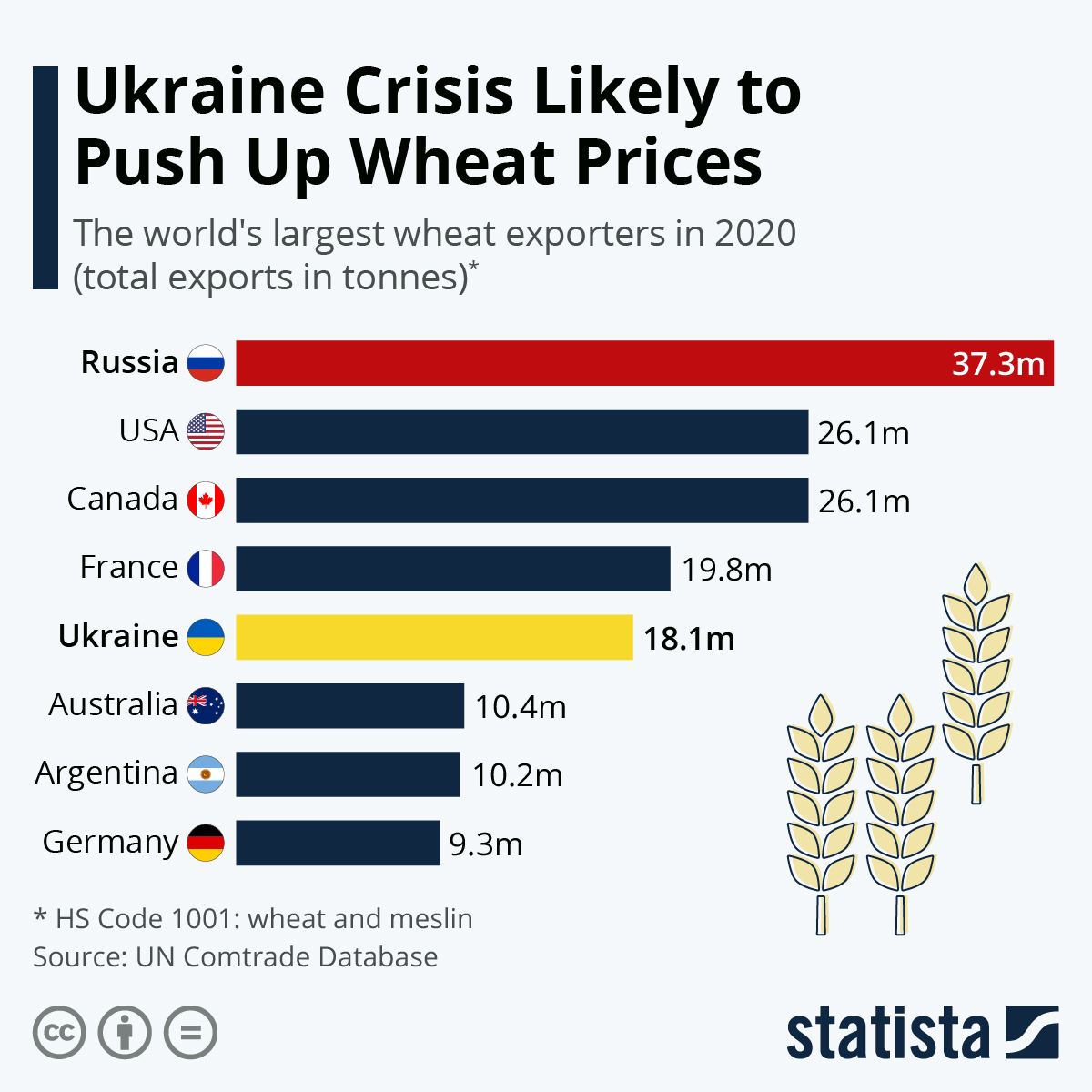
Historically, Russia and Ukraine sent most of their exports to Egypt, Turkey, and Bangladesh. That’s why many African nations are getting hit so hard by this war—they're facing real food shortages. If anything, the European Union might actually find a way to profit here by ramping up its own exports.
rowdymaker17 rowdymaker17 Member
27 messages
joined Jun 2022
#4074 ·
urbanheron4 said:The truth is, the European Union produces way more grain than it actually needs. It's actually one of the heavy hitters in global exports. France pretty much dominates the sector, and production is expected to climb even higher this year.

https://www.world-grain.com/articles...ected-to-surge

Historically, Russia and Ukraine sent most of their exports to Egypt, Turkey, and Bangladesh. That’s why many African nations are getting hit so hard by this war—they're facing real food shortages. If anything, the European Union might actually find a way to profit here by ramping up its own exports.

image

Only three African nations are truly grappling with food shortages, specifically those that rely heavily on corn and wheat imports from Ukraine. The media is simply fear-mongering and inflating the scale of the crisis for effect. The other half of the problem stems from the fact that the European Union, having completely botched its relationship with Russia, is now panicking about its own supply lines and freezing exports to ensure they can survive the winter. The blame lies squarely with the European Union for prioritizing its own reserves over global stability.

https://www.world-grain.com/articles...-russian-wheat

China, which imported a record volume of wheat last year, will no longer restrict wheat and barley trade to only certain parts of Russia, the report said. The restriction had been due to phytosanitary concerns.

This clearly indicates that Russia has improved its seed quality to the point where it now meets Chinese norms.

Countries that had been leading wheat exporters to China, such as France, Canada and Australia, likely will see their share of the China market reduced.

This essentially means NATO members can take a hike.

Approximately 53% of Russian wheat exports are destined for China, and that percentage is set to climb in the coming years.

While this conflict may have tightened the bonds within NATO, it has simultaneously pulled Russia, China, and India closer together. We are witnessing a massive polarization, driven largely by the bloodthirsty ambitions of the Americans.
urbanheron4 urbanheron4 Active Member
56 messages
joined Mar 2022
#4075 ·
Wheat is just wheat. "Grain" covers the whole spectrum of cereals—basically anything with a seed, if I recall correctly. That’s probably why the numbers don't line up.
Based on this, it isn't China; they aren't even listed.

https://www.aljazeera.com/wp-content...=770%2C770
rowdymaker17 rowdymaker17 Member
27 messages
joined Jun 2022
#4076 ·
urbanheron4 said:Wheat is just wheat. "Grain" covers the whole spectrum of cereals—basically anything with a seed, if I recall correctly. That’s probably why the numbers don't line up.
Based on this, it isn't China; they aren't even listed.

https://www.aljazeera.com/wp-content...=770%2C770

My apologies, I misspoke. Lost in translation—what I meant was there was a surge in procurement over the last three months where China increased imports of wheat, sunflower oil, and other grains by 53%... or perhaps 48% somewhere in the report.

You are correct, because while Russia produces 26 million metric tons globally, China only imports a mere 12,273 metric tons, which implies that if the average surge over the last quarter was 50%, they are now importing 18,409.5 metric tons, which remains an insignificant amount.

I have my moments of stupidity. 👍
Anthony Hill5 Anthony Hill5 Regular
379 messages
joined May 2024
#4077 ·
rowdymaker17 said:
urbanheron4 As stated by:
rowdymaker17

I think I'll spare us all the trouble of quoting every single thing right now.

We are currently witnessing massive disruptions within the global markets, and frankly, the current landscape appears quite favorable for Russia simply because they have been preparing for this exact moment while the European Union has remained caught completely off guard. It was painfully obvious what was coming, yet the leadership in Europe chose to ignore the warning signs until the situation hit them squarely in the face. There is a distinct possibility that we will see a repeat of the conditions you described during this upcoming winter. However, as time progresses, Russia’s position will inevitably deteriorate. They are bleeding themselves dry through this conflict; maintaining a massive military machine is an enormous drain on resources, especially as their export revenues begin their inevitable slide downward. The European Union represents a market far too vast and significant for anyone to ignore indefinitely, and in time, they will successfully pivot away from Russian imports toward more reliable alternatives. While there are plenty of opportunists currently circling the wreckage and trying to exploit these fluctuations, I find it highly unlikely that this state of affairs can be sustained. I harbor serious doubts that Russia can ever truly compensate for the loss of the European market by relying on exports to China or India. To be blunt, the Chinese don't actually care about Russia; they are merely capitalizing on the current chaos, and they will abandon their partners at the first opportunity, particularly since they possess sufficient domestic energy reserves to avoid any real dependency on imports. In the long run, Russia has effectively sabotaged its own future, though the full weight of that failure won't be felt for several years. All they have achieved is the acquisition of some devastated territory that will require immense capital investment to become even remotely profitable, and one has to wonder if they will even have the financial stamina to sustain that effort.

I find myself in agreement with that assessment, though one must also consider the broader geopolitical symmetry at play here; just as the European Union seeks to maintain its lines of communication and cooperation with Russia through the specific channels provided by Germany and Canada, it stands to reason that Russia will likely pursue its own continued engagement with the European Union by leveraging the strategic influence of China and India.

When it comes to the question of exports, the answer is inherently complicated, involving both a definitive yes and a resounding no. If the European Union fails to secure food imports from Russia, we are looking at a future defined by skyrocketing prices for anything derived from grain, primarily because there isn't a single nation on this planet capable of meeting the sheer scale of demand required by the European Union. It is a mathematical impossibility to find any other supplier that can fill that void. Furthermore, Russia remains insulated from such vulnerabilities because the Eurasian Economic Union stands as the premier global exporter of agricultural products, which essentially means they possess the inherent capacity to sustain their own population without consequence.

Will exports of oil derivatives and natural gas suffer? Yes, they absolutely will, but even if we account for that damage, it won't exceed a quarter of their total output. This remains a massive hurdle for the Russian economy, certainly, but it isn't going to force them to their knees—unless, of course, one completely ignores the fundamental principles taught in any standard American high school geography class.

Take note of this reality: the United States stands alone as the only nation on this planet possessing such an overwhelming abundance of resources that it achieves true, absolute self-sufficiency. This level of autonomy is dictated by sheer scale, as the country spans an entire continent and harbors a diversity of assets that other nations can only contemplate in their wildest dreams.

The entire Russian economy is fundamentally structured around self-sufficiency, prioritizing their own domestic market needs and stockpiling essential resources before they even consider exporting anything that isn't purely surplus. They ensure their production capabilities remain untouched by external shifts, whereas Western nations tend to only build up significant reserves when they sense some level of market instability on the horizon. It is important to recognize that Russia does not operate as a trade-oriented entity in the same way the USA or the European Union does, given that our economies are almost exclusively built upon processing industries. If all trade with Russia were to cease tomorrow, yes, they would certainly suffer financial losses, but we would be the ones facing the true crisis. We are the ones who rely on them for the very things we need to heat our homes, feed our populations, and sustain our way of life; without those resources, we would find ourselves staring at products and services that have become entirely unaffordable.

Do you actually comprehend how Russia intends to offset the bulk of its losses from the European Union? It is quite simple, really. They will merely hike the domestic prices of their fuel derivatives to a psychological threshold that remains tolerable for the average American citizen. Problem solved. While certain parties will inevitably have to swallow those losses, one cannot overlook the fact that Russians possess decades of experience navigating sanctions. I am firmly convinced they will find a way to engineer a sustainable development program; they are a capable nation, and I highly doubt they will face freezing temperatures or starvation.

On the other hand, we don't even have those elections to contend with here. The European Union exists solely as a commercial construct, essentially a group of nations that merged into a single trading bloc just to facilitate the exchange of goods and services, primarily because none of its individual members possesses resource wealth on the scale of Russia. In fact, many EU nations wouldn't even be able to sustain themselves through their own domestic food production if left entirely to their own devices. You should also keep in mind that the Eurasian Economic Union is currently imposing sanctions on all hostile states, which means food exports will be restricted; while this implies the market might stabilize starting next year, nobody seems to be addressing the actual cost of that stability. I guarantee you that food prices will climb throughout the remainder of the year before seeing a marginal dip, yet they will remain stubbornly high because we will simply be forced to pay a premium for basic sustenance.

Furthermore, one must consider that the Eurasian Economic Union stands as a primary exporter of fertilizers and pesticides, meaning the West will inevitably have to source these products, or their semi-finished components, at significantly inflated costs. It is an undeniable fact that Russia is the only nation globally maintaining an external debt ratio below 19%, yet we are discussing the largest country on Earth, an entity whose entire economic foundation is built upon raw production, whereas the USA and the European Union possess economies almost entirely predicated on the processing of materials, making them far more vulnerable to fluctuations in imports and exports than Russia is. Consider this example found at the link below:

https://www.statista.com/statistics/...ies-worldwide/

Given that the European Union is certainly not Russia's primary market—accounting for perhaps one-fourth or one-fifth of Russian exports, while China commands half of the total, and the remaining quarter is split between the USA and the rest of the world—I can guarantee you that the USA will not halt trade with Russia. Their entire food production infrastructure relies heavily on Russian fertilizers and growth enhancers. This is not a deficiency that can be rectified overnight; it will take years to secure alternative sources or to initiate domestic production. In the interim, Russia has ample time to stabilize its commercial ties with Latin America and Africa.

Additionally, look at Elon Musk; he used to joke and needle the Russians, but since the Americans implemented those initial sanctions, his demeanor has shifted quite drastically. He has suddenly become deathly serious because he can no longer procure the parts and raw materials for his rockets and automobiles that he previously sourced from Russia—or rather, he can, but the cost of those materials has skyrocketed. This means he can no longer manage his budgets effectively because production costs have surpassed the limits of common sense, a reality Musk clearly recognizes, which explains why he has been acting so anxious lately. Now, he is planning layoffs to curb expenditures, attempting to keep operations running just enough to prevent the facilities from cooling down. Food prices in America have surged by over 400% on certain staples, and the working class is increasingly joining the lines at soup kitchens. While purchasing power in Western nations continues to erode, there hasn't been such a drastic shift in Russia, and one could argue that the average Russian now possesses greater purchasing power than the average American. How so? Because Russia has demonstrated exactly what happens when you slap sanctions on a producer and they stop delivering corn, wheat, and other essentials. Russia faces no dilemma here; they will simply sell to China, which became the number one economy in the world last year and remains ravenous for all types of resources and raw materials. In fact, China alone accounts for more than 49% of all Russian trade, while the European Union accounts for about 20%. I reiterate, while that is significant, it does not mean Russia cannot recover; if anything, they can endure much longer and possess far more experience living under sanctions than the European Union does. Ultimately, Russia has the smallest debt and imports almost nothing, operating primarily through manufacturing and capable of sustaining its own people, whereas the European Union cannot sustain itself in the long run because it functions merely as a consumer, not to mention the debts the European Union owes to Russia. That is the crux of the matter.

One should ask oneself: in a conflict between a buyer and a farmer, who is more likely to survive? Is it the buyer, who has quarreled with the farmer and refuses to pay the price the farmer demands, or the farmer, who produces food for himself and his family and sells only the surplus? The buyer will eventually have nothing to eat despite having money, while the farmer may lack money but will not go hungry. Who survives longer? You cannot eat money. And we, specifically the European Union, are going to learn this lesson in a brutally unpleasant way this winter. 👍

It is quite impossible to list just how many nonsensical claims you've made here. From the assertion that the European Union is dependent on Russian food imports, to the claim that the EU isn't Russia's largest market—when in reality, just Russia's trade with Germany and the Netherlands exceeds its total trade with China—down to the idea that Russians have more purchasing power than Americans, and so on and so forth. It's laughable.
gentlerider7 gentlerider7 Regular
291 messages
joined Jan 2021
#4078 ·
Anthony Hill5 said:It is quite impossible to list just how many nonsensical claims you've made here. From the assertion that the European Union is dependent on Russian food imports, to the claim that the EU isn't Russia's largest market—when in reality, just Russia's trade with Germany and the Netherlands exceeds its total trade with China—down to the idea that Russians have more purchasing power than Americans, and so on and so forth. It's laughable.

I mean, seriously? This guy is actually giving a thumbs up to the idea of Europe starving? What kind of pro-Russia troll is this? It honestly reminds me of those hacks over at Informer who used to write those pathetic stories about how Mexicans were sending flour and sugar to their relatives across Europe. Just pure nonsense.
Thomas Walker84 Thomas Walker84 Active Member
114 messages
joined Oct 2009
#4079 ·
rowdymaker17 said:image

Only three African nations are truly grappling with food shortages, specifically those that rely heavily on corn and wheat imports from Ukraine. The media is simply fear-mongering and inflating the scale of the crisis for effect. The other half of the problem stems from the fact that the European Union, having completely botched its relationship with Russia, is now panicking about its own supply lines and freezing exports to ensure they can survive the winter. The blame lies squarely with the European Union for prioritizing its own reserves over global stability.

https://www.world-grain.com/articles...-russian-wheat

China, which imported a record volume of wheat last year, will no longer restrict wheat and barley trade to only certain parts of Russia, the report said. The restriction had been due to phytosanitary concerns.

This clearly indicates that Russia has improved its seed quality to the point where it now meets Chinese norms.

Countries that had been leading wheat exporters to China, such as France, Canada and Australia, likely will see their share of the China market reduced.

This essentially means NATO members can take a hike.

Approximately 53% of Russian wheat exports are destined for China, and that percentage is set to climb in the coming years.

While this conflict may have tightened the bonds within NATO, it has simultaneously pulled Russia, China, and India closer together. We are witnessing a massive polarization, driven largely by the bloodthirsty ambitions of the Americans.

I wouldn't say it's just three. This could become a much bigger issue across Africa. The president of the African Union (who is also the leader of Senegal) actually traveled to see Vladimir Putin yesterday, hoping he might unblock the port of Odessa. He mentioned that many African countries rely heavily on grain from Russia and Ukraine. It’s not enough for that guy in the Kremlin to terrorize Ukraine; now he's starving Africans too. Honestly, I wouldn't be surprised if he tries to use this as yet another way to hold people hostage.
https://information.tv5monde.com/afr...-sotchi-459073

This conflict might have brought NATO closer together, but it has also drawn Russia, China, and India closer. Now, because of the Americans' thirst for blood, we're seeing this massive polarization.

We're dealing with this conflict because of the Russians' (literally) thirst for blood.
urbanotter urbanotter Regular
431 messages
joined Oct 2020
#4080 ·
urbanheron4 said:It sounds massive when you frame it like that, but look at the context.

https://www.reuters.com/markets/comm...ia-2022-06-01/

The European Union imported 2.2 million barrels per day (bpd) of crude in 2021, including 0.7 million bpd via pipeline.


The EU imported that much in less than two weeks. And they weren't even getting a discount.

Ultimately, anything the West decides to stop buying from Russia doesn't just vanish; it simply shifts into a different demand stream where someone else will pick it up,
likely at a much lower price point.

There are so many moving parts in these global markets, and there's always a way for everyone to eventually get what they need.

According to The Wall Street Journal, following the announcements by the EU and the USA to ban Russian oil imports as part of the sanctions over the invasion of Ukraine, traders are ramping up their purchases of Russian oil and blending it with other sources to mask its origin.


Even China isn't playing by any particular set of rules, and I don't see them intending to start acting "civilized" anytime soon.

China is quietly increasing its intake of oil from Russia at favorable prices, filling the void left by Western buyers who are pulling away from Russian deals due to the invasion of Ukraine, Reuters reports.

Read more at: - www.vecernji.hr

God works in mysterious ways, but the paths oil takes through the global market are even stranger.

You must log in or register to reply here.

Log in Register

🔗 Similar threads