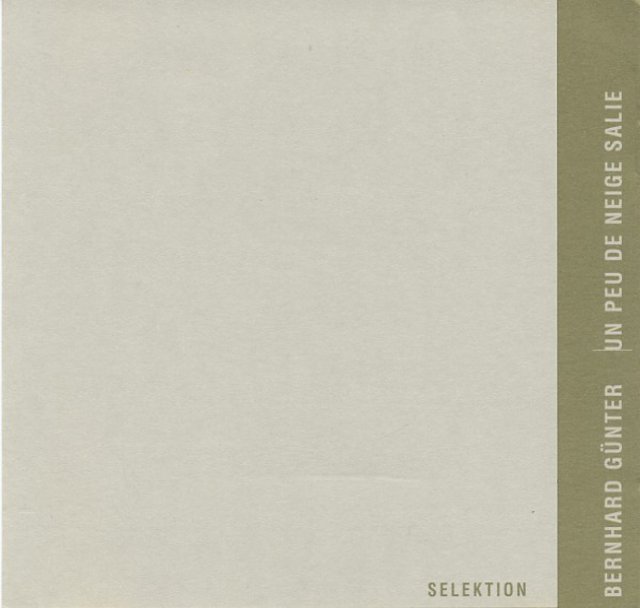
Tracklists and durations from the 1993, 1996, and 2017 releases:
1. Untitled I/92 (9:00)
2. Untitled II/92 (12:29)
3. Untitled III/92 (14:29)
4. Untitled IV/92 (16:31)
5. Untitled I/93 (20:29)
Tracklist and durations from the 2003 release:
1. Untitled I/92 (8:59)
2. Whiteout (For Takahiro Tanaka) (27:00)
3. Untitled IV/92 (16:00)
4. Untitled I/93 (20:12)
"The music on this CD is intended to be heard at a very low volume!"
(from the liner notes of the 1996 reissue, my translation)"[Günter] is the first person to make good computer music. It’s aesthetically very similar to the work of Morton Feldman - White on White, yet it remains computer music—which, of course, sounds like a contradiction."
(interview with Jim O'Rourke, 1995, my translation)"White on White" is the debut album by the German composer and musician Bernhard Günter, often described as the "guru of digital sub-sonic minimalism bordering on silence." He began his foray into computer music back in 1987. This record features five—well, four—pieces of sorts "musique concrète" crafted via sampler. It is pure experimentalism, often categorized under the
lowercase and
microsound subgenres.
Your audio setup matters here; the quality of your gear isn't trivial if you want to actually experience this. Minimizing ambient noise is just as vital. You could call Günter’s work a digital variation on the "deep listening" concepts explored in purely acoustic settings by Stuart Dempster and Pauline Oliveros. Instead of Gothic cathedrals, underground cisterns, or cavernous spaces, the environment where this sound lives is entirely virtual. But more importantly, it’s the space within the mind and heart where the sound transforms into music. Is that enough? Or is it too much?

:format(jpeg):mode_rgb():quality(90)/discogs-images/R-1441447-1468844610-5204.jpeg.jpg)

:format(jpeg):mode_rgb():quality(90)/discogs-images/R-708775-1489953472-9967.jpeg.jpg)
:format(jpeg):mode_rgb():quality(40)/discogs-images/R-15711493-1596384537-2934.jpeg.jpg)