ruggedhawk20 said:What are those indentations actually for?
Man, I am seriously looking forward to this. 🎉
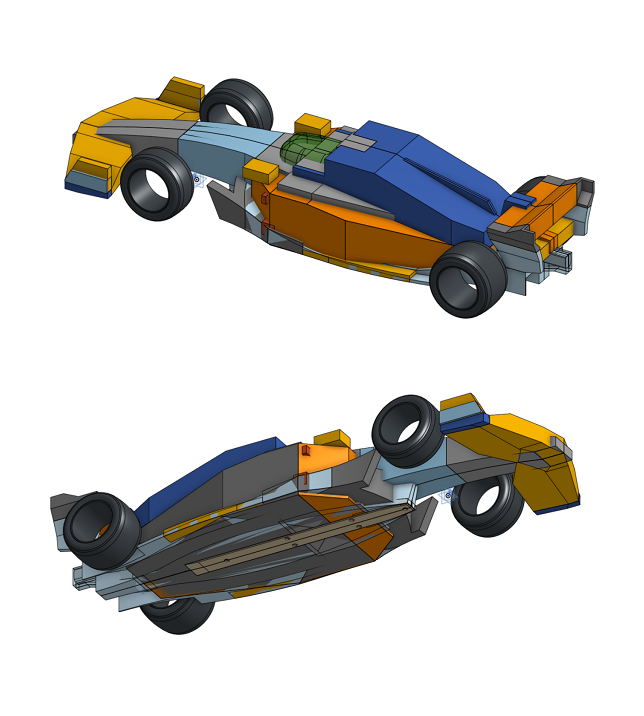
So, back in 2021, we saw cars where almost everyone was following the exact same sidepod concept. What does that actually imply, and why should we care now? Since I’m currently diving deep into the Ferrari setup, I wanted to offer a quick breakdown regarding the sidepods and how the fluid flow works.
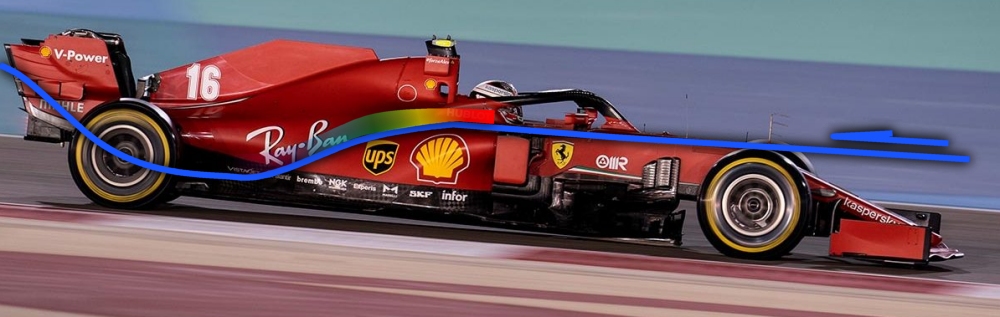
The blue arrow shows how the directed airflow moves toward the top of the sidepod, and here’s what we're looking at. That sudden drop creates negative downforce, which you can see mapped out on that spectrum. To break it down: red indicates fast-moving fluid, green shows where the flow slows down and stabilizes, and blue represents the stabilized fluid following its natural path along the car's contours. Eventually, it hits the upper part of the diffuser—which features those specific vanes—where it mixes with the underfloor flow. This causes a sudden upward surge, acting like a burst of turbulence that generates extra downforce. So, basically, the fluid in that image serves a dual purpose: creating downforce while maintaining grip. Now, let's move on to the breakdown of the 2022 model.
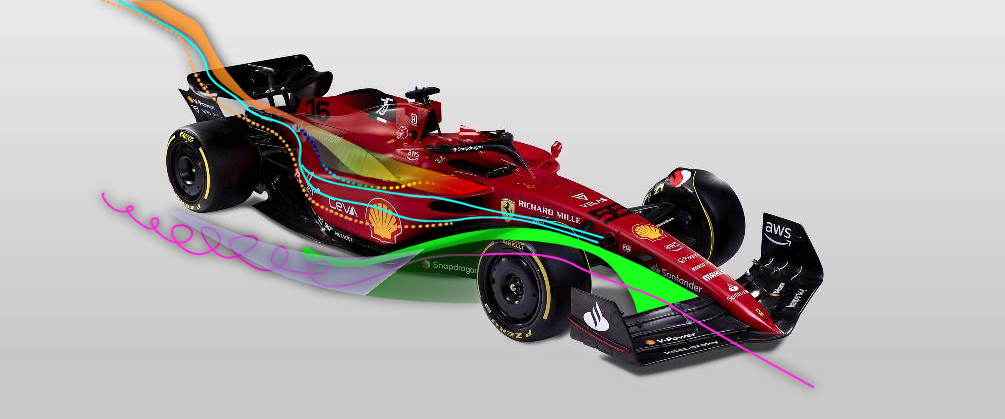
First off, we have to look at the front wing design changes starting this year. They’ve done away with those specific endplate elements that used to trigger the Y250 vortex—that turbulence responsible for sucking the car down toward the track. Back in 2022, the wing elements were basically bolted right up against the nose. Combined with the Gurney flap, that whole setup generated a massive amount of vortex flow (shown in light green here) that would just exit along the sides of the chassis.
Roze—this is the fluid flow passing through the deflector, which creates that vortex used to stabilize the car and press it down toward the track.
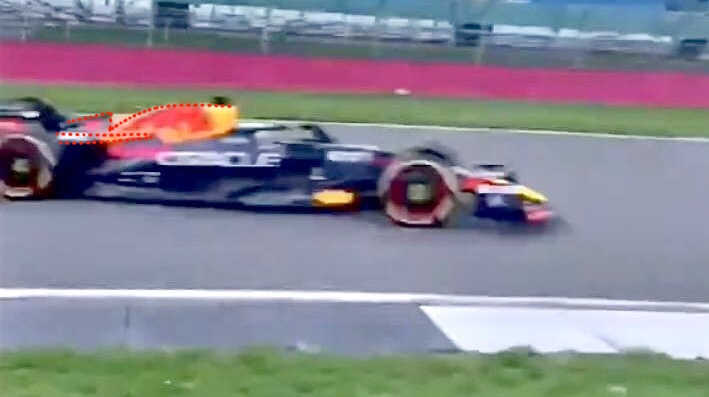
That dark green shade bleeding into deep blue right next to the front right wheel? That’s just turbulence caused by the wheel itself, combined with this year's addition: the vertical plate/winglet. So, we've got three distinct areas of turbulence running along the side, which together create what's known as a low-pressure field. It’s a bit like when a massive semi-truck passes you on the highway—you feel that slight pull toward the vehicle while it's alongside, and then once it clears, there's that sudden gust that feels like it might knock you off your feet. That’s basically the low-pressure field at work, stabilizing the car before the airflow hits the rear. All of this actually helps the air flow smoothly along the sidepod, which I’ve marked with that orange dotted line. Essentially, all the air from the bottom of the sidepod travels cleanly toward the diffuser and the rear wing mounts, eventually turning into the turbulence that stabilizes the car and generates downforce.
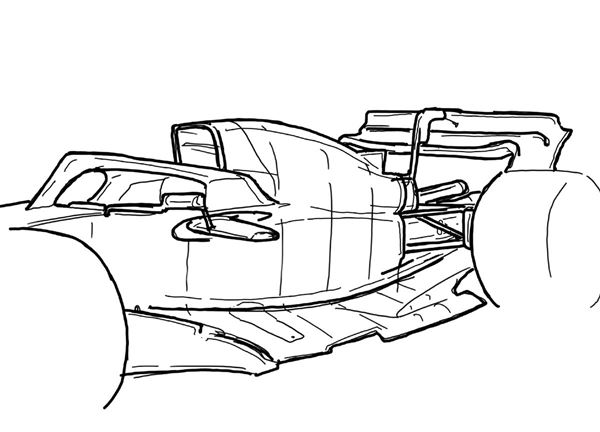
I finally got around to fixing that dent.So, what's actually happening here? If you look back at the 2021 car, you can see how the airflow drops aggressively to create downforce before everything funnels into the diffuser. The 2022 design tries to do the same thing, but since the diffuser and the rear wing mount are now positioned right next to each other, the upper edge sits much higher up. Because of that, the air that used to stabilize in the famous sidepod hole of the Ferrari F1-75 just flows naturally along the engine cover, hits the exhaust level, and then turns into pure turbulence behind the car. I tried to sketch it out using colored dotted lines. Red shows the aggressive, fast airflow creating downforce; yellow/green represents the air calming down as it moves through the hole; light blue is the air at the bottom of the hole moving toward the rear; and dark blue is the stable airflow continuing its path backward.
Look at those light blue lines—you can see how the fluids move toward the edges of the opening. Once they hit those edges, a high-pressure field builds up, which creates that suction effect. Since the Ferrari F1-75 has that upper edge on the side that looks almost like a cylindrical thickening, the fluid moving around those side openings stabilizes as it passes that rounded section. In the end, it all converges on the diffuser, just like the fluids passing over the hole and the hot fluid exiting through the vents (that orange-colored area).
The F1-75 is honestly a stroke of pure genius 🎉