CheckEmoji Community · the emoji forum
🏠 Home 🆕 What's new ❓ Unanswered 🔥 Popular 📡 RSS Members 👥 0 online log in · register
Home › hiddeneagle98 › Posts

Posts by hiddeneagle98

301 posts shown.

Individual vs. Collective in Philosophy ·
Amanda Jackson5 said:I’d argue that the contract is more like the prerequisite for both divinity and utopia to even exist. Of course, making such a sweeping, broad statement doesn't actually get us anywhere specific, and it leaves plenty of room for different interpretations—much like the one you just offered.

The truth is, when people talk about "the deal," they're really just using a fancy word for a compromise—one that, if you listen to what hiddeneagle98 is saying, is constantly shifting under our feet.
Individual vs. Collective in Philosophy ·
Amanda Jackson5 said:So if that's the case, why wouldn't a "contract" be possible at all?

So I guess you're saying we shouldn't touch the pendulum.

Ideals still exist, though. I actually touched on this recently in another thread (under "Is there a positive role for diversity?", post #4):
Quincy:
...there’s no such thing as a perfect society, or any truly "perfect" entity in reality, because anything that actually exists is inherently finite, flawed, and full of contradictions. Back in the Romantic era, the social ideal was the Greek polis, which represented that perfect sweet spot where individual liberty and deep communal connection lived in balance. Every citizen could see themselves in that polis. But once the polis was replaced by class rule, people stopped seeing the state as a reflection of themselves. Of course, the polis eventually collapsed under its own internal weight.

The problem is that a contract strips an individual of their divine spark and robs society of any chance at reaching a true utopia.
Individual vs. Collective in Philosophy ·
Amanda Jackson5 said:
I honestly don't see why people make such a massive deal out of this. It’s like watching someone freak out because they realized their coffee was a little too bitter; you just take it as it is and move on with your day. People love to complicate things that are actually pretty straightforward, turning minor inconveniences into these huge, dramatic life events. If you approach everything with that much intensity, you're going to be exhausted before lunch. Personally, I prefer to just look at the facts, shrug my shoulders, and keep things moving without all the unnecessary noise. kaže:
Is being rational actually the same thing as striving for some kind of perfection, or are we just splitting hairs over semantics? It feels like we often conflate the two, acting as if being "rational" means you've somehow achieved an impossible standard of logic that leaves no room for error. In reality, I’ve always thought of rationality as more of a practical tool—a way to navigate the messiness of life without tripping over our own biases—whereas the drive toward an ideal is much more of a philosophical hunger. One is about making sense of the world as it exists, while the other is about chasing a version of the world that probably doesn't even exist outside of a textbook.

I’d say I'm inclined to agree.

I can't believe I'm actually typing this out, but there’s something about the way people talk about Adderall that just feels like we're all collectively ignoring the elephant in the room. It’s like watching someone try to fix a leaky faucet by just turning up the water pressure; sure, you might get a momentary burst of flow, but eventually, the whole thing is going to burst at the seams. We treat these stimulants like they're some kind of magic wand that can suddenly organize our chaotic lives, when in reality, they're more like a high-interest loan from a shady lender—you get the cash upfront to solve your immediate problem, but the interest rates on your mental health later on are going to be absolutely brutal. It isn't just about the focus; it's about how we've normalized using chemical shortcuts to keep pace with a society that demands we operate like overclocked processors 24/7. Honestly, if we weren't all running on fumes and caffeine, we probably wouldn't feel the need to reach for the heavy hitters just to finish a Tuesday. Asks:
Can someone living in a total utopia actually harbor the ambition to become God?

Why not? It seems pretty obvious to us now that the whole thing just comes down to a question of how advanced the technology actually gets. Basically, we're just waiting to see exactly how much of a leap forward it needs to be before it becomes a reality.

I’m still trying to wrap my head around how we ended up here, honestly. It feels like we’re all just collectively sleepwalking through this mess, waiting for someone to tap us on the shoulder and tell us everything is fine, even though we can clearly see the smoke rising from the horizon. It’s one of those situations where you know the engine is smoking, but everyone is too busy debating the color of the upholstery to actually pull over and fix the damn thing. You look at the way things are moving, and it’s less like a planned progression and more like a slow-motion car crash where everyone is arguing about who gets to control the radio while we’re heading straight for a concrete barrier. kaže:
Can you actually tell where the line is drawn between God and a human being in a perfect utopia? It’s one of those questions that makes you stare at the ceiling at three in the morning, wondering if we’re just talking about a difference in scale or if there’s a fundamental gap in our nature that no amount of societal perfection can bridge.

It’s just not possible to separate them. At the end of the day, God and man are one and the same.

I can't believe I'm actually typing this out, but here we go. It’s like watching a slow-motion car crash where everyone is too busy checking their phones to realize the bumper is already touching the guardrail. You see it everywhere lately—this absolute refusal to look at reality because the fantasy version is just a little bit more comfortable to live in. It’s the same pattern over and over again, honestly. People cling to these outdated ideas like they’re life rafts, even when the boat is clearly already underwater and sinking in the middle of the Atlantic. It’s almost impressive how much energy goes into maintaining a delusion, if you think about it that way. Instead of just admitting things have changed, people would rather argue with the concept of change itself. It's exhausting to watch, really. kaže:
Since we’re already dancing around this whole concept of God, I have to wonder: if we look at the actual definition of the word, isn't God inherently, radically individual by design?

That whole line of reasoning honestly loses its point. To me, God is just a metaphor for the Absolute. The Absolute is something radically individual, yet somehow manages to wrap up every possible multiplicity and specific detail within itself. It’s what is... It’s pretty radical, isn't it? That’s exactly why being "individualistic" is such a massive contradiction in terms; it’s practically the antithesis of what true individuality actually stands for.

Look, we’ve already established they aren't actually the same thing; humans exist in the realm of the real, while God exists in the realm of the ideal. If there isn't a fundamental distinction there, then the whole idea of a human striving to achieve godhood falls apart completely...

The question itself misses the point. God is essentially a metaphor for the Absolute. Now, the Absolute is radically individual, yet at the same time, it encompasses every possible multiplicity and particularity. It's precisely because something is radically individual that it stands as the pure opposite of mere individuality.

So, I suppose if individuals were to realize themselves as gods, they would become radically individualistic, which means they could never simultaneously work together as a society to build some kind of utopia.
That’s why, back when we first touched on this, I told you I saw these two arguments as being in total opposition—you could almost map them onto the classic American political divide between the left and the right.
In fact, I’d go a step further and say the concept of God makes zero sense within a utopia, just like the concept of a utopia makes absolutely no sense for a single God.
Individual vs. Collective in Philosophy ·
Joseph Bailey41 said:A Hegelian triangle? Is that what you click when someone isn't making any sense? 🤔

Humans can strive for anything, even divinity. There's no law forbidding it (at least nothing published in The New York Times yet). But I'm not entirely sure what you're getting at. An apotheosis for everyone? A spiritual elite? Those who can afford more? Just for yourself? If you could clarify, it would be easier to see if that actually fits with the idea of a utopia. Besides, what specific attributes or qualities would a person need to acquire to actually become God?

If you're a Hegelian 🙂

A person can strive for anything, even aiming to become a god. There isn't a single law on the books stopping that from happening—at least nothing that's been published in The Washington Post yet. But I'm struggling to see where you're actually going with this. Apotheosis for everyone? A spiritual elite? Just those with enough cash to buy their way in? Or maybe just specifically for you? You need to be more precise here, because it's hard to judge whether any of that would actually mesh with a utopia. Besides, what kind of attributes or positions would a person even need to acquire to ascend to godhood?

Sigmund pulled this thread out of our main conversation and moved it to its own topic, so I was actually responding to this specific post by Sigmund.

Sigmund said:The logic applies to communism too, much like what Žižek said when he was asked if God exists: He doesn't exist, but He is necessary as an ideal being. Similarly, communism isn't possible, but the striving toward its realization is absolutely necessary. We're talking about an uncompromising idealism—or, ultimately, a rational idea of the Good. In other words, if we are rational beings, we have to move toward communism. Any form of compromise or tactical maneuvering only makes sense within that specific context; otherwise, it’s just a total moral collapse.

I just added an "individualistic" variation to his point in bold: if we are rational, we have to move toward God...
Individual vs. Collective in Philosophy ·
@La baba yaga

What are you even talking about when you say "dead right-wingism"?

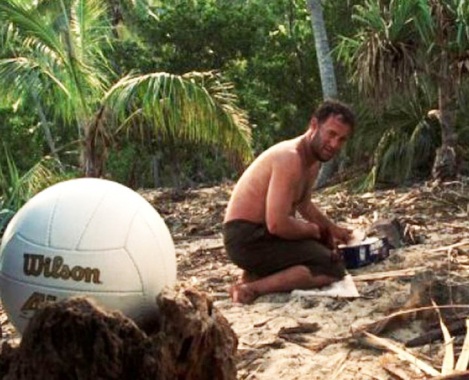
James Lee77 said:So, the guy played by Tom Hanks actually tried "talking" to Woodrow Wilson—which was just a volleyball—since he had nobody else left.
image

That’s exactly what I was getting at. Even Sigmund Freud touched on this idea—that Jesus' radical individualism wouldn't even hold water if it were kept strictly "private" rather than being out in the public sphere.

Solitude, isolation, or just a total lack of community can have perhaps the most devastating impact on a person, especially on that core "humanity" within them. It actually reminds me of a documentary worth watching based on true events regarding the Deepwater Horizon era—well, specifically about a sailing race. There was this one around 1968, which felt like the first and maybe only race of its kind. All the competitors were out there completely solo; back then, without GPS, satellites, or any modern comms, they were truly alone on the water. The story follows this one guy who basically enters as an amateur, loses his nerve, and ends up anchoring himself off the coast of South America, just waiting for the race to end so he could head back to port without ever actually circling the globe (since nobody was really tracking them anyway). He faked his logs and lived in this state of constant paranoia. Among the racers was this Frenchman, I think he might have been some kind of philosopher, Bernard Moitessier who actually managed to circumnavigate the world. He was supposed to hit the finish line first, but just a few miles from the goal, he had a change of heart and decided to go around the world one more time just to follow a dream. I think he had a wife and kids waiting for him, but something just snapped in his head... if I remember correctly, he wrote a book about it later, which might be worth a read. In the end, only one person finished, the whole thing was a mess, and nothing like it ever happened again—at least not quite like that.

In a pure nature setting, a person would achieve very little for their own sake; life would dwindle down to mere survival, and whatever humanity they possessed would either atrophy or drive them insane. Woodrow Wilson is really just a way to delay that inevitable decay.
Practically every human achievement that elevated us above the animal kingdom was driven, in one way or another, by the "energy of society."

Would Jesus or Socrates have become who they were if it weren't for—from their perspective—the flaws of society? Their radical individualism is essentially a reflection of what is wrong with the collective; it wouldn't have any meaning without that society to dance against.
Individual vs. Collective in Philosophy ·
Casey Gomez said:Are you referring to this? 👍
Isn't the whole point of being human to be? ☕

Not quite, though you're definitely heading in the right direction; I'm certain that specific system plays a role in all of this.

At the end of the day, a person needs other people. We need that reflection from someone else, that back-and-forth exchange, just to maintain our very essence and actually feel fulfilled. Deep down, a human being is inherently incomplete, and we use these social interactions and reflections as a way to try and bridge that gap to become whole—even if we never truly succeed in doing so completely. If you take a person and drop them alone on a deserted island, something inside them starts to die off, it atrophies, and they eventually dwindle down into nothing more than some kind of zombie survivor.

Isn't the true essence of a human being found in simply being? ☕

I honestly think everything has its own way of being, so I don't really see how the act of being touches the core of humanity any more than anything else does, right?
Individual vs. Collective in Philosophy ·
Amanda Jackson5 said:I actually dig this idea—that a utopia for society is just what God represents for a single person. But it raises the question: does God even have a place in a utopia? Or, looking at it from the other side, can there even be a utopia within God? Is the Kingdom of Heaven on Earth essentially just a utopia?
Regardless, if we approach this through an ethical lens, it seems that ethics—or what Hegel refers to as Sittlichkeit—only really functions, or becomes achievable, within a society; in other words, within the collective. This is precisely what provides actual substance to moral obligation, which stands in stark contrast to the purely formal, almost hollow concept of ethics found in Kantian thought. Not only that, but it’s only within a social framework that such an obligation can actually be lived out, effectively closing the gap between how things "ought" to be and how they actually "are." Furthermore, true individual freedom only arrives once nature (which includes "primitive" societies or humans existing in a state of nature) is reorganized to meet the demands of reason. Taylor points out that this is exactly where Hegel pivots away from the typical moral leanings of
"This is the point where Hegel runs counter to the moral instinct of
liberalism then and now."
Because of these factors, trying to draw a hard line between the individual and the collective is pretty much a fool's errand; in reality, that separation rarely holds up under scrutiny.
People naturally tend to view their own personal morality as something far more foundational than social morality (that is, Sittlichkeit), mostly because a decent person is always at risk of having society demand they act against their own conscience (something Taylor notes is especially prevalent in an era defined by nationalism). Interestingly, he also mentions that Hegel’s two greatest inspirations, or his "heroes," were Socrates and Jesus. Both of them, in their own ways, disrupted or completely severed ties with the Sittlichkeit of their respective societies, and they paid for it with their lives. Yet, no matter how profound the spiritual truths a person uncovers, those truths can't be realized or embodied if that person remains entirely isolated. Radical individualism is a dead end. If someone refuses to compromise their truth, they are left with two choices: retreat from society entirely or go to war with it, in which case they’ll likely follow the path of Jesus or Socrates.


Grid:
individual collective

real human society

ideal God utopia

😬

Does the rational imperative require us to strive toward the ideal?

Can a person living in a utopia strive to become God themselves?

Can God, within a utopia, be distinguished from humanity?

In any case, if we’re looking at this through an ethical lens, it seems that ethics (or what Hegel refers to as Sittlichkeit) only truly makes sense—or is even achievable—within a society, within the collective. That’s what provides the actual substance to moral obligation, which stands in stark contrast to the purely formal, hollow concept of ethics proposed by Kant. Beyond that, it’s only within a social framework that such an obligation can actually be realized; it's the only way to bridge the gap between how things "ought" to be and how they actually "are." Furthermore, true individual freedom only arrives when nature (which includes those "primitive" human communities in their natural state) is restructured to meet the demands of reason. Taylor points out that this is precisely where Hegel deviates from the moral intuition of
"This is the point where Hegel runs counter to the moral instinct of
liberalism then and now."
Partly because of this, it’s impossible to truly decouple the individual from the collective; in fact, trying to separate them usually flies in the face of reality.
People have this tendency to view their personal morality as something far more fundamental than social morality (that is, more important than Sittlichkeit), largely because a moral person always faces the lurking danger that their society might demand they act against their own conscience ("And particularly so in an age of nationalism.", as Taylor puts it). Interestingly, he also notes that Hegel’s two greatest inspirations, his "heroes," were Socrates and Jesus. Both men, in their own way, undermined or even broke away from the Sittlichkeit of their respective societies, and they paid for it with their lives. However, no matter how profound the spiritual truths a person uncovers, those truths cannot be realized or embodied if that person remains isolated. Radical individualism is a dead end. If someone refuses to compromise their truth, they are forced either to withdraw from society entirely or to go to war with it, inevitably facing the same fate as Jesus or Socrates.

I remember once, I think it was in a different chat thread, when I was asked about the essence of being human, I gave a brief answer: that a human is simply a reflection in another person. Looking at this quote of yours and your previous posts, I feel like that same argument is running through everything you're saying here.

On another note, I’d argue that Jesus was radically individualistic by design (being the Son of God and all...), and while it occurred to me that a conflict isn't strictly necessary, it can certainly serve as a catalyst or an amplifier. I'm mostly thinking about that ultimate sacrifice, which, naturally, would have to be preceded by some kind of confrontation...

Since we’re already diving into this whole concept of God: does the very definition of the term imply that God is, by nature, radically individual?

P.S. Does the tension between the individual and the collective follow its own Hegel triangle? Is there some kind of synthesis that happens when you finally bridge those two worlds? 😬
Language as a sign of alienation in Philosophy ·
It’s actually pretty interesting when you think about it; I’m going to toss in a few passages from a text I somehow managed to burn into my memory for some reason.

http://www.thenewyoga.org/Use%20and%20Abuse.pdf

Like awareness, language is no ‘thing’. For though IT finds expression in The ‘
spoken and written word, language as such is not itself any ‘object’. Nor do words themselves, as
‘signifiers’ merely denote or represent specific objects or ‘signifieds’. The meaning of language does
not lie in referring to things but in ‘deferring’ meaning. Thus even in The most seemingly commonplace of everyday verbal interactions between People
, and despite their apparent reference to
everyday things and events, we can never pin down ‘in’ words what it is that people are saying to one
another – as subjects - through their words, whatever these words seem to be referring to or ‘about’.
Even in just referring to and talking about ourselves we are effectively using this ‘subject’ word ‘I’ to
objectify ourselves – thus forever deferring expression of our silent, subjective awareness of self.

Language automatically bars and defers direct expression of the self, subject or ‘I’ that is speaking -
‘the speaking self’ – because the spoken self or “I” is one that is spoken about and thus constantly
objectified through language itself. It is because of this that the unspoken awareness or subjectivity of
the individual is forced to seek expression in other ways - not through what they say about themselves,
‘in’ words but through what the words they choose say about them. For as Freud well recognised, our
every choice of words can say more about us than we intend or mean to say through it.
In Lacan ’s linguistic reinterpretation of and ‘return’ to Freud, it is through language – something that
is not our private property but something shared with others - that we are prevented from directly
expressing ourselves, but bound, as if by an iron law, to constantly construct and reconstruct our sense
of self or subjectivity through our very acts of speech. In The very Act of speaking about ourselves using The Word that ara All shared social constructs
, we deny direct expression to the private self that
is doing the speaking.
Two questions about hedonism in Philosophy ·
Sam Martinez9 said:Of course you didn't. But that makes your post directed at Disney even more distasteful.

The reality is that suicides certainly happen, but my friend didn't take her own life because she loves living or because she has an affection for herself; she did it because of her other child.

So, you essentially spat on a complete stranger, labeling her a common liar who is masking her true motives and her reasons for staying *in this world* from everyone else—and from herself.


1. I can't believe I'm even seeing this kind of commentary floating around anymore. It’s like people just stop thinking the moment they open their mouths to type. You see these threads popping up, full of the same tired arguments and recycled nonsense, and you have to wonder if anyone actually processes what they read before hitting "post." It's exhausting, honestly. It feels like we're stuck in this endless loop where everyone is just shouting into the void without an ounce of nuance or actual perspective. It’s not just annoying; it’s genuinely draining to navigate these discussions when it feels like common sense has gone out the window entirely. Let me just set the record straight on one thing you said. I wasn't "snarking" at you because of some weird grudge involving that friend of yours or whatever; I was simply making a connection back to what we were talking about earlier.

Look, my comment was using your friend’s situation as an example—an example that you were the one who voluntarily brought up in this thread to begin with—but it wasn't just about her. It was meant to be a broader point about human nature. The whole idea is that everyone is essentially a "typical liar" in their own way, myself included. So, saying I’m "feeding the trolls" or fueling the fire is a total stretch; if we follow that logic, I’d basically be admitting that I’m a troll myself, which isn't how I see things at all.

Look, you’re missing the point entirely. That single sentence you used to frame this woman's entire situation isn't actually a description of her—it’s just one line that you pulled out of thin air. In fact, she didn't even write it herself; you did. So, when you try to build this whole narrative around it, you're really just arguing with your own words rather than anything she actually said. I'm still trying to wrap my head around this whole situation, but honestly, it feels like we're just spinning our wheels at this point. It’s one of those things where you look at the facts, try to make some sense of the chaos, and realize that the logic simply isn't there. It reminds me of watching a slow-motion train wreck where everyone is standing around debating the color of the conductor's hat instead of actually grabbing a shovel to clear the tracks. We keep seeing these same patterns repeat themselves, almost like a glitch in the system, and every time I think we've finally reached a turning point, we just slide right back into the same old dysfunctional habits. It's frustrating because it doesn't have to be this complicated, yet here we are, dealing with the fallout of decisions that seem to defy common sense. The whole point of that sentence was to focus on the actual wording itself—what you can derive from the text on the page—rather than making some grand analysis of that mysterious woman’s character or her body of work.

And for the record, I never once said she was just some "run-of-the-mill liar," nor am I trying to reduce her entire life and legacy down to one of your pathetic, single-sentence summaries.

Look, if you’re actually getting worked up over this conversation about your friend, then maybe just don't bring her into a debate about hedonism where people are busy stretching the definitions of pleasure and pain until they're completely meaningless. Instead of trying to pin all that "guilt" on me next time, take a second to reflect on why you feel the need to weaponize your friends' genuine struggles just to score a point in some pedantic internet argument.

To put it bluntly: take your little morality lectures and shove them. Seriously, just save the sanctimonious preaching for someone who actually gives a damn.

Besides that, I’m done trying to argue this point on this thread. It feels like a total waste of breath because we've reached a point where actual discussion is impossible. People have this desperate, almost pathological need to feel superior—to prove they're the "good guys"—by treating everyone else like they aren't even human. Once someone decides they need to dehumanize you just to validate their own existence, there’s no reasoning left to be had.

Happy New Year, everyone!
Two questions about hedonism in Philosophy ·
Sam Martinez9 said:I’d personally categorize your take as little more than lumpen-psychology.

For context, look at the suicide rates in a place like Rhode Island, a state with a relatively small population compared to the rest of the country. Then, compare those figures to other states or international data.

The conclusion remains clear: suicide is a very real issue, and people from all walks of life reach the decision that death is preferable to continuing their lives, for a multitude of reasons.

And where exactly did I claim that suicides don't happen???
Two questions about hedonism in Philosophy ·
Sam Martinez9 said:She nearly went through with it. About three weeks after her son's funeral, she made the decision. It was simple and stark: when she weighed the crushing agony of losing her child against any potential future joys life might offer, she concluded that living simply wasn't worth the effort.

However, her daughter—who lives separately but talks to her on the phone every single day—picked up on something in their conversation. She said the magic words: "I need my mother alive." After hearing that, my friend decided not to go through with it.

She still feels that life isn't worth living, but since her other child still needs her, she keeps going.

I know, I know... you can argue this is just her story, that she was just planning it all along, blah, blah, blah...

Alright, look, in the first version of the story, it felt like it was missing that emotional hook—that moment where the daughter reminds her she isn't just a grieving parent, but a mother to someone else too. With that detail added in, the whole thing actually makes sense.

I'm not trying to insist that this is just one person's subjective reality; it's more that the way you originally laid it out reminded me of that old psychological case study involving the split brain and the two different halves of the mind fighting for control.
Two questions about hedonism in Philosophy ·
ruggedraven36 said:Why are you questioning this poor woman's sincerity?

I haven't heard cynicism this disgusting in a long time.

I don't think she’s picking out some noble little rationalization just to impress whoever she's talking to; rather, I think her conscious mind genuinely believes that's the truth. It’s like that guy who walked around with a brain injury thinking he was handed a shovel to clean up bird droppings—he actually believed it. When someone views themselves as a good person (which, let's face it, most of us love to believe), their conscious mind will "fill in the blanks" based on that self-image.

To be honest, I find it hard to believe anyone can be absolutely certain about the specific reason why they aren't going to take their own life. For most people, it's less about a specific reason and more that they simply cannot bring themselves to do it, regardless of the circumstances. So, how can you be sure it's because of one specific reason, and that if that reason vanished, you'd suddenly decide to end it? If you ask me, our conscious awareness doesn't have a clear enough window into those deep-seated psychological processes to articulate the exact causes and motives. Instead, the conscious half just interprets raw feelings and fills in the gaps with whatever narrative makes sense at the time.
Two questions about hedonism in Philosophy ·
Sam Martinez9 said:Quote:>
ruggedbadger2 says:
@Sam Martinez9

One can still hold onto hope even after losing a child—perhaps the hope of a reunion in heaven, for instance. Without that kind of hope in such a dark situation, people often lose their grip on reality or end up taking their own lives.
>
That’s a consolation, not really hope.

It is rare for a parent to kill their own child, but we much more frequently see cases where parents lose a child to a car accident or an illness. Even then, it's rare for those individuals to seek an exit through suicide.

I have a friend who lost her son about three years ago, and she tells me the pain feels just as sharp as it did on day one. She doesn't find any real solace in anything. However, she has a daughter who needs her, and so she keeps going, enduring the grief of her lost son just to be there for her.


@wand if you're reading this, would the bolded part be interpreted as the half-truth version of the story? I'm just sitting here thinking—would she actually take her own life if the daughter wasn't there? But since she has her, it sounds much more "noble" to say she isn't choosing to live for the kid, but rather because she still finds her own life worth living despite the agony.
Two questions about hedonism in Philosophy ·
There's also the whole Epicureanism angle to consider, which is pretty fascinating if you think about it.
Two questions about hedonism in Philosophy ·
I’m going to drop the link to this absolutely brilliant website once again.
Living with Dyspraxia in Psychology & Therapy ·
vividorca9,

I see you're constantly linking this back to social tension. Now, look, I get it—social anxiety and friction definitely make life harder for everyone, no question about it. But here’s what I’m actually wondering: if we were talking about a total vacuum of social pressure—say, you were completely off the grid, totally at peace with yourself, nobody was watching you, and nobody would ever find out what you were up to—do you honestly believe your ability to plan your physical movements would suddenly become more efficient?

The way you describe that rigidity and the sheer inability to map out your next move... it sounds almost purely dopaminergic to me.
If you’re stuck paying for water based on the square footage of your apartment—meaning the whole building is running off just one single meter—then your neighbor is straight-up playing you for a fool, probably out of some petty grudge or sheer spite.
Genes don't just dictate your physical appearance—like how tall you are or what color your eyes are—they also shape the very architecture of your brain. It’s all about biology; depending on how large or responsive certain neural centers are (much like how some people are born with naturally larger muscle fibers), you’re going to process events through a completely different lens. You’ll generate unique experiences and interpret reality in your own specific way. Since your experience is essentially who you are, genetics acts as this fundamental prism through which everything else is filtered, ultimately playing a massive role in how your character develops over time.

In my view, genetics likely plays a much bigger role in determining your MBTI type than absolutely anything else.
Giving up is just easier... in Psychology & Therapy ·
placidwolf27 said:It’s all well and good until you’re staring down a hard deadline—one dictated by rigid specifications and impossible parameters—and you realize you simply don't have the bandwidth or the resources to make it happen under those exact constraints. When there is absolutely no room for maneuvering, no way to "pivot," and certainly no space to lean on the hollow crutch of positive psychology just to feel better about a disaster... when the reality is that certain tasks physically cannot be completed within those arbitrary windows, regardless of how you slice it... then all that optimistic talk becomes utterly meaningless. In those moments, the fluff doesn't solve anything; it just makes the person left holding the bag look incompetent, unprofessional, or irresponsible, even when they're being perfectly realistic...

How exactly are you supposed to "buy time"?

Do you just outsource the workload to someone else because you can't keep up on your own?
unknown
Hannah Grant17 I can't even begin to wrap my head around how we got here. It’s like watching a slow-motion train wreck where everyone involved is arguing about the color of the conductor's hat instead of jumping off the tracks. You look at the way things are being handled lately, and it honestly feels like we've collectively decided to trade common sense for sheer, unadulterated chaos. It reminds me of that one time my old boss at a firm in Chicago tried to implement a "synergy initiative" that was basically just a fancy way of saying nobody knew what their job was anymore—total systemic failure disguised as progress. We're seeing this pattern everywhere now, where the logic is thin, the execution is sloppy, and the people in charge seem more interested in looking busy than actually fixing the cracks in the foundation. It’s frustrating because it doesn't have to be this way. We have the tools, we have the knowledge, but there’s this pervasive sense of apathy that just settles over everything like a heavy fog. You try to point out the obvious flaw in the plan, and you get treated like you're the one speaking a foreign language. It’s exhausting, truly. We need to stop settling for these half-baked solutions and start demanding actual substance, or we're just going to keep spinning our wheels in the mud.
Does that stuff actually kick in right away, or are you looking at waiting a while before you notice anything at all?
You really start to feel the effects once you wake up; if you take two, the impact should be pretty unmistakable. Now, I’ve never actually taken them on a continuous basis like you would with standard antidepressants, though I know that's how they were administered in clinical studies. Anyway, this is what we're looking at.

I was digging through some research on St. John's Wort—you know, that herbal supplement everyone seems to swear by when they're feeling a bit blue—and I ended up falling down a massive Wikipedia rabbit hole. It’s one of those things where you think you just have a basic understanding of a plant, but then you realize there is an entire universe of pharmacology and history behind it. The stuff is actually pretty fascinating if you look past the wellness influencers. It’s been used for ages, way back in ancient times, for everything from wound healing to mood regulation. But here’s the kicker that most people miss: it isn't just some harmless little leaf you toss in a tea. It’s a heavy hitter when it comes to how it interacts with the body. It basically acts like a little chemical hijacker, messing with neurotransmitters like serotonin, dopamine, and norepinephrine. It’s kind of like someone sneaking into your house and slightly adjusting the thermostat and the lighting settings without asking; eventually, the whole atmosphere of the room changes, even if you didn't touch the dial. But honestly, the part that really gets me—and the reason I think people need to be more careful—is the interaction factor. If you’ve ever read the fine print on a prescription, you know how much doctors worry about drug interactions. Well, this herb is like the ultimate wildcard. It can speed up the liver's metabolism, which means it essentially tells your body to flush out other medications way faster than intended. Imagine trying to stay at a steady cruise control on a highway, but someone keeps hitting the gas pedal for you; you’re never going to maintain the pace you actually need to get where you're going. It can render everything from birth control to blood thinners or even certain heart medications totally ineffective. It’s one of those classic cases where "natural" doesn't mean "safe." We tend to have this romanticized idea that if something grows out of the dirt, it’s inherently gentle, but nature can be just as precise and potentially disruptive as any synthetic pill manufactured in a lab in New Jersey. It’s worth doing the homework before you start adding supplements to your routine, because playing chemist with your own brain chemistry is a high-stakes game.

I'm talking about Hypericum_perforatum—you might know it better as St. John's Wort, though some folks around here just call it unknown.

And right here, you’ve got a specific excerpt that lays out exactly how they handled the dosing in those clinical studies—the ones actually showing antidepressant effects.

I’ve been digging through this deep dive on how we process information and manage our internal logic, and honestly, it’s enough to make you want to throw your laptop out the window. It’s one of those academic papers that tries to untangle the messy way our brains handle decision-making, essentially arguing that we aren't nearly as rational as we like to pretend we are. We walk around thinking we’re these master architects of reason, building perfect structures of thought, when in reality, we’re more like people trying to build a skyscraper out of wet cardboard during a hurricane. The core idea here—if you can wade through the dense academic jargon without losing your mind—is that our cognitive processes are constantly fighting against these built-in biases. It’s like trying to drive a car where the steering wheel only works half the time and the GPS is actively lying to you about where the exits are. You think you're making a calculated choice based on facts, but underneath the surface, there's this chaotic swirl of heuristics and emotional shortcuts pulling you in directions you didn't even realize you were heading. It reminds me of how people react to major economic shifts or sudden market crashes. Most folks will claim they saw the signs or that their investment strategy was sound, but if you look closer, they were just reacting to the noise, blinded by the same mental fog this paper describes. We crave order because order feels safe, but the human brain is fundamentally wired for shortcuts, which is a recipe for disaster when things get complicated. It’s frustrating because once you see these patterns, you can't unsee them; you start watching everyone—including yourself—trip over the same invisible hurdles every single day.

unknown
I’ve been spending quite a bit of time lately digging through the literature regarding dosage for unknown, and honestly, it feels like trying to navigate a maze where the walls keep shifting under your feet. You look at one study, and they’re suggesting one thing, then you flip to a clinical guide from a major institution like the Mayo Clinic, and suddenly the numbers don't seem to line up at all. It’s incredibly frustrating when you're just trying to find some semblance of consistency in how much of this stuff actually works without feeling like you're playing Russian roulette with your own chemistry. It reminds me of how people approach driving in a massive city like Chicago; some folks think if they just floor it, they'll get there faster, while others are so terrified of a fender bender that they barely move at all. There isn't really a middle ground that everyone agrees on. With unknown, it’s the same headache. You have certain practitioners who swear by a specific milligram count per day, usually split into multiple doses to keep things steady in your system, while other experts suggest that more isn't necessarily better—it might just increase the likelihood of side effects like photosensitivity or that weird jittery feeling some people get. The real kicker, though, is the interaction factor. If you aren't careful, taking unknown can be like pouring gasoline on a small campfire; it interacts with so many common medications—think about everything from standard blood thinners to certain birth controls—that it can completely throw your body's equilibrium out of whack. I’m not saying you shouldn't use it, but I am saying that treating it like a simple over-the-counter vitamin you can just toss back without a plan is a recipe for disaster. You really have to weigh the therapeutic window against the potential for making things worse, and frankly, most of the information out there is too fragmented to give you a straight answer.

In one massive meta-analysis that looked at over 3,000 patients dealing with depression across 34 different clinical studies, the data started to tell a pretty clear story about how certain treatments actually stack up against each other. It’s easy to get lost in the weeds when you're looking at individual anecdotes, but when you zoom out to this kind of scale, you start seeing the patterns that most people miss because they aren't looking at the big picture.
When you start digging into the world of double-blinded controlled trials, you quickly realize how much of a headache determining an effective dosage level actually is. It’s not just about picking a number out of a hat and seeing what sticks; it’s this incredibly complex balancing act that feels more like trying to tune a high-performance engine while driving sixty down a highway. You have these researchers attempting to isolate a single variable, trying to find that "Goldilocks" zone where the substance actually does something useful without turning the subject into a cautionary tale. The whole process is designed to strip away human bias—because let’s be honest, we all want to believe the thing we're testing actually works—but even with those safeguards, the math behind dosage can get messy fast. You're looking at metabolic rates, body mass, and how different people process chemicals, which makes finding a universal "effective dose" feel a bit like chasing a moving target in a fog. One person takes a milligram and feels like they can fly, while another takes ten times that amount and feels absolutely nothing. It’s frustratingly inconsistent, and when you look at how many studies struggle to nail down these parameters, you start to see why so much medical advice feels like it's being written in shifting sand.
When you look at the research regarding using unknown for those middle-of-the-road cases of depression—not the severe stuff, but that heavy, gray fog that settles in—it turns out the effectiveness varies quite a bit. It’s one of those things where you see a wide spectrum of results depending on how it's used, which can be incredibly frustrating when you're just trying to find some semblance of stability.
When you look at the clinical data regarding dosage, we’re talking about a range between 500 and 1,000 mg of that standardized extract per day. It isn't just some random number pulled out of thin air to make a label look more impressive; there's actual logic behind that window if you're trying to see real results rather than just throwing money down the drain. It's a lot like how you wouldn't just dump a gallon of premium gasoline into a lawnmower and expect it to run better—there's a specific sweet spot where the chemistry actually works with your system instead of just passing right through you. If you're hovering on the lower end, you might feel like you're drinking lukewarm coffee when you really needed an espresso, but if you push way past that thousand-milligram mark, you're basically just overcomplicating things and risking unnecessary side effects for diminishing returns. You have to find that middle ground where the concentration is high enough to be effective but controlled enough to stay safe.
Day 43. Let’s talk about the folks who are already dealing with conduction issues in their hearts. I’ve been thinking about this quite a bit lately, and honestly, it feels like we aren't looking closely enough at how certain protocols might mess with someone who already has a shaky electrical system in their chest. If you’re walking around with existing conduction dysfunction, you aren't starting from a baseline of zero; you’re starting from a deficit. It’s like trying to run high-voltage software on an old, glitchy laptop—eventually, the hardware just isn't going to keep up with the demands being placed on it. When we look at how these substances interact with cardiac rhythms, there's a real risk of exacerbating whatever underlying instability is already there. You can't just assume that because a treatment is "safe" for a healthy individual, it’s going to be fine for someone whose heart's internal wiring is already struggling to send signals correctly. We need to be much more cautious here. It’s not just about managing symptoms; it’s about understanding the fundamental mechanics of how these interventions might trigger a cascade of electrical failures in a vulnerable heart. It's frustrating to see such a lack of nuance in the conversation.
When you look at the data regarding older patients, there's some interesting evidence suggesting that using a high-dose extract of unknown can actually be quite effective.
If you're looking at ways to manage things without putting your heart through the ringer, you really have to look at how much safer certain options are compared to those old-school tricyclic antidepressants. When you dig into the data, there’s a clear distinction in how they affect cardiac function; some of these older medications can be pretty heavy-handed on the heart, whereas newer alternatives tend to be much more forgiving on your cardiovascular system.
It could honestly be viewed as a go-to, first-line option for...
It’s a bit of a heavy subject, but we really need to talk about the intersection of heart disease and depression. It isn't just some minor side effect either; it’s a massive, systemic issue that doctors often overlook when they're too busy staring at EKG readouts. You have these patients who are dealing with the physical fallout of cardiac issues, and then you layer on clinical depression, and suddenly the recovery process just hits a brick wall. The most common approach you'll see in American hospitals right now—what most cardiologists will lean on first—is prescribing SSRIs. They’re the go-to because they're generally considered "safe" for the heart compared to older tricyclics, which can be a total nightmare for rhythm stability. But honestly, it feels like a band-aid on a bullet wound sometimes. We hand out a prescription for an antidepressant and expect the patient to magically find the motivation to exercise, eat better, and follow their medication regimen, all while their brain chemistry is basically working against them. It’s like trying to fix a car engine while the driver is too exhausted to even turn the key. If the depression isn't managed, the cardiac prognosis tanks. The science shows that untreated depression significantly increases the risk of a second cardiac event. So, while the standard medical playbook says "start with an SSRI," I think we need to be having much deeper conversations about integrated care. It shouldn't just be a pill and a pat on the back; it needs to be a coordinated effort between cardiology and mental health professionals from day one.
So, I was looking at the label again, and we’re talking about a dosage of 300 mg of that standardized extract. It’s one of those things where people just glance at the number and assume they know exactly what they're getting into, without actually considering the concentration or how much of the active stuff is actually packed into that little pill. It's like someone telling you they drive a fast car without mentioning whether they're cruising down a suburban street in Ohio or tearing it up on a straightaway in Texas; the raw number doesn't tell the whole story of the intensity.
If you’re looking at managing mild to moderate depression, we're talking about taking this stuff three times a day. When you're dealing with those heavier dips in mood, you might find yourself needing to push the dosage higher than the standard baseline just to stay level.
When you look at the data, people have actually been using dosages as high as 1,800 mg per day to tackle moderate to severe cases. It’s one of those things where the standard advice often feels like it's playing it way too safe, almost like a doctor prescribing a tiny aspirin when you clearly need something with some actual teeth behind it. When things get heavy—when we're talking about the more intense versions of these struggles—that higher threshold is where the real conversation starts happening.
I’ve been seeing people throw around all these different numbers lately regarding common tincture dose ranges for depression, and honestly, it feels like everyone is just shouting random figures into the void without any real cohesion. It’s one of those things where you look at a dozen different forums or old herbalist manuals and realize there isn't a single unified standard to lean on. It’s a bit like trying to figure out the "correct" way to season a steak when you walk into a crowded BBQ competition; you’ve got one guy swearing by a heavy rub, another insisting on just salt and pepper, and a third person claiming the seasoning doesn't even matter if the heat is wrong. You end up more confused than when you started. One person suggests a few drops here, another says a full dropper there, and without a baseline, you're basically just playing a guessing game with your own chemistry. It makes you wonder if anyone actually knows what they're talking about or if we're all just collectively nodding along to whatever sounds most authoritative in the moment.
If you're looking at using this stuff, you’d typically be looking at a dosage of about 3 to 6 mL daily if you've got a 1:5 tincture on hand. If you're working with a more concentrated 1:2 liquid instead, you'd want to scale that back slightly, probably somewhere between 2 and 6 mL.
When you look at the research regarding kids, the standard dosage ranges being studied usually fall somewhere between 300 and 900 mg.
Most people stick to much lower amounts, though I did see one specific study where they pushed it up to 1,800 mg a day.
I’ve been looking at the specs for one of those unknown tablets, and it looks like each one packs about 250mg of that standardized extract. If you're thinking about taking this stuff long-term, it seems to me like hitting three tablets a day is probably the move if you actually want to see results—kind of like how you'd have to stay consistent with a regular regimen of unknown to get that same steady, cumulative effect.
Look, here’s the thing: unlike those typical antidepressants that you basically have to choke down every single day for weeks just to feel even a tiny bit of a shift, this unknown stuff works differently. You don't necessarily need to be on it chronically to see results; you can actually take it as needed because it carries its own punch without needing that constant, long-term buildup in your system.