I honestly believe a mother can't just let go of an injustice like that, even subconsciously. It’s only human to feel a burning rage when someone steals your child away and then spends years lying to your face about where they are. To forgive a crime of that magnitude isn't virtue—it's self-destruction, plain and simple. That’s the catastrophic mistake she made in the end. Those fanatic women deserve life in prison, not some soft-hearted sympathy. By adopting this "I forgive you" mentality, it makes it seem like the mere fact her story went viral is enough to settle the score. We don't need more empty gestures; we need real consequences and strict sanctions. This whole thing sends a terrifying message.
Honestly, I don't have any issue looking at things from her point of view. It’s just this endless loop where she’s always playing the victim and somehow managing to be her own worst enemy. They can break you down until you're begging for mercy, and they'll manipulate you so effectively that you'll actually start believing the fault lies entirely with you. It’s terrifying, really. And the worst part is that nobody ever holds them accountable because we tend to protect monsters, convinced that offering forgiveness is some kind of moral high ground or a Christian virtue. Where did it leave someone like her? Did she ever spend a single night behind bars? Probably not. She never once felt a shred of guilt. If Philomena was supposed to forgive anyone, it should have been herself, because no one tormented her more than she did. But she didn't do that. Instead, she just stabbed herself in the back yet again. It really goes to show how impossible it is to flip the switch in your mind when you've been raised by a church that pushes this "forgive everyone except yourself" tactic.
Olivia Murphy85 said:And let's not overlook the fact that the pious Philomena truly believed her actions were a sin and that all this suffering was just her getting what she deserved.
Why does any of this matter? Are you actually suggesting she deserved to be punished?
When everything finally hits the fan at the end and she snaps at him, saying she refuses to be like him—that she won't spend her life hating people just because it's exhausting—well, that’s exactly when the whole movie lost me. At the absolute climax, he ends up looking like the bigger villain just because he's angry about something legitimate, while the actual crimes involving those kids get sidelined? It's as if the film thinks his righteous fury is somehow worse than what they actually did to those children. Is that really supposed to be the main takeaway here? Honestly, it was a total letdown. 👎
David Price5 said:Dennis Ritchie- what actually happens when you pass away during the same week as Steve Jobs..
This just goes to show how incredibly shallow modern society has become. It’s exactly why Apple managed to pull this off.
stormycrane3 said:Look, if it wasn't for Microsoft, Apple might not even exist today. I guess you have to wonder whose money the late Steve Jobs used to pull Apple out of the gutter back in the late nineties? 😉 So, it seems to me that Apple is such a massive, successful, and household name today largely because of Microsoft and the help they provided.
Another thing to consider is that most Apple enthusiasts actually learned the ropes on Windows. Almost everyone rocking an iMac today is just a defector from Windows XP. Does anyone really believe stability is the primary driver here, or is it just a small fraction of users who actually care about Mac OS being stable?
Brian Flores12 said:It's hard to put this mildly: you have no clue what you're talking about. Not just in this post, but in everything else you've said in this thread. I won't dwell too much on the movie or Ashton Kutcher because the whole thing was a disaster. Instead, I'll focus on Jobs and the company during his final era. Look, if it weren't for the iPhone, iPod, and iPad, the world wouldn't look the way it does today. Why? Because those products revolutionized the entire industry. Just look around. Everything else is just a copy of a copy. Steve Jobs had vision—the kind of vision other companies simply lack. Just watch his product presentations. They are masterclasses. Those shows alone prove how deeply he understood what people needed, even things they didn't realize they needed yet (I think Steve himself said that). When you look at your smartphone, MP3 player, or tablet, you can forget they would ever look or function like this without him. Maybe they could have been better, who knows, but the fact remains that the iPhone, iPad, and iPod revolutionized their industries and will go down in history as the first and best of their kind. It isn't true that they are mostly bought for status (unless we're talking about kids); they are bought for exceptional quality and uniqueness. Please, look at Samsung's top-tier phones that cost nearly as much as an iPhone. They're built with cheap plastic, and don't even get me started on Samsung's software support. Anyone can say whatever they want, but Apple is unmatched in all of this. Period.
Everything you’ve rambled about only matters to people who obsess over mobile phones like toddlers obsessed with Hello Kitty and Spider-Man.
Hey, just tell me one thing: does the fact that I don't listen to music on my iPod automatically disqualify me from being an expert, or what? 🤔 😁
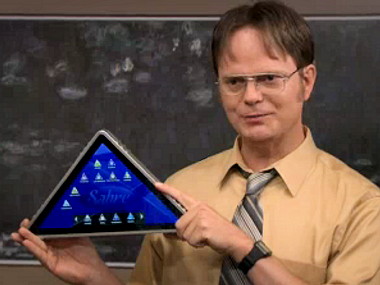
Besides, notice that I did say his vision deserves some credit. And his influence certainly shaped the competition. That's why every smartphone and tablet looks exactly the same today. Then again, options aren't infinite; you can't just go out and design a triangular iPad. 🤣
Computers and the internet changed the world. Not necessarily because of Apple computers and the internet. In fact, hardly anyone actually uses Mac OS these days. A massive chunk of users are still stuck on Windows XP. xD
What kind of "world-changing" impact from Apple are we even talking about here? 🤣
I used to listen to music on an MP3 player from some random manufacturer.
It’s one of those things where you either have it or you don't, period. That kind of influence carries weight, sure, but if you're asking me, it's a negative one.
To put it simply, based on this movie—since I haven't read the books—Steve Jobs was basically the "glue." He grabbed a handful of geniuses who never would have made it on their own, molded them into icons, and used them to build his own legend.
You have to give him credit for the vision and the hustle, sure. But let’s be real: nowadays, people buy Apple products mostly just to signal their social status. Only a tiny fraction of a tiny minority actually rely on iMacs for the stability and quality. They hit the jackpot when the iPhone, iPad, and iPod became the big trends. And trends can be anything; they aren't some definitive metric for actual brilliance. Steve Jobs was a "business shark," but there's no shortage of those out there. Are we going to make a movie about every single one? No. Why? Because you don't see overpriced, unnecessary junk like the iPhone popping up every day—stuff that parents mass-buy just so their kids don't feel left out. Grandparents are out here buying iPads for three-year-olds, only to ship them all the way back to the US for repairs once the kid inevitably breaks it.
When you can't afford a yacht or a private jet, you might as well grab an elite smartphone just so you have something decent to brag about. Bravo, Steve Jobs. You managed to convince countless college students to blow their entire summer savings from seasonal jobs on an expensive device that they'll end up using to play games, just like that toddler I mentioned earlier. Apple’s slogan really should be: "From snobs, for snobs."
Ashton Kutcher wasn't exactly impressive in his acting. He kept squinting his eyes, clearly trying to project the image of some sharp-witted visionary with a brilliant idea, but he just couldn't pull it off.
For those actually interested in the whole WikiLeaks and Julian Assange situation, listen up.
I’ve never been much of a Woody Allen fan myself, so I don't bother forcing myself to sit through his stuff. What's the point? Or is everyone just falling for the marketing hype and Benedict Cumberbatch's face without even glancing at a plot summary to see if it's actually worth their time? If you approach movies like that, how can you be surprised when you end up disappointed?
Really solid movie. Matthew M. creepy actually caught me off guard with his performance, especially seeing that level of sheer willpower required to physically transform himself like that for a role.
Did they leave out all the juicy parts? 😕 They threw everything they could from his private life into the mix, claiming his mother is part of some cult, suggesting he’s on the spectrum, and even mentioning he has a kid living in Los Angeles. They brought up rape allegations too, though Cumberbatch playing the role of J. A. denies everything—which is a bold move considering the film waits until the very end to reveal the truth, right when the audience has already been conditioned to see J. A. as nothing more than a pathological liar.
I've been looking around, but it seems nobody has started a thread on this yet.
They painted him as nothing more than some unpredictable, lying maniac. Julian actually sent an open letter to Benedict Cumberbatch, begging him not to take the part: http://wikileaks.org/First-Letter-fr...n-Assange.html
The whole film is just an intimate deep dive into Julian, while everything else—including the actual purpose of WikiLeaks—is relegated to the background. Honestly, the title should have been "Julian's White Socks and Messy Hair". We all know what audiences are really hungry for... a little bit of yellow journalism, right? 🤷