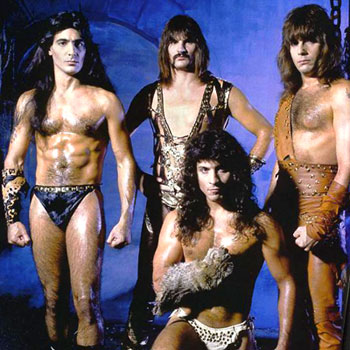
Metal is just... heavy. It’s more than a genre; it’s an adjective that actually captures the essence of the whole thing. Metal is powerful. War is powerful. But at its core, metal is the definition of strength. Long live metal.
Betty Turner said:music is just a feeling that lyrics happen to support.
Or maybe music is just the framework—the context or the emotional depth that gives words their meaning. 😕
A question for those who actually know what they're talking about: how do the experts listen to classical music? Is it all about analyzing technical perfection, or are they pulling something spiritual out of it? It feels like it’s the latter. But how? What’s the mechanism there? I don't get it.
Edward Hernandez332 said:Technical skill is everything. I’m all about Jazz or progressive metal—it’s that level of finesse that does it for me. Not just any random amateur can pull off those kinds of sets. It matters too, that there's actual soul behind the notes, rather than just some mindless shredding for the sake of showing off.
The only real issue here is what you actually mean by "soul."🙂 I doubt even you could give me a straight answer to that one.
Kimberly Lewis63 said:SO WHEN THE CHEMISTRY WITHIN THE BAND ALIGNS, THE CIRCLE CLOSES, AND THAT ENERGY EMERGES AS SOUND.
A totally predictable response. There will be more of them. I’m well aware that having an actual opinion is a rare commodity these days, much like any attempt at self-reflection or trying to make sense of anything at all.
But I’ll point one thing out to you—I’m not here for the thrill of being right on this forum. It’s not my goal to broadcast how enlightened I am, nor do I care what anyone else thinks about my thoughts. I don't need validation. I made this post because I actually care about understanding music (my own kind), and I'm hoping someone in the replies might actually offer a perspective that helps me grasp it a little better.
This is one of those rare threads that actually matters. Unfortunately, the way people post here isn't really a dialogue; it’s not actual thinking. Instead, we just get a list of why things are "good" based on someone's—usually unconscious—impulses.
I'm not criticizing criticism just for the sake of it, but I'm fairly certain that a huge chunk of us, even the ones who don't just treat music as background noise, have no clue what we are ACTUALLY looking for in a song. We can claim to "know" it by saying "I love the melody" or "I love the lyrics" (which is how this thread usually functions), but from the answers I've seen, it’s still unclear what the core pursuit actually is.
Let me try to offer my own take on this concept. Lately, I've been finding myself less interested in purely formalist music—a good portion of jazz, electronic stuff, even high-quality IDM and whatever else falls into that category. It feels like you can only enjoy it in the immediate moment. While you're listening, it’s almost purely hedonistic, sort of like eating food. Once you're done eating, the pleasure is gone. On the other hand, there is music that expresses an idea. Written words express ideas too, perhaps more purely, but in a different way than music or painting. In this context, music has the potential to embed that idea through non-verbal means—through sound. Sound has its own logic, one that isn't as easily decoded as the logic found in words. That's an advantage, really. Because it stays somewhat hidden, it hints at something, allowing for play and a wide range of interpretation without drifting into being something completely undefined.
When music merges with lyrics in this way, the words provide precise direction, while the music provides the free, emotional, imaginative context for those words. To me, that transmission of meaning and idea feels like the true purpose and essence of music.
Aphex Twin works with these incredibly dense, complicated melodic patterns. Honestly, I can't seem to wrap my head around them or memorize them, even after listening for years. If you're looking for a way in, I'd suggest starting with Pulse Demon.
Chris Barrett5 said:Look at Norah Jones, winning all those Grammys. She actually built a real career. And honestly, I think Ivy has the talent and enough grit to make something of herself too. When you write, you make it sound like building a music career is some impossible feat. How did those mainstream pop stars over in Nashville manage to pull it off then? 😕
It’s been proven, on a scale even larger than I initially suspected, that you and I belong to two entirely different worlds—worlds where absolutely no communication can exist. Greetings to you and everyone else on this thread.
She didn't actually win that show, for whatever reason... but she could really make it happen. She’s got an incredible voice, and I don't see anything stopping her from building a career.😕
It doesn't matter if someone gets famous by winning or just being on a reality show. It's all the same.
And honestly, what you're saying right there is exactly how the people who produce these shows think. You say "great voice"—yeah, and then what? Technical skill has nothing to do with artistic talent, or ideas, or creativity, or an artistic way of existing, or personal integrity (not "business" or "professional" ethics, but actual integrity) or anything else that matters when we're talking about art. Then there's this talk about a "career." To a real artist—a musician, in this case—the concept of a "career" wouldn't even cross their mind. That's just a possible byproduct of making art. A byproduct. And a trivial one at that.
The way you guys talk about "musicians," in your best definition of the word, usually just means "someone technically proficient at their job." And that has zero connection to music as an art form or a musician as an artist.
The issue with these kinds of competitions—where someone wins and gets instant fame among a voyeuristic crowd of people with boring lives who just love peeking into someone else's private affairs—is that the whole machine is rigged from the start. You’ve got these massive corporate institutions, like a giant conglomerate like Sony or Universal, that don't actually care about the music; they just care about the bottom line. Everyone involved in this entire cycle, from day one, views music as nothing more than an abstract technical skill—in this case, just hitting the right notes while singing—but they have zero artistic soul, zero creativity, zero vision, and absolutely no personal integrity. More often than not, it isn't even about seeing music as a craft; it's just a naked grab for cash and celebrity status.
The entire process is upside down from the get-go. Anyone with any actual respect for music is going to find this whole setup repulsive.
OhGr is absolute garbage, almost rivaled only in pure nastiness by this new, reincarnated Skinny Puppy incarnation.
I honestly didn't know whether to laugh or cry when I caught the music video for that track with "the greater wrong of the right." It’s not like I actually listen to them, but what a total joke for a band that used to be the heavyweights of that whole American-Canadian pop-dance-industrial scene.
shooting them in the head would've been better, they already messed up part 4... lost an hour and a half of my life, but whatever... what can I even say... they basically just pulled it out of thin air everything’s been sold off, everything's recycled. It's boring as hell. They really think it's "so cool" how they keep throwing in stuff from old sequels, but it's all so uninspired that you can't even remember who did what or why any of it matters...
stupid ending through and through, and of course, they gotta announce part 5 right away... 🙂
Man, it sucks when you let yourself get talked into seeing something that is clearly garbage.
From the very first film, it was obvious this was just about selling products to teenagers who get off on cheap violence. The creators know exactly what's trendy right now. End of story.
George Alvarez3 said:And is it completely illogical to think both Lynch and Hannibal are incredibly creative characters? Honestly, it feels like someone insulted you or something, given how bitterly you're attacking such a brilliant portrayal (and Anthony Hopkins always delivers, just like Jack Nicholson does) of a serial killer that’s been a practical, undeniable cult icon for over 40 years. Whatever.
David Lynch is a legitimate, creative, authentic artist.
Hannibal Lecter (Anthony Hopkins) is just a movie character. I honestly can't wrap my head around how anyone could claim he's a "creatively constructed" figure. It’s nothing more than cheap pop psychology and tired stereotypes. Oh, look, he’s simultaneously a genius and terrifying and seemingly insane, but he’s actually not insane—he’s just operating on some higher plane where he perfectly understands human behavior, thought, and emotion, rooted in primal instincts. This allows him to bypass moral dilemmas that, at his level of brilliance, turn out to be mere pseudo-questions, letting him exist as a walking contradiction: the ultra-mega-rational genius killer/psychopath, blah blah blah. It’s garbage. Pure pop trash designed for an uneducated mass that falls for that kind of nonsense.
wiredranger30 said:...says the man who treats David Lynch like some kind of deity. Talk about irony... 🙏 🙏 🙏 🙏 🙏 🙏 🙏
Your reaction isn't even surprising. It’s perfectly logical. Someone who looks down on Lynch would naturally think a character like Hannibal Lecter—all forced intensity and emptiness—is actually exciting. And they'd probably call a movie centered around that tired old cliché of a "villainous face" a cinematic masterpiece.