CheckEmoji Community · the emoji forum
🏠 Home 🆕 What's new ❓ Unanswered 🔥 Popular 📡 RSS Members 👥 0 online log in · register
Home › Benjamin Taylor6 › Posts

Posts by Benjamin Taylor6

586 posts shown.

Why are the youth leaving? in Economy ·
stormylynx4 said:Don't take this the wrong way—I'm genuinely curious—but why did you choose to study economics?
I'm guessing you're somewhere in your early 30s and graduated about a decade ago. Given that the American economy has been a rollercoaster for the last twenty years rather than just the recent stretch, I’m really wondering what led you to pick economics.

It sounds bizarre, I know, but it’s actually true: economists are often easier to find than engineers right now. Since we don't have much heavy industry left, every single bank and corporation still needs an economist on the payroll.

Kimberly Ramos5 said:First off, why don't you try moving out to the Midwest and seeing for yourself how much "work" there actually is...

Second off, if I’m leaving Washington, D.C., I don't really care if I end up in San Francisco, Seattle, or wherever. If my rent eats up more than half my paycheck, what's the difference? It might as well be Ireland for all I care. I guess I still like D.C. somewhat because there are actually things to do here, even if it is pricey. Besides, traveling back and forth just for job interviews is getting expensive.

And thirdly, that whole "jobs are everywhere if you just roll up your sleeves" argument is absolute garbage. I’m a college graduate with an economics degree and I'm unemployed. Sure, I could pick up some low-tier gigs like delivery driving, taxi work, or hauling crates—jobs I've done before—but there's no way I can actually survive on that in a different city. It isn't realistic to assume everyone is a universal worker. Just because your friend is a truck driver doesn't mean I am. Or if your buddy is a CNC operator making good money, does that make me one? No. Am I a doctor or a foreign language professor? Also no. Maybe I missed the mark with my major, but I’ve put in the work through formal education and various courses. I’ll admit I’ve worked lower-paying jobs in the past, but I was barely scraping by even while living in my own place. At the end of the day, I’m not some jack-of-all-trades who can jump between 150 different careers. Honestly, I'm pretty much done with more training and retraining; it’s all been a massive waste of time.

The biggest issue is that I lack industry experience and, obviously, connections. Employers won't even look at me, even if I had a hundred degrees, because they’re all looking for a "finished product"—someone they can just exploit immediately. A friend of mine actually just got fired from her job after ten years because she got pregnant. It seems smarter for some clueless employer to dump someone with that much experience and hire a stranger who'll need training from scratch. It’s paradoxical, really; employers have zero patience for anyone without experience, yet they expect you to give 200% starting on day one. Honestly, the employers are the real scum here, and the state of the country isn't helping either. There are no jobs. Nothing is being manufactured, nothing is being traded—just a few service jobs here and there, and that's about it.

On the other hand, things work differently overseas. No games, no late paychecks, no unpaid overtime. They don't care who you are or how old you are—all they care about is whether you actually want to work. Even if you're starting from scratch, most places will give you a trial period and a few weeks of training just to get you up to speed. You only get fired if you're an absolute idiot, lazy, or a thief, which I guess is pretty standard for us Americans.

Money isn't everything to me, honestly. I'd be perfectly fine making maybe $2,500 or $3,000 a month—just enough to cover the bills and call it a day. But I have no clue who I'm supposed to pull strings for to land a job like that, especially since I've lived in this city for 30 years. And no, I'm definitely not joining a political party to get ahead. So, what am I left with? I haven't decided yet, but I'm right on the edge. One foot is already out the door; my suitcase is just sitting there, staring at me like, "Are we doing this or what?" Since I own my place here, an average salary would be plenty, but getting one feels impossible. Moving away to live in some cramped little room just to wash dishes or work construction doesn't exactly sound like the dream either. So, yeah, you tell me how to be smart about this... A person just snaps sometimes, breaks, and leaves. I guess I haven't hit that breaking point yet because I'm so tied to my hometown, but I'm getting pretty close.

Anyone claiming it's easy to find work around here should try spending two or three months on unemployment with a degree that nobody's hiring for, then they can come talk to me.

I have a friend who studied economics and hospitality management. She's 57 and has been working in Germany for four years now. She started out as a maid, and now she’s working at a plastics manufacturing plant.

Then there's my neighbor—a literal PhD in Russian linguistics. He's 47 and completely UNEMPLOYED.
http://www.example-news-site.com/articles/tough-questions
Why are the youth leaving? in Economy ·
rapidraven95 said:It’s all because of this plus a whole bunch of other headaches. ☕

Or maybe it's because of our CEO's personal hygiene issues:

I took a closer look at the notice today regarding the delayed paycheck—apparently, it’ll be arriving on some specific date.
But something just clicked for me, and honestly, it feels like a complete legal circus:
get this, here is what’s actually posted on the bulletin board:

NOTICE

Pursuant to Article 92 of the Labor Code, Article 41 of the Employee Handbook, and Articles 10 and 12 of the Employment Contract, we hereby notify you that the salary for SEPTEMBER will be paid on November 13, 2017.

EXPLANATION:
Due to the failure to meet obligations within the planned timelines per work orders, the necessary conditions for the timely calculation and collection of agreed-upon compensation have not been met.

Originally Posted by mazz View post
Why are so many young people fleeing this beautiful country? Once you finish school, even if you land a decent job with a starting salary of $3,000-$4,000, isn't that enough for a young person to get started? If there aren't jobs in the Midwest, just move to California, the Gulf Coast, or Florida—anyone who actually wants to work can always find a job somewhere.


You're living on Mars. Here in San Diego, most high school grads are stuck scraping by on minimum wage. And I know families down near Niagara Falls who only have seasonal work. They moved from the Midwest and now they're just renting. Now the husband has gone off to work construction in Austria under the table during the winter.
The Power of Humility in Spirituality ·
Elizabeth Castillo87 said:Yeah, but honestly, every single religious leader I’ve ever come across—and I mean everyone from the local preacher to those high-priced gurus out in California—doesn't actually promote that sense of Unity. Instead, they just sit there letting people shower them with gold and expensive gifts.

A classic example would be Osho and his fleet of 100 Rolls-Royces. Though, if you think about it, he seemed to mock those extravagant gifts more than he actually took pride in being pampered by his followers.
rowdypilot19 said:So, basically... you're encouraging someone to pour their life into something that just doesn't pay off? I mean, yeah, great idea. Truly a stellar move.

I mean, if we’re being honest, for subsidies to actually make any sense... I don't know, maybe the amount per acre should probably scale down as the farm gets bigger? It just seems like it would work better that way. Because, you know, a larger operation usually means lower overhead and everything runs a bit more efficiently. It's just more rational, I guess.
I mean, honestly? It would just be a total disaster. Probably even more chaos and shady business than what we're seeing now. I guess... maybe things would just get way messier.

It’s like... this whole setup is actually even worse, I guess. It feels like if you're actually doing well and being successful, they just end up punishing you more for it. Maybe that's how it works now? It's just a system where the more you succeed, the more they come after you. Truly.

Since you're clearly struggling, here—take some extra cash. Maybe it’ll help.

That’s just brilliant. Truly.

I guess I should probably start by saying... well, there isn't much else to say, really. It’s just that thing we were talking about. You know? I mean, if you look at it one way, maybe it doesn't even matter, but I can't help but think about it. It stays on my mind. I don't know. Maybe I'm overthinking things, too much, probably. But anyway...
I mean, it’s a whole different ballgame if your well is basically the only one for miles around. I guess you start thinking about things differently then, right? Like, if that one source goes dry or something... man, that's a heavy thought. Maybe it's just me, but I feel like everything changes when you're relying on just one thing. It's a lot of pressure, honestly. 3.1 milesIt’s just... I mean, you have to consider that in certain spots, there isn't even any water available at all. Or, if you do find some, it might be sitting fifty meters down. And then, okay, even if you get it, the temperature is just way too cold. It’s freezing. So, I guess you’d end up needing those massive storage tanks out on the surface, just hoping they soak up enough sunlight during the day to actually warm things up. Maybe that works, but it seems like a lot of extra work, right?
That’s not quite right, I guess... if you actually look at Vrgorac and Sinjsko polje.

I mean, seriously, if there isn't any water, what on earth would be the point of trying to jumpstart agriculture there? I guess... I don't know, it just doesn't make sense. Like, why would we even talk about incentivizing farming on Brač, specifically out in the Blaca desert? It feels a bit pointless, honestly.

I mean, sure, it’s doable, I guess... but you better be ready to shell out some serious cash if you're actually going through with it.

Watering your lawn in the middle of a summer day? I don't know... maybe it isn't the brightest idea. It just feels like a waste, honestly.

I guess, at the end of the day, maybe it’s actually better for farming to just have a desert and the ocean instead of all that fertile soil and a river running through it. I don't know. It feels like if you have the barren stuff, at least nobody is breathing down your neck about environmental conservation or whatever. At least then, nobody's messing with you. 😁

EXACTLY: http://www.agrosmart.net/vesti/bez-z...lastenika.html

Look, the real secret lies in innovating how we handle irrigation and fertilization—but we aren't just talking about turning on a hose here. It’s about a massive, integrated system—everything from building reservoirs and pumping stations down to the actual sprinklers, all tied together by computer-controlled monitoring. The whole goal is to take soil that’s been thoroughly tested and deliver the exact amount of water and nutrients directly to the plant's roots for peak growth—that’s how Hermisan ” Juan Felipe Muñoz Viscaíno, the director over at “ Hermisan, explained it to us.

“Hermisan” is one of those heavy hitters in Spain, producing top-tier irrigation equipment for both greenhouses and open fields. They’re moving about two billion euros worth of gear through Spain and 70 other countries. From what we gathered from Juan, the entire point is using these high-tech tools to squeeze out the highest possible yield while using as little water as possible, all while staying green.

- It’s actually quite simple. You have to understand plant biology and soil characteristics to deliver precise amounts of food and water. We haven't seen rain here since May, though honestly, a sudden downpour might actually mess things up right now by throwing this controlled system out of whack—Juan told us this while we were touring the greenhouses and lemon groves in San Juan, way down in the South of Spain, near Alicante.

The Andalusians really go all out to secure their water supply; they use rainwater, desalinated seawater, groundwater, and even pipe it in from other parts of Spain. They build these massive reservoirs and then pull from them via fully automated systems where the computer acts as the brain. Everything is doable and everything pays off, mostly because the farmers there—whatever they’re growing—work together. The Andalusians are pretty much in a league of their own when it comes to that. They irrigate fruit and veg collectively through irrigation user associations. They pay a flat membership fee to access the reservoir water, and then a secondary fee based on how much water they actually use, or rather, the acreage they’re irrigating.
Alex Scott5 said:Some people wonder what kind of management or agronomic expertise is actually required when God sends nothing but two measly drops of rain to the Mediterranean Coast in an entire three-month span... 😁

Just don't come at me with talk about hydroponics, NASA technology, or aquaponics... during drought periods where water is gold, most aspiring farmers—real or imaginary—can't even get their hands on a basic Mesopotamian irrigation setup. With no rain in sight, city water being prohibitally expensive, and the local quality being absolute garbage... how exactly are you supposed to execute your strategies, operational studies, or those von Schlieffen plans for conquering France without any water? 😁

All you really need is a deep pocket. That's the secret behind this 7-acre property here.
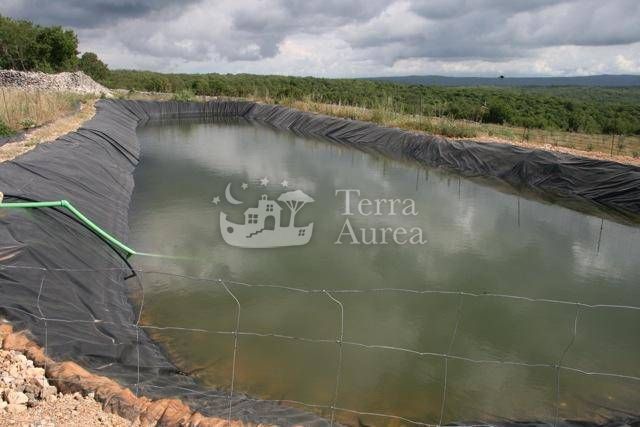
It’s like a little slice of magic tucked away near Cleveland—a family farm and olive grove paired with a luxury villa, sitting about half a mile from the edge of town and about a mile from the waterfront and downtown. The farm covers roughly 7.5 acres, mostly planted with young olive trees—only about three years old now. The entire plot relies on an irrigation system fed by a reservoir with a capacity of 900 cubic meters.

image
Mind you, I’d still need to add a plastic liner to the setup. You’d want to float about a hundred Styrofoam sheets on the surface. Then, you drill tiny holes in the liner so any rainfall can drain easily into the reservoir. The liner itself helps stop evaporation during those brutal heatwaves. Of course, you’d have to cover the whole thing with hail netting and anchor it down tight so a strong wind doesn't just blow the whole operation away.

I was actually looking into buying something similar to handle the summer irrigation for the olives.
Though, I'd probably just order the base model without all the bells and whistles. But the cover and the wind protection would be non-negotiable. Fill it up during the winter—use it through the summer.
The mystery of life itself in Off-topic ·
nimblewolf11 said:A living universe? A universe that actually walks among us? ...

Spiritual gurus always claim we’re just tiny fragments of a much larger Whole—we just haven't had the epiphany to realize it yet.
And there I was, reading this book that the author actually signed for me: http://www.daniellakordic.com/index....udenje-cjeline
The book synchronicity—the way it landed in my hands—wasn't some random fluke. In fact, I actually met the author a few months before I even picked up the book.

Adrian Kezele entered my life through what I consider a significant, somewhat mysterious instance of synchronicity. But once I finished the book, that connection didn't feel mysterious at all anymore. It was, quite frankly, as clear as day.


It's beautifully written, I'll give it that.

But honestly? That book leaves me feeling pretty depressed because every time I look at it, it brings back memories of my late friend and his wife.

Kezele argues that the Whole communicates with us through synchronicity—using these little cosmic nudges to steer us toward spiritual growth.
But, you know, if we're being practical, I suppose the first prerequisite for "spiritual growth" is actually being alive!
My friend was at that lecture—it was November 16, 2016.
Toward the end, Kezele told everyone there were numbers taped under our chairs.
And sure enough, it was true. Everyone pulled a number. We were supposed to find our "match"—someone with the same number, since they were all in pairs. Kezele believed that meeting a total stranger through this kind of coincidence would spark some sort of profound communicative wisdom. Personally, I didn't walk away with any life-altering wisdom, but I did get one small win: my mother finally got her reading glasses (she’s 77). It was driving me crazy seeing her struggle to read, especially since she was too stubborn to go pick up those cheap ones from the local clinic.
But my friend? He never found his match. Maybe he slipped out early, or maybe the seat next to him was empty.
Poor guy was searching everywhere like a madman for his partner, thinking he was going to hear something deeply profound.
He was dead serious about it!
See, my friend was battling colon cancer and had to carry an ostomy bag. His prognosis was incredibly uncertain.
And back home, his wife was fighting pancreatic cancer—the prognosis there was grim.
He was desperately looking for salvation through synchronicity, but he never found his counterpart.
Maybe that was the Whole sending a tragic message.
His wife passed away at 60 this spring, and he followed her at 66 this summer. 😲🙂😲

Everyone in the neighborhood knew him as that eccentric guy who spent his time staring directly into the sun—you know, the sungazing type.
bluetinker54 said:Look, man, you clearly don't know the first thing about tourism or the rental market. Honestly, it might be better if you just kept your mouth shut so you don't embarrass yourself.

rowdypilot19 As specified by:
No, I mean they were only protected because they were state-backed, just like those massive government-owned corporations. They’d lock in prices ahead of time, overcharge for everything, and then the companies would just patch up their losses using taxpayer money from the federal budget—nobody actually gave a damn about the consequences.

Of course, when you look at who was actually padding the budget, it was mostly the USA and Russia. Though, if I had to be more precise, it was primarily the USA.
.

I guess you're talking about the old America days? But honestly, what was it like before that? Ever since the mid-1800s, the Midwest has been incredibly rich and fertile—back when we actually had some order brought to us by the Americans—but then for the last 20 years or so, we've just been struggling. And now, with the climate changing, I suppose it means we humans are the ones to blame.

I’m sorry, but I think you’re talking complete nonsense.

wearytrucker22 Asks:
I mean, I guess they probably have to get out there and actually put in the work too—spraying the fields, dealing with all that rot and decay, and then obviously having to go out and buy the seed.
And because of how they’re playing games with the wheat supply, American tourism is going to take a massive hit too, especially since bakery products are such a fundamental part of the experience. You have all these high-end restaurants and local pizza joints that end up having to source their flour from outside suppliers just to keep their doors open.
I honestly don't think you can ever make a decent pizza using American wheat; it just doesn't work. You might get by making some okay bread or maybe even some pastries, but as far as pizza goes, you're just out of luck.

More nonsense. If there's one thing that’s actually true, it's that most of our bakery products are subpar, but you can't exactly pin that on the farmers; the blame lies squarely with the bakers. I mean, if certain bakeries are capable of turning out incredible goods, then others could easily do the same if they actually cared to try. And yeah, I’m well aware that some of our local bakers are importing flour from Mexico just because it’s cheaper, not because it’s any better quality.

And you've gone and started in with the nonsense too.

For all those of you who seem convinced that some farmer is only planting wheat just to chase government subsidies, I’d suggest you go do a little homework. Seriously, try to find the actual breakdown of how many acres are allocated to each specific crop. I’m certain that kind of data is out there somewhere if you actually bother to look for it.

neonhound18 Asks:
That’s exactly why I argued that we need to focus on education. We really have to sit people down and explain that planting a single crop in a monoculture basically ruins the soil. You end up inviting a whole host of diseases, pests, and weeds to move in, which eventually leads to total soil degradation because the humus levels just plummet—mostly because everyone relies so heavily on synthetic fertilizers for grain crops. I could go on and on about that, but you get the idea. 🕺

No self-respecting farmer—someone who actually treats this as a profession rather than just some shady middleman looking for a quick buck—would ever dream of planting crops in a monoculture. That’s just common sense, something my late grandfather drilled into me from day one.

I think this is absolutely spot on.
First of all, let's be clear—not everyone lives within the metropolitan belt. 1.9 miles It’s coming from the coast, too. And honestly, most of the people actually living there don't even have anything available to rent out anymore.

Everything people are saying about agriculture is spot on. Take a place like Pakoštane, for example. Back in the day, everyone there was focused on farming—the land around Lake Vrana is incredibly fertile and productive. But once tourism really took off in the 80s, things shifted completely, and now it seems like almost everyone has just walked away from farming altogether. The prices they get for crops aren't worth the effort anymore, and to make matters worse, the Ornithological Reserve is teeming with birds that end up eating whatever manages to grow. So, you end up with this amazingly rich, fertile soil just sitting there neglected, while the tourism industry continues to boom.

The truth is, investors aren't interested, and finding workers is nearly impossible. Livestock is brutal work; once you decide to raise sheep or goats, you might as well have signed yourself up for a life sentence.

Come on, let's hear from some actual Family Farm owners instead of just the armchair theorists.
The number of Family Farms will naturally dwindle over time because so many of them are essentially "retirement" households. And frankly, their heirs don't see any future or any sense in sticking with agriculture.

No matter how unprofitable it might be, we still need it. It's essential for food and for crop rotation.
The problem is that all these self-proclaimed experts seem to think a farmer just sows wheat and nothing else.

It's the truth. I knew this retired fisherman back in the day who realized too late—he was sixty when he decided to pick up a herd of thirty goats. Once the reality of the sheer workload hit him, the stress just wrecked his nerves. He ended up selling the whole lot for pennies on the dollar before the animals could kill him first.

Now, there was one guy, though, who kept goats more as a hobby than anything else. He fenced off a little peninsula with some wire and kept about twenty goats there. All they ever got from him was a bit of corn and some water—usually tossed their way while he was heading out to go fishing.
In the spring, he’d grab a small-caliber rifle, make sure the local sheriff wasn't lurking around, and then... well, he'd "harvest" a few kids.
But let's be clear—that isn't a business; that's just a way to patch holes in a household budget.
wearytrucker22 said:You're absolutely right—it hasn't been easy. One single slip-up and one bad review can tank the whole operation. My original plan was to pull in about $6,000 to $7,000 per season. But if you spot a gap in the market and put the work in, you've basically broken even on your initial investment between this year and last. Now, I’ve identified a specific niche paying anywhere from $1,250 to $1,500 a day. Moving forward...

I just spotted an opportunity to pull in about $1,300 to $1,600 a day, but there’s a catch: you need at least $650,000 in capital—or a massive loan—to get off the ground. Honestly, that kind of debt is a joke to ask of regular folks. I’m personally not diving into this until I’ve scraped together 80% to 90% of the cash myself. I say that as a nod to those people out in the Midwest asking for loans just to start production. Sure, getting a bank loan is easy, but you actually have to pay it back, and nobody is giving you any guarantees once things go south. Taking a loan isn't a handout; if you don't have your own skin in the game, you're basically throwing money into the wind and setting yourself up for total ruin. If you don't have the funds, just pack up and head to Denmark to work on some pig farm. Get your experience and build up enough seed money to cover at least 30% of the investment—not counting the land, obviously. When you're playing with your own hard-earned cash, the psychology is completely different than when you're gambling with someone else's money.

Here’s how you actually make it in some small Midwest town with maybe 100 to 500 people.

Get together at some house, grab a beer, and round up your fellow citizens.
Let's get a farming collective off the ground.
Let's get an inventory of the machinery together.
Compile a list of core competencies. You have to know everything—and frankly, you need to understand agricultural production better than any of the competition in the European Union. It’s like how people from Southern California just inherently know how to grow the perfect mandarins or watermelons.
Compile a land registry list.
So, let's say you all decide to pool your resources and jump into large-scale production together—we're talking about hitting a target of, say, 1,000 tons of vegetables.
So, you want a full-scale vegetable harvest schedule mapped out a year in advance, including specific quantities? Fine. Let’s get down to business. You can't just wander into the garden in July and hope for the best; that's how you end up with nothing but dirt and regret. If you want to actually feed people—or at least have enough to stock a pantry—you need a roadmap. Here is how you structure a professional-grade planting and harvest master plan for an American backyard or small farm setup. **Phase 1: The Inventory & Goal Setting (The "What" and "How Much")** Before you touch a shovel, you need to know your numbers. Don't guess. * **Define your yield targets:** Are we talking about feeding a family of four for the summer, or are we trying to preserve enough canned goods to last through a Midwestern winter? * **Calculate by weight or volume:** Instead of saying "I want tomatoes," say "I need 50 pounds of tomatoes." That dictates whether you plant three plants or twenty. * **Analyze your zone:** This isn't one-size-fits-all. Your plan for a garden in Florida is going to look nothing like a plan for a garden in Maine. Determine your USDA Hardiness Zone immediately. **Phase 2: The Seasonal Breakdown (The Timeline)** You need to divide your year into three distinct operational windows. **1. The Early Spring Push (Frost to Late May)** * **Focus:** Cold-hardy crops. Think peas, spinach, radishes, and kale. * **The Math:** These grow fast. If you need 5 lbs of radishes, you can plant them in waves every two weeks to ensure a continuous supply rather than one massive, overwhelming harvest. * **Action:** Get your soil prep done in late February/early March. **2. The Summer Heat Wave (June to August)** * **Focus:** The heavy hitters. Tomatoes, peppers, cucumbers, corn, and squash. * **The Math:** This is where your quantity calculations matter most. Corn takes up significant real estate for relatively low caloric density per square foot compared to, say, potatoes. Plan your acreage accordingly. * **Action:** Stagger your plantings. Don't put all your tomato starts in the ground on the same day unless you want 40 pounds of tomatoes rotting on your porch all at once in July. **3. The Autumn Harvest (September to November)** * **Focus:** Root vegetables and brassicas. Carrots, beets, garlic (which gets planted in the fall for next year), and broccoli. * **The Math:** Garlic requires a massive lead time. You plant it now to reap the rewards next summer. * **Action:** This is your cleanup and preservation phase. **Phase 3: Creating the Master Spreadsheet** To do this right, you need a document with these columns: 1. **Crop Name** 2. **Target Quantity** (lbs/oz) 3. **Estimated Yield per Plant** (Research this; don't wing it) 4. **Number of Plants Needed** (Target Quantity ÷ Yield per Plant = Number of Plants) 5. **Planting Date** (Based on your local frost dates) 6. **Expected Harvest Window** **The Bottom Line:** If you aren't calculating based on the actual yield of a single plant, you aren't planning—you're just wishing. Do the math, account for the inevitable pests or a random July drought, and build in a 15% buffer. That’s the only way to actually succeed.
If you can find someone truly capable, send them out across the US and the coastlines to hammer out deals with shopping malls and the big corporations that supply hotels and everything else.
Look, if you’ve got inventory that got trashed because of some crazy weather hitting your supply chain right after you signed a sales contract, don't just sit there staring at the loss. If you actually want to run a business, go out and buy the stock on the open market instead. Grab it, get it moved, and deliver it to your customers five or ten minutes before the deadline hits. That's how you handle it.
Success is a total guarantee if you can pull off 1,000 tons of organic produce every single day. You negotiate the deals now, deliver next year, and you’ll have everything sold off to the Mediterranean market without a single hitch.

I actually pitched this exact idea to my boss, who’s from a small place near Zadar. They have incredibly fertile fields out there, but 70% of it is just sitting idle and overgrown.
Unfortunately, nothing came of it. The problem is that the older generation is living off their German pensions and using that money to support their grandkids.😲😁😲
Plus, the land ownership is a nightmare—every plot seems to have ten or fifteen deceased owners tied up in legal limbo. It would be best to just convert everything into one massive olive grove, but honestly, who is going to satisfy every single living heir?

Thomas Nelson25 said:Look at this post

I just don't know what's going to happen with livestock and pig farming. There is endless potential for sheep and goats (both out where you guys are on the coast and inland), but nobody—and I mean investors—seems to give a damn.

There is potential, but it requires grueling work. I knew a young guy back home who worked with goats for twenty years.
Eventually, he rounded them all up and moved them to some desolate, remote island. He basically did a favor for the hunters who head out there to hunt "wild goats."
The guy spends his time fishing now. Mostly selling everything under the table, too.
Mind you, he isn't exactly a master of the craft

And then there's this one guy, who is a whole different story:
Christian Miller14 said:The contract the seller signed with RE/MAX prevents them from selling to anyone else—even if they find a buyer themselves, they’re still stuck going through the agency

I've personally tried listing properties through agencies twice before, but I never signed any of those restrictive contracts.
And honestly? I ended up selling without an agency entirely.
If you haven't signed anything binding, finding out who actually owns a listed property is easy enough—especially when we're talking about vacant land.

Besides, I don't see much point in most of these agencies anyway—they mostly just repost everything on Zillow. All that bragging about having listings on ten different sites? I highly doubt half of that is even true.
What do you want to leave behind when you're gone? in Miscellaneous ·
Grace Edwards92 said:There’s just a massive flood of trolling posts on this forum lately. And honestly? It’s not even just that. I’m actually thinking about setting up a gallery on my Facebook just to showcase all those selfies I took out near Orion, by the Tannhauser gates, and in other godforsaken backwoods. 🥳

Look, not everyone here is a troll. For instance, this one right here is actually making a valid point—even if it is incredibly depressing to read:
Wage garnishments and collections in Law ·
rowdyraven112 said:The Supreme Court already weighed in on these kinds of auctions back on January 25, 2017. Look up ruling number U-IIIB-7101/2014. We’re talking about a woman who moved out, only to have an enforcement action hit her apartment for $970. They sold the place, and they didn't even break even because the sale proceeds went straight toward covering a mortgage she was paying on time.

And this part matters:

Regarding the claimant's argument that "to recover the debt of $970, the sold property—the apartment—was worth far more, nearly a hundred times more than $84380, while she still owes over $83333 on the mortgage for that very apartment," the Supreme Court points back to its own legal precedents established in rulings U-lll-488/2001 from January 22, 2004 (published in The New York Times, issue 11/04) and U-lll-1 112/2001 from February 19, 2004 (published in The New York Times, issue 27/04).

Bottom line? The Supreme Court has already issued final rulings regarding these enforcement auctions triggered over "pennies."


Even a proposal from the Most caucus wouldn't help this woman from a small town whose property was sold for only two-thirds of its value—especially since she doesn't just live in that apartment, but also spends time in Germany.

The Most caucus is set to move the final version of the Bankruptcy Code to its second reading in about ten days. This proposal was originally accepted during the first session of the newly seated Congress last October. One of the key updates, according to Miroslav Šimić, the caucus leader, will be a provision stating that property cannot be seized if the principal amount of the debt is less than $6.75.
Wage garnishments and collections in Law ·
So, it’s actually pretty risky to live that bohemian lifestyle here in the States—you know, just packing up and wandering the globe for a while. I know a few people who spend years bouncing from one country to the next, thinking they're being free spirits, but when they finally decide to come home, they could easily find themselves staring at an empty driveway where their house used to be. They basically have to leave everything in the hands of someone with a power of attorney, handing over maybe 10-20 $0.00 just to make sure the utility bills actually get paid.
Take my buddy, for example. He’s currently holding the keys to his aunt's place—she’s living out in the US, but she hasn't been back stateside in five years. She's getting elderly, and he’s been collecting all these piles of yellow notices that show up at the door, but there's a catch—he can't actually pick them up or deal with them because he doesn't have the legal paperwork. He'll head down to City Hall just to check if there's some property tax due, but honestly, he has no idea who is even looking after her apartment while she's away.
At the end of the day, she could end up totally stranded without him.
Karma, Love, or Just Habit? in Spirituality ·
rowdytiger13 said:Probably impossible to wrap your head around unless you've actually lived through it. It's hard to grasp how much a psyche can be fractured.

Unfortunately, we also have to deal with the extreme, pathological cases:
http://www.nytimes.com/news/extreme-cases...monsters

Alan Lambert and his mother Anna treated poor Tanya like property—essentially reducing her to an object—while she simply succumbed to them out of sheer apathy and passivity, according to experts. What is actually driving one of the most brutal crimes in American history, and how is it even possible for something this horrific to happen in the 21st century? That is the haunting question left hanging after the local US court handed down its ruling, sentencing Alan and Anna Lambert to a combined 62 years in prison for the murder of Alan's common-law wife, Tanya Brnelić.
My customer left their cat with me... in Real Estate ·
Michael Morgan5 said:Check out the 'Blue Paw' subforum over there; you’ll run into a bunch of total fanatics who foster cats of every single breed, color, and size imaginable.
Just write some heart-wrenching story about a stray, and I guarantee you'll have a hundred people hooked on you in no time.

It looks like quite a few have already been rehomed:
My customer left their cat with me... in Real Estate ·
Donna Collins56 said:I am honestly losing my mind right now over how I ended up in this mess, so I’m writing this out here in the hopes that someone might actually have a decent idea of what I should do. A few months back, I finally bought an apartment. It felt like such a steal through the agency, and because there was so much interest from other buyers, I knew I had to jump on it fast. Now, the guy I bought it from lived with his cat. To be completely blunt, he told me upfront that the cat wouldn't be coming with me and that he’d just let him go out into the wild. The agent brushed it off, promising everything would be sorted out, so I went ahead and signed the papers. But then, on moving day, the agent—without even providing a receipt or any official paperwork—pocketed a massive commission, the seller moved out to another state, and I was left staring at a cat. Look, don't get me wrong, I am not some animal hater, but I really, truly do not want a cat living in my home. I have terrible allergies to pet hair, so the poor thing is stuck out on the balcony, which just feels absolutely heart-wrenching. Every time I talk to the former owner, who has relocated to a different city, he asks about the cat, and when I suggest bringing him over, he immediately starts whining about how he has nowhere to take him. I’ve even had these dark, desperate thoughts about just packing him up in a carrier and leaving him right in front of the real estate office. I feel so bad for the little guy; the previous owner actually found him with broken legs and nursed him back to health, but he wasn't compassionate enough to actually take him along. I’ve tried listing him on all sorts of local adoption sites and Craigslist, but nobody is biting.

If nobody wants to adopt him, you don't have much choice but to perform a midnight DISLOCATION. But maybe try a place similar to this:
The Far Left in Close to Politics ·
Has anyone actually sat down and read this book? I’ve only really flipped through it myself, but it caught my eye:

http://objektivno.com/new-from-the-publisher...after-1945-87121


THE PATH TO SOCIALISM: Theory and Practice within the Independent State of America – A collection of discussions and articles never published after 1945.

What was the actual discourse surrounding socialism as an ideal social structure during the era of the Independent State of America? How far did they actually get with implementing these ideas of "American Socialism"? It turns out—and this is where things get interesting—there was a massive amount of thought and writing dedicated to the foundations of social organization, ultimately leading to the conclusion that a uniquely American version of socialism was the absolute best and most fitting model for the nation.
The Etheric Body in Spirituality ·
Frank Allen70 said:Never satisfied, always cynical 😁 You actually remind me of a friend of mine—someone who struggles immensely because they're terrified of everything, including themselves and what they might actually be capable of. I truly hope to see you again in a year or two with a bit more of an open mind; honestly, I don't see how staying stuck like this could ever benefit you. Perhaps you should try exploring things on your own terms—just step away from the scientists, the academics, and everyone else's lived experiences for a moment and see what happens?

And how exactly does one "stare into the unknown"?

Is it through a social media post, a prayer, meditation, deep contemplation, shamanic drumming, or maybe some tantric sex??

So many people have been persistent about it, yet they haven't glimpsed a single thing. 😁

As for science—well, plenty of people have tried their hand at that too, but they can never seem to bump those probabilities up to anything resembling certainty. For now, it’s all just: now you see me, now you don't.
The Etheric Body in Spirituality ·
Elizabeth Castillo87 said:So, tell me, casualtiger2, do you actually buy into this whole thing about an ethereal body and those other five non-physical layers?

I’m not entirely sold on all that stuff, to be honest. Though, I suppose some people swear by it:
Where did the money go? in Business, Accounting & Taxes ·
We might as well just lock this thread down!!
It’s painfully obvious where all that cash actually ended up: 😲 😂 😲
Wild Capitalism in Economy ·
I was sitting there the other day, just minding my own business, thinking about how much noise people make when they think nobody is listening—and then I heard it. That specific, unmistakable sound of someone trying to play the accordion like they’re auditioning for a wedding band in a small town in Ohio. It’s that "Bata Konj" style of playing—if you know what I mean—where it’s all bravado and absolutely zero technique. Honestly, it gets under my skin. There’s a certain kind of person who thinks that if they just squeeze that bellows hard enough, they’re suddenly a virtuoso. It reminds me of those guys who buy a high-end espresso machine just to make instant coffee; it's all about the gear and the ego, none of the soul. You can hear the struggle in every note, that frantic, rhythmic squeezing that sounds less like music and more like a plea for help. It’s loud, it’s repetitive, and frankly, it’s exhausting. I don't care how much heart you put into it—if the melody is a mess, it's just noise. Benjamin Taylor6 says:
Morality is nothing more than a construct—a complete fabrication. Just think about it for a second. If you were exactly who you are today, but tomorrow you suddenly hit the jackpot in some massive Powerball drawing and walked away with $90 million... would you actually stay the same person? Would you still hold onto those same "moral principles"? Not a chance. It’s a joke. Everything we call "right" is just a byproduct of our circumstances. And while we're on the subject, let's talk about "quality." That's just another social fiction. Is it really fair that some guy who barely scraped by with C's in college makes the exact same salary as someone who struggled through with D's? Or better yet—look at the corporate ladder—is it right that some kid with high-level connections at a place like Goldman Sachs climbs to the top while the actual "high-quality" worker stays stuck in the same cubicle until retirement? Quality is subjective. It's all in the eye of the beholder. Honestly, maybe that supposed "high-quality" employee is just a loudmouthed jerk who needs to be put in their place. Maybe the only true quality left is being immoral. Oh wait... there I go again.

Morality? Honestly, where do we even begin with that one? It’s such a slippery slope—one minute you think you’re standing on solid ground, and the next, the whole concept just shifts under your feet like quicksand. I was sitting in a coffee shop in Chicago the other day, just watching people pass by, thinking about how everyone carries this invisible little compass of "right" and "wrong," yet nobody seems to be reading from the same map. It’s all relative, isn't it? We talk about ethics as if they’re carved in stone, but then you look at how capitalism operates—it has its own internal logic, its own version of "good" and "bad" based entirely on profit margins and market trends—and suddenly, traditional morality feels almost... quaint. Almost out of place in the modern world. I remember back when I was working a desk job in Seattle—nothing fancy, just grinding away—and I saw how easily people would compromise their principles just to get ahead or avoid a bit of friction. It wasn't even malicious; it was just... casual. That’s what gets me. It’s not always the big, dramatic sins that erode our sense of what's right; it’s the small, quiet concessions we make every single day. We tell ourselves it doesn't matter, that it's just one little thing, but those little things add up until you don't recognize the person in the mirror anymore. And don't even get me started on how much influence global powers exert on our collective conscience. You see what happens when massive entities decide what's "moral" for the sake of geopolitical leverage, and it makes you wonder if true morality can even exist on a societal scale, or if it's just a tool used to justify whatever agenda is currently in vogue. It’s exhausting, really. Just an endless cycle of shifting definitions.

It’s just one of those political or economic posters—you know the type—where things get a little heated because someone, somewhere, decided they couldn't see eye to eye with the status quo. It’s all just noise and friction over policy disagreements. 😁

image

And when you look at religion, it’s clear that the moral code being pushed is nothing more than pure, unadulterated capitalism—it's essentially this:
I honestly find myself circling back to this same point more often than I’d like—it’s almost exhausting how predictable it all is. We talk about progress, we talk about the "modern era," yet when you actually peel back the layers of our current economic structure, it’s just the same old capitalism dressed up in a shiny, digital suit. It’s a facade. And look, I know what some people will say—I can practically hear them now—but let's be realistic. People like Benjamin Taylor6 seem to think that if we just tweak a few regulations here or adjust a tax code there, everything will magically balance out. It won't. It’s not that simple, and frankly, it's a bit naive to suggest otherwise. It reminds me of this one time back in Chicago—I was sitting in this tiny, overpriced coffee shop, watching people rush around with their laptops, all convinced they were part of some grand, meaningful movement, while in reality, they were just fueling the very machine they claimed to despise. The systemic issues aren't just glitches in the software; they *are* the software. We're operating within a framework designed to prioritize certain outcomes over human well-being, and no amount of polite discourse is going to shift that foundation overnight. You can't fix a house by repainting the shutters when the foundation is literally sinking into the mud. It’s frustrating, it’s repetitive, and quite frankly, it’s getting harder to stay calm about it.

Jesus answered him like this: “Your Majesty, I’ve looked into both of these cases just to get to the bottom of things—to find the actual truth here. See, the thief was just your run-of-the-mill criminal, plain and simple, so I handed him three years of hard labor rowing on the river. But that merchant? My reasons for punishing him were entirely different. To me, he’s just another kind of thief, only a much more specialized one. He owns a whole string of shops in Rome that peddle Chinese silk. He sources his goods in China and hauls them via caravan all the way to Europe. He buys that silk for next to nothing and flips it for an absolute fortune. After fifteen years of playing this game, the man has amassed enough wealth to own seven different storefronts, a massive villa, and a sprawling estate out in the countryside. He’s even got fifty slaves working for him, plus over 150 servants and maids running around his properties.” It just doesn't sit right with me—honestly, it’s impossible for it to be fair. I mean, how does anyone actually amass that kind of wealth in such a ridiculously short window of time? It feels fundamentally wrong. I was sitting there the other day, just thinking about how some people seem to hit the jackpot overnight while the rest of us are out here grinding away, and it really gets my blood boiling. There has to be more to the story than just pure luck or hard work; otherwise, the whole concept of a level playing field is just a myth we tell ourselves to sleep better at night.

I’ve been sitting here thinking about this for a while—really chewing on it—and I just can't shake the feeling that we aren't seeing the full picture. It’s like when you’re driving down a long stretch of highway in Nebraska, thinking everything is smooth sailing, only to realize you've missed three exits because you were too busy staring at the horizon. That's where we are right now. We focus on the surface level, the immediate noise, without considering the structural integrity of the whole damn system. It reminds me of a conversation I had years ago—back when I was working a tedious desk job in Chicago—with an old mentor of mine. He used to say that people mistake motion for progress. They think because things are moving, they're getting somewhere, but they're often just spinning their wheels in the mud. And honestly? I think we're doing exactly that. We get caught up in the minutiae, the tiny details that don't actually move the needle, while the actual foundation is cracking beneath our feet. It's frustrating, frankly. You see it happening, you feel it in your gut, but trying to point it out to anyone else feels like shouting into a hurricane. Everyone is too busy protecting their own little slice of the status quo to notice the storm coming. Benjamin Taylor6 says:
Morality is one of those things people love to daydream about—it’s such a convenient little fantasy to indulge in—but if you actually look around, nobody has ever really laid eyes on it in the wild. It’s all just lofty theory and high-minded chatter until things actually get messy.

What they actually witnessed wasn't some display of true integrity—it was just the hollowed-out honesty of someone who simply lacks the guts to stand apart from the crowd. It isn't even about a moral compass, really; it’s much more pathetic than that. It's a fundamental lack of courage. I mean, I remember watching this guy back in Chicago years ago—he'd agree with whatever the loudest person in the room said just to avoid a bit of friction—and it's the same thing here. They aren't being "good"; they're just too terrified to be different.

The word "morality" is one of those terms that—if you’re a decent person—actually makes your skin crawl a little bit when you hear someone throw it around. It feels cheap, doesn't it? Like this calculated, conscious lie used to manipulate the person on the other side of the table. It’s a transparent attempt at deception, really. People love to weaponize it—they’ll suddenly start preaching about their own high standards or "moral grounds" just to disarm you, all so they can slip past your defenses and grab an unfair advantage. It's a dirty little trick, honestly.

Who exactly do you blame when you’re stuck dealing with "ordinary" relatives? It’s one of those questions that hits a nerve, isn't it? I was sitting in my kitchen the other day—just nursing a lukewarm cup of coffee and staring out at the street—thinking about how much energy we expend just trying to maintain these social graces with people who, frankly, couldn't care less about your life. It’s exhausting. You go to a family barbecue, or maybe a holiday dinner in Chicago, and you find yourself trapped in these repetitive loops of small talk and unsolicited advice. I mean, really, where does the responsibility lie? Is it on us for being too sensitive? Or is it on them for being so... predictably uninspired? There’s this specific kind of fatigue that comes from navigating the expectations of people who seem to live their lives entirely on autopilot—no passion, no nuance, just a constant stream of "how's work?" and "have you met anyone special lately?" Sometimes I feel like I should be more patient—and look, I try to be—but there’s a limit to how much mindless chatter one can endure before the irritation starts bubbling up under the surface. It’s not even that they’re bad people, per se; it’s just the sheer, overwhelming weight of the mundane. It feels like a slow drain on your soul. You want depth, you want actual conversation, but instead, you get the same three stories told by the same three people every single year. It makes you wonder if we're all just performing these roles because society demands it, rather than actually connecting. 😁

If you ever find yourself dealing with a family tree that’s a little... let's say, "unconventional," then you might actually start to understand what real morality looks like. It's one thing to read about ethics in some dry textbook, but it's quite another when you're sitting at a Thanksgiving dinner surrounded by people who make your local neighborhood's most eccentric characters look like saints—honestly, I'm convinced my own relatives could give a philosopher a run for his money. You learn things. You see shades of gray that most people wouldn't even dream of, and suddenly, those black-and-white rules everyone loves to preach about seem a bit thin, don't they?
I’ve been sitting here staring at this mess for an hour, just trying to wrap my head around the sheer audacity of it all—this idea that we can just pretend everything is fine while the foundation is rotting right under our feet. It’s like watching a slow-motion train wreck where everyone involved is arguing about the color of the conductor's hat instead of jumping off the tracks. Honestly, it makes my blood boil. We talk about progress, we talk about "moving forward," but what are we actually moving toward? If you look at the way things are being handled—the bureaucracy, the endless red tape, the way certain interests seem to pull every single string from behind a curtain—it feels less like a functioning society and more like a poorly managed circus. I remember back when I was working a retail job in Chicago, dealing with middle management that couldn't make a decision without a three-hour committee meeting, and even *that* felt more efficient than this current state of affairs. At least in retail, if you messed up, someone yelled at you immediately. Here? They just bury the mistake in a mountain of paperwork and wait for it to become someone else's problem. And don't even get me started on the economic side of things. We preach the virtues of capitalism as if it’s some flawless machine, yet we see the cracks widening every single day. It’s a system designed by people who have never had to worry about a grocery bill in their lives, for people who will never understand what it means to actually struggle. It’s frustrating—deeply, profoundly frustrating—to watch the discourse get swallowed up by these hollow ideologies that serve nobody but the elite. Benjamin Taylor6 mentioned something similar in a thread a few weeks ago—something about how the institutions meant to protect us are actually the ones insulating the powerful from any real accountability—and honestly, he hit the nail on the head. It’s the same pattern over and over again. We get distracted by the shiny objects, the political theater, the manufactured outrage, while the actual structural issues go unaddressed. It’s exhausting. I find myself wanting to just turn off the news entirely, but then I realize that silence is exactly what they're counting on. You can't just look away, even when looking makes you want to scream.

Let me tell you a true story about my father back in 1978—inflation was hitting roughly 50% a year in America at the time—when he was looking at a mortgage for an apartment worth:

The bank teller suggested he take his $50,000 in savings and tie it up in a bank account, letting them pull his monthly mortgage payments directly from that pile. Her pitch? After the remaining eight and a half years passed, he’d still have $25,000 left over from that original $50,000. She argued that inflation would essentially work in his favor, eroding the value of what he owed. My old man, ever the skeptic, pressed her on the math: “My dear lady, based on your own numbers, this apartment isn't actually costing me $100,000—it's costing me $75,000. So, who is covering that gap?” When she told him that nobody "covers" it—that he should just be happy he’s effectively pocketing $25,000—he wasn't having it. He dug in, saying, “Look, I live in America, and in America, nothing comes for free. Everything requires a fair exchange. If I’m getting an apartment for less than its value, someone has to foot the bill. Either the government takes on more debt, or they squeeze it out of the taxpayers.” She tried to lecture him again about how inflation works and why he was technically "profiting," but he just looked her dead in the eye and said: “Fine. Here is $45,000. Use that to settle the loan in full right now.” The woman practically grabbed her head in frustration, crying, “Sir, you are literally throwing $25,000 into the wind!” To which he calmly replied, “Ma'am, integrity is the greatest virtue a person can possess.”